Kraken WebSocket API

The Kraken WebSocket API provides event-driven, real-time access to Kraken's spot and futures markets. Version 2 (v2) is the current API, offering public feeds for market data (no authentication required) and private authenticated feeds for account events and order management. WebSocket v2 consolidates order status and fill events into a single executions channel, replacing the separate streams from v1.

General
DeveloperKraken (Payward Inc.)
TypeWebSocket API (real-time streaming)
LicenseCommercial API (free with Kraken account)
Documentationdocs.kraken.com
GitHubkrakenfx/api-go

Core Features

  • Public feeds (no auth): ticker, order book (L2), and trade streams available without a Kraken account.
  • Private authenticated feeds: execution events, balance updates, and order management.
  • Configurable order book depth: 10, 25, 100, 500, or 1,000 levels with CRC32 checksum for integrity verification.
  • Level 3 data: per-order orders channel (authenticated) for full depth-of-market.
  • Multi-symbol subscriptions: subscribe to multiple instruments in a single message.
  • Request/response correlation: req_id field for matching responses to requests.
  • Futures support: separate WebSocket endpoint for futures market data and order management.

Endpoints

EndpointURL
Public (spot, v2)wss://ws.kraken.com/v2
Private (spot, v2)wss://ws-auth.kraken.com/v2
Futureswss://futures.kraken.com/ws/v1
Colocation (spot)colo-london.vip-ws.kraken.com

Public Channels

ChannelDescription
tickerBest bid/offer, last trade price, 24h OHLCV, VWAP, and price change percentage
bookAggregated order book (L2) with configurable depth and CRC32 integrity checksum
tradeTrade events with side, quantity, price, order type, trade ID, and RFC3339 timestamp

Snapshots are sent on subscription by default ("snapshot": true). The ticker channel supports "bbo" (best bid/offer changes) or "trades" as the event trigger.


Private Channels (Authenticated)

ChannelDescription
executionsOrder status updates and fill events (replaces v1 openOrders and ownTrades)
balancesAccount balance changes in real time
User TradingAdd, amend, and cancel orders via WebSocket without a REST roundtrip

Authentication for private feeds:

  1. Call GET /0/private/GetWebSocketsToken via REST using your API credentials
  2. Use the returned token (valid 15 minutes) in the subscribe message
  3. Include the token as: {"event": "subscribe", "subscription": {"name": "...", "token": "..."}}

Tools and Resources


Ecosystem and Integrations

  • Rate limits are shared across REST, WebSocket, and FIX for the same API key.
  • Colocation endpoints are available via the Beeks Group for institutions requiring sub-millisecond access.
  • Commercial redistribution of market data streams requires prior approval from [email protected].
  • The official Go SDK supports both Spot and Derivatives WebSocket under a single import.

Subscribe to public feeds immediately at wss://ws.kraken.com/v2 without any authentication. For private feeds, generate a WebSocket token first via the REST token endpoint.

Kraken Websocket api top builders

Explore the top contributors showcasing the highest number of Kraken Websocket api app submissions within our community.

kraken Kraken Websocket api AI technology Hackathon projects

Discover innovative solutions crafted with Kraken Websocket api, developed by our community members during our engaging hackathons.

ERRATA

ERRATA

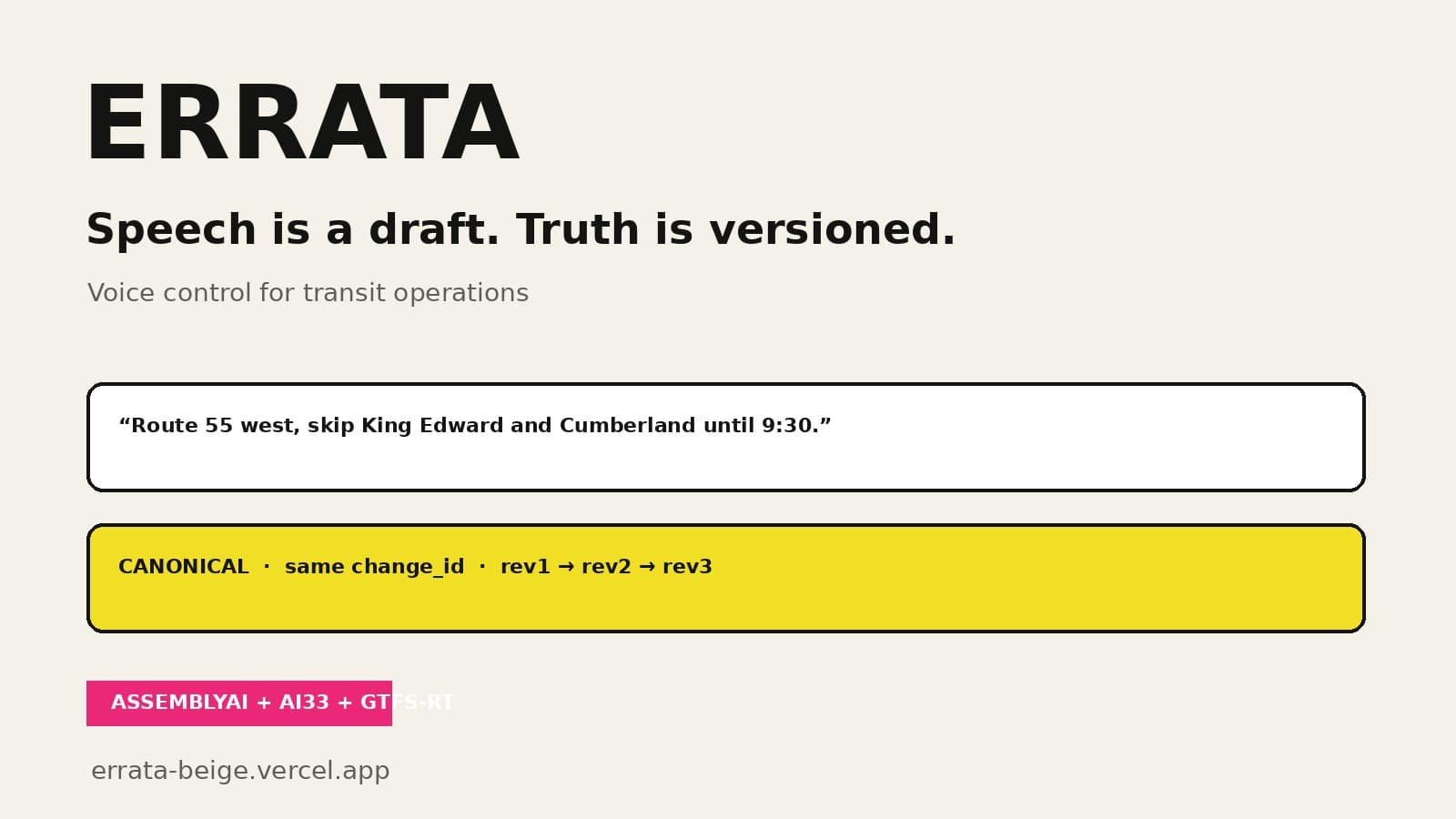
Transit controllers constantly correct themselves while handling radio, maps, incidents and live service pressure. In a conventional voice workflow, each new utterance can become another instruction which creates a dangerous failure mode when a correction conflicts with what was said seconds earlier. ERRATA is built around a stricter rule: speech is a draft; operational truth is versioned. A controller can say: “Route 55 west, skip King Edward and Cumberland until 9:30.” AssemblyAI Universal-3.5 Pro Realtime transcribes the live microphone stream. ERRATA interprets the instruction as a non-mutating draft, shows the controller exactly what would change, and waits for explicit human Apply. If the controller then says: “Wait — garde Cumberland. Make it 10.” ERRATA does not create a second instruction. It repairs the same change_id, advancing the existing service change from one revision to the next while preserving a single canonical operational state. Incomplete speech is handled safely as well. A phrase such as “Wait, keep Cumberland. Make it.” produces NEEDS_CLARIFICATION: Apply remains unavailable, the revision does not advance and the canonical hash stays unchanged. Final authority is also version-bound. A stale reviewed hash is refused; only the current reviewed state can be committed. ERRATA then serializes the canonical change into GTFS-Realtime and independently decodes the resulting protobuf so the downstream operational consequence is visible and testable. AssemblyAI is load-bearing in the live product path. AI33 provides generated voice guidance to the operator, while deterministic Python logic owns parsing, validation, revisioning, evidence generation and commit authority. ERRATA is not a passenger chatbot. It is a control layer for high-consequence voice operations where fast, fallible speech must never silently become operational truth.

Meeting notetaker

Meeting notetaker

ScribeAI is a real-time meeting notetaker built on AssemblyAI's streaming transcription API. It solves a problem every team knows well: meetings generate decisions and action items that get lost the moment the call ends, buried in someone's memory or a half-finished notes doc. During a live meeting, ScribeAI streams microphone audio directly to AssemblyAI's Universal-Streaming API in real time, producing a live transcript with speaker diarization so you can see who said what as it happens. Rather than waiting until the meeting ends, ScribeAI incrementally summarizes the conversation as it unfolds — the summary, key decisions, and action items update continuously, built on the new content since the last update rather than reprocessing the entire transcript from scratch each time, keeping the live experience fast even in long meetings. Action items are extracted using structured LLM outputs, so each one comes with an inferred assignee and due date where the conversation makes that clear, not just a flat bullet list. For online meetings held elsewhere — Discord, Google Meet, or similar — ScribeAI can also capture tab/system audio alongside the microphone, so it's not limited to hearing only the local speaker. Beyond live meetings, ScribeAI includes an upload flow for pre-recorded recordings: drop in an existing video or audio file, and it runs the same transcription and summarization pipeline asynchronously, producing a full transcript, summary, and action-item list once processing completes — no live call required. Every meeting is exportable as a clean, text-searchable PDF, and past meetings live in a searchable dashboard so nothing gets lost after the call ends. The UI is built with a deliberately restrained, editorial design system — minimalist layout, a single accent color, and glass-panel surfaces used only where they earn their place — because a meeting tool people use daily should feel calm, not cluttered.

Fresno LUX: A Living City

Fresno LUX: A Living City

Fresno LUX is a prototype for a living intelligence layer across an entire city. Fresno already contains enormous amounts of intelligence: residents know where problems exist, nonprofits know where help is needed, businesses know where opportunities exist, educators understand gaps in learning, researchers generate knowledge, and government maintains critical infrastructure and data. The problem is that much of this intelligence is fragmented across disconnected systems. Fresno LUX connects those pieces. The platform creates a shared city graph where people, organizations, resources, needs, projects, observations, experiments, and outcomes become connected nodes. Instead of simply collecting data, LUX continuously asks: What is happening? What do we know? What is missing? What can we test? What changed? A community problem can become an observable signal. That signal can become an experiment. The experiment produces evidence. Evidence changes the system's understanding. That updated understanding informs the next action. Observe → Connect → Understand → Act → Measure → Learn → Converge. The goal is to move Fresno from disconnected information toward collective intelligence—a system where knowledge can travel across boundaries and successful solutions can be discovered, tested, measured, and replicated. LUX is designed to make the invisible connections visible: the relationship between a neighborhood and its resources, between a student and educational opportunity, between a business and workforce capacity, between environmental conditions and community health, and between an idea and measurable real-world impact. This hackathon prototype demonstrates the beginning of a Living Fresno Graph: a city that can observe itself, learn from evidence, and coordinate toward better outcomes.