LlamaIndex

LlamaIndex is an open source data framework that allows you to connect custom data sources to large language models (LLMs) like GPT-4, Claude, Cohere LLMs or AI21 Studio. It provides tools for ingesting, indexing, and querying data to build powerful AI applications augmented by your own knowledge.

General
AuthorLlamaIndex
Repositoryhttps://github.com/jerryjliu/llama_index
TypeData framework for LLM applications

Key Features of LlamaIndex

  • Data Ingestion: Easily connect to existing data sources like APIs, documents, databases, etc. and ingest data in various formats.
  • Data Indexing: Store and structure ingested data for optimized retrieval and usage with LLMs. Integrate with vector stores and databases.
  • Query Interface: LlamaIndex provides a simple prompt-based interface to query your indexed data. Ask a question in natural language and get an LLM-powered response augmented with your data.
  • Flexible & Customizable: LlamaIndex is designed to be highly flexible. You can customize data connectors, indices, retrieval, and other components to fit your use case.

How to Get Started with LlamaIndex

LlamaIndex is open source and available on GitHub. Visit the repo to install the Python package, access documentation, guides, examples, and join the community:

AI Tutorials


LlamaIndex Libraries

A curated list of libraries and technologies to help you build great projects with LlamaIndex.


LlamaIndex top builders

Explore the top contributors showcasing the highest number of LlamaIndex app submissions within our community.

LlamaIndex AI technology page Hackathon projects

Discover innovative solutions crafted with LlamaIndex, developed by our community members during our engaging hackathons.

JodTod – Smart Expense Sharing App

JodTod – Smart Expense Sharing App

Managing shared expenses is a common challenge for friends, roommates, families, students, and travel groups. When multiple people contribute different amounts toward food, trips, rent, events, or daily purchases, tracking who paid, who owes whom, and how much needs to be settled often becomes confusing. People frequently depend on manual calculations, chat messages, screenshots, spreadsheets, or separate payment applications, which can lead to errors, forgotten payments, unnecessary back-and-forth, and unclear financial records. JodTod is a smart group expense management and settlement application designed to simplify this entire process in one place. Users can create or join groups, add shared expenses, record who paid, define how an expense should be divided, view individual balances, and settle outstanding amounts. Instead of manually calculating multiple transactions, JodTod organizes the information and presents each member's financial position clearly. The primary target users are students, friends, roommates, families, travel groups, event organizers, and any group that regularly shares expenses. Users interact with JodTod by creating groups, adding people, recording expenses, selecting participants, and choosing how costs should be split. The application maintains the group's expense activity and provides settlement information so members can understand their outstanding obligations and complete the required payments. What makes JodTod distinctive is its focus on connecting the complete shared-expense lifecycle rather than treating bill splitting as an isolated calculation. Group activity, people management, expense creation, balances, settlement actions, profiles, and notifications are designed to work together as a unified experience. This reduces the need to maintain fragmented information across messaging apps, calculators, spreadsheets, and payment records. JodTod also emphasizes a simple and accessible mobile-first experience so that an expense can be recorded immediately when it occurs. By centralizing group financial information and automating calculations, the application reduces manual effort, minimizes calculation errors, improves transparency among group members, and makes settlement easier to understand. For evaluation and demonstration, a dedicated demo account will be provided so reviewers can access the application directly without completing the signup process. The demo credentials will allow users to log in and explore the application's core features and workflows using a prepared demonstration account. The overall goal of JodTod is to turn shared expenses from a source of confusion and repeated calculations into a structured, transparent, and convenient group-management experience. Project Repository: https://github.com/jha16rohit/JodTod App: [APP LINK]

VeriSci

VeriSci

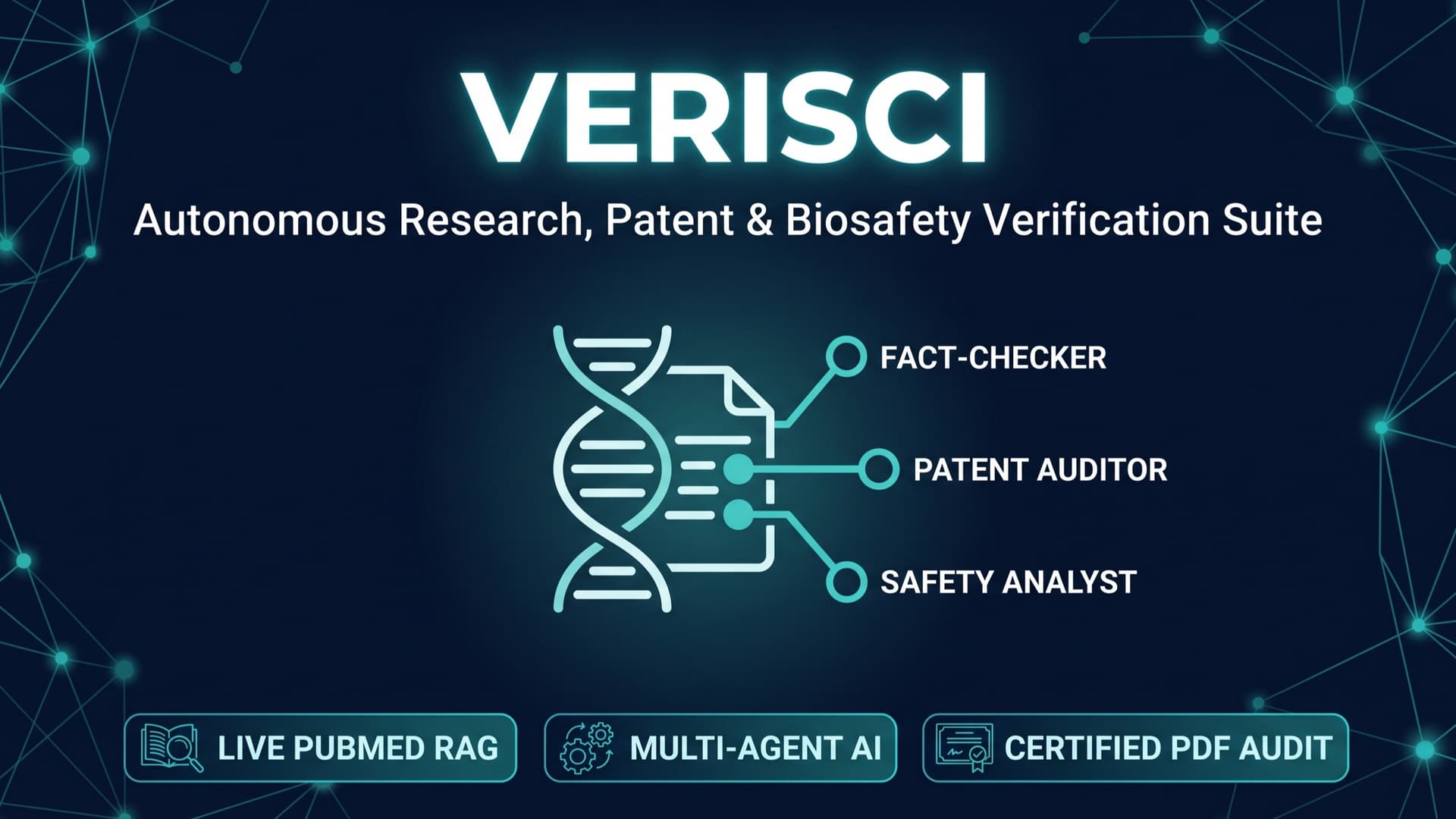
The Problem: Every year, research institutions, pharmaceutical companies, and patent attorneys waste hundreds of hours manually screening dense clinical protocols, research papers, and patent filings. A single missed compliance risk, unverified scientific claim, or overlapping prior art can result in massive financial losses, failed regulatory approvals, and months of delayed innovation. Our Solution (VeriSci Agent): VeriSci Agent is an enterprise-grade, autonomous multi-agent verification platform built to solve this exact bottleneck. Instead of relying on static databases or tedious human review, our application deploys a coordinated team of specialized AI sub-agents to audit documents instantly: Fact-Checker Sub-Agent: Cross-references claims against live PubMed literature using a robust Retrieval-Augmented Generation (RAG) engine. Patent & Prior Art Auditor: Analyzes technical specifications to evaluate IP novelty and prior art overlap. Protocol Safety & Compliance Analyst: Flags biosafety and regulatory risks based on established frameworks. Key Features: Real-Time Executive Metrics: Instantly calculates Claims Analyzed, Consistency Scores, Novelty Index, and Biosafety Status. Transparent Orchestration Log: Displays step-by-step background execution trails for complete AI auditability. Certified Compliance PDF Export: Generates professional, ready-to-share audit reports with a single click. Streamlit Cloud Interface: Fully deployed, interactive, and optimized for immediate stakeholder evaluation.

Fresno LUX: A Living City

Fresno LUX: A Living City

Fresno LUX is a prototype for a living intelligence layer across an entire city. Fresno already contains enormous amounts of intelligence: residents know where problems exist, nonprofits know where help is needed, businesses know where opportunities exist, educators understand gaps in learning, researchers generate knowledge, and government maintains critical infrastructure and data. The problem is that much of this intelligence is fragmented across disconnected systems. Fresno LUX connects those pieces. The platform creates a shared city graph where people, organizations, resources, needs, projects, observations, experiments, and outcomes become connected nodes. Instead of simply collecting data, LUX continuously asks: What is happening? What do we know? What is missing? What can we test? What changed? A community problem can become an observable signal. That signal can become an experiment. The experiment produces evidence. Evidence changes the system's understanding. That updated understanding informs the next action. Observe → Connect → Understand → Act → Measure → Learn → Converge. The goal is to move Fresno from disconnected information toward collective intelligence—a system where knowledge can travel across boundaries and successful solutions can be discovered, tested, measured, and replicated. LUX is designed to make the invisible connections visible: the relationship between a neighborhood and its resources, between a student and educational opportunity, between a business and workforce capacity, between environmental conditions and community health, and between an idea and measurable real-world impact. This hackathon prototype demonstrates the beginning of a Living Fresno Graph: a city that can observe itself, learn from evidence, and coordinate toward better outcomes.

NEXUS - Autonomous Future Intelligence

NEXUS - Autonomous Future Intelligence

NEXUS is an AI-powered digital twin and decision-intelligence platform that helps organizations understand the consequences of important decisions before they act. Instead of simply answering business questions, NEXUS combines structured business data, company knowledge, multi-agent AI, RAG, MCP tools, and large-scale simulation to explore possible futures and identify better strategies. For the initial implementation, NEXUS creates a realistic digital twin of NovaCart, a synthetic e-commerce company containing customers, products, orders, inventory, suppliers, financial records, and company policies. A user can ask questions such as “What happens if we reduce the price of this product by 10%?” NEXUS decomposes the problem across specialized agents, retrieves relevant evidence, generates candidate strategies, and runs thousands of simulated scenarios. The system compares expected revenue, profit, inventory impact, stockout probability, uncertainty, and risk before producing a transparent recommendation. The platform follows a human-in-the-loop architecture: AI can analyze and simulate autonomously, but consequential actions require human approval. MCP provides a standardized interface between agents and business tools, while AMD ROCm and AMD GPU infrastructure will be explored for computationally intensive workloads such as parallel simulation and AI inference. NEXUS is designed to evolve from a controlled synthetic environment into a platform capable of connecting to real organizational systems, turning AI from a system that merely answers questions into one that helps organizations reason about consequences.

Intelligent GitHub Repository Analyzer

Intelligent GitHub Repository Analyzer

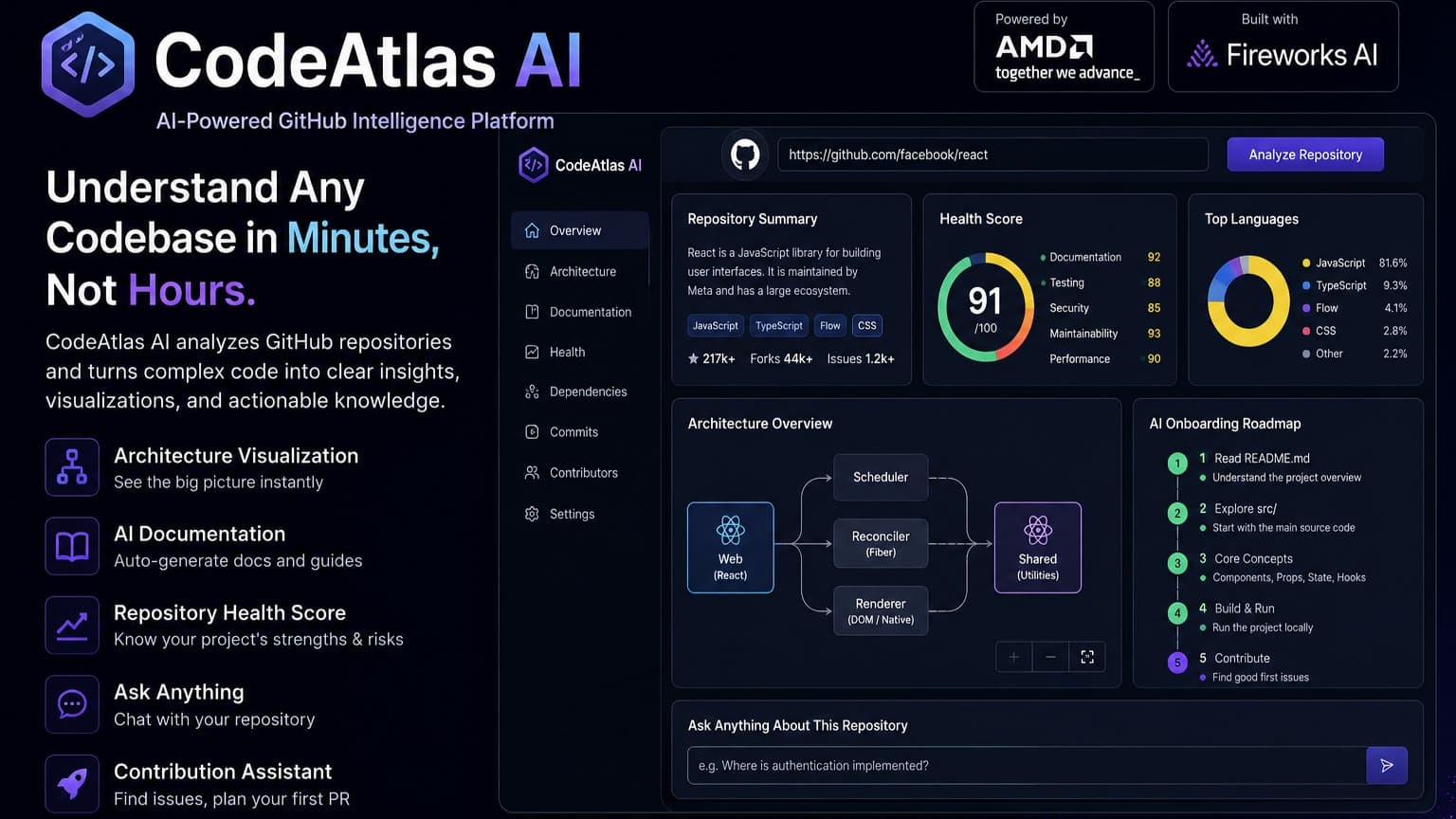
CodeAtlas AI is an AI-powered GitHub Intelligence Platform designed to simplify the process of understanding, exploring, and contributing to open-source and enterprise software projects. Developers often spend hours navigating unfamiliar repositories, reading documentation, and tracing code before becoming productive. CodeAtlas AI dramatically reduces this onboarding time by automatically analyzing a GitHub repository and generating meaningful insights through artificial intelligence. The platform provides an interactive architecture overview, intelligent repository summaries, dependency visualization, repository health analysis, AI-generated documentation, and personalized learning paths for new contributors. Users can ask natural-language questions about the repository, receive explanations of important modules, discover where key functionality is implemented, and understand relationships between components without manually reading hundreds of files. Our solution combines GitHub APIs with modern large language models running on AMD-supported infrastructure to transform raw source code into actionable knowledge. The platform emphasizes usability, software engineering best practices, and developer productivity while leveraging AI to automate repetitive repository analysis tasks. By reducing onboarding complexity and improving repository comprehension, CodeAtlas AI benefits students, open-source contributors, software engineers, and development teams. Instead of spending hours understanding a new project, developers can gain architectural insights, identify critical files, assess project quality, and begin contributing confidently within minutes. Our vision is to build an intelligent developer copilot that makes every GitHub repository easier to understand, maintain, and evolve.