LLaVA

LLaVA represents a novel end-to-end trained large multimodal model that combines a vision encoder and Vicuna for general-purpose visual and language understanding, achieving impressive chat capabilities mimicking spirits of the multimodal GPT-4 and setting a new state-of-the-art accuracy on Science QA.

General
Relese dateNovember 20, 2023
Repositoryhttps://github.com/haotian-liu/LLaVA
TypeMultimodal Language and Vision Model

What is LLaVA?

Visual Instruction Tuning: LLaVA, short for Large Language-and-Vision Assistant, represents a significant leap in multimodal AI models.

With a focus on visual instruction tuning, LLaVA has been engineered to rival the capabilities of GPT-4V, demonstrating its exceptional prowess in understanding both language and vision. This state-of-the-art model excels in tasks ranging from impressive chatbot interactions to setting a new standard in science question-answering accuracy, achieving a remarkable 92.53%. With LLaVA's innovative approach to instruction-following data and the effective combination of vision and language models, it promises a versatile solution for diverse applications, marking a significant milestone in the field of multimodal AI.

LLaVA Tutorials


LLaVA Libraries

A curated list of libraries and technologies to help you build great projects with 'technology'.


LLavA top builders

Explore the top contributors showcasing the highest number of LLavA app submissions within our community.

LLavA AI technology page Hackathon projects

Discover innovative solutions crafted with LLavA, developed by our community members during our engaging hackathons.

Fresno LUX: A Living City

Fresno LUX: A Living City

Fresno LUX is a prototype for a living intelligence layer across an entire city. Fresno already contains enormous amounts of intelligence: residents know where problems exist, nonprofits know where help is needed, businesses know where opportunities exist, educators understand gaps in learning, researchers generate knowledge, and government maintains critical infrastructure and data. The problem is that much of this intelligence is fragmented across disconnected systems. Fresno LUX connects those pieces. The platform creates a shared city graph where people, organizations, resources, needs, projects, observations, experiments, and outcomes become connected nodes. Instead of simply collecting data, LUX continuously asks: What is happening? What do we know? What is missing? What can we test? What changed? A community problem can become an observable signal. That signal can become an experiment. The experiment produces evidence. Evidence changes the system's understanding. That updated understanding informs the next action. Observe → Connect → Understand → Act → Measure → Learn → Converge. The goal is to move Fresno from disconnected information toward collective intelligence—a system where knowledge can travel across boundaries and successful solutions can be discovered, tested, measured, and replicated. LUX is designed to make the invisible connections visible: the relationship between a neighborhood and its resources, between a student and educational opportunity, between a business and workforce capacity, between environmental conditions and community health, and between an idea and measurable real-world impact. This hackathon prototype demonstrates the beginning of a Living Fresno Graph: a city that can observe itself, learn from evidence, and coordinate toward better outcomes.

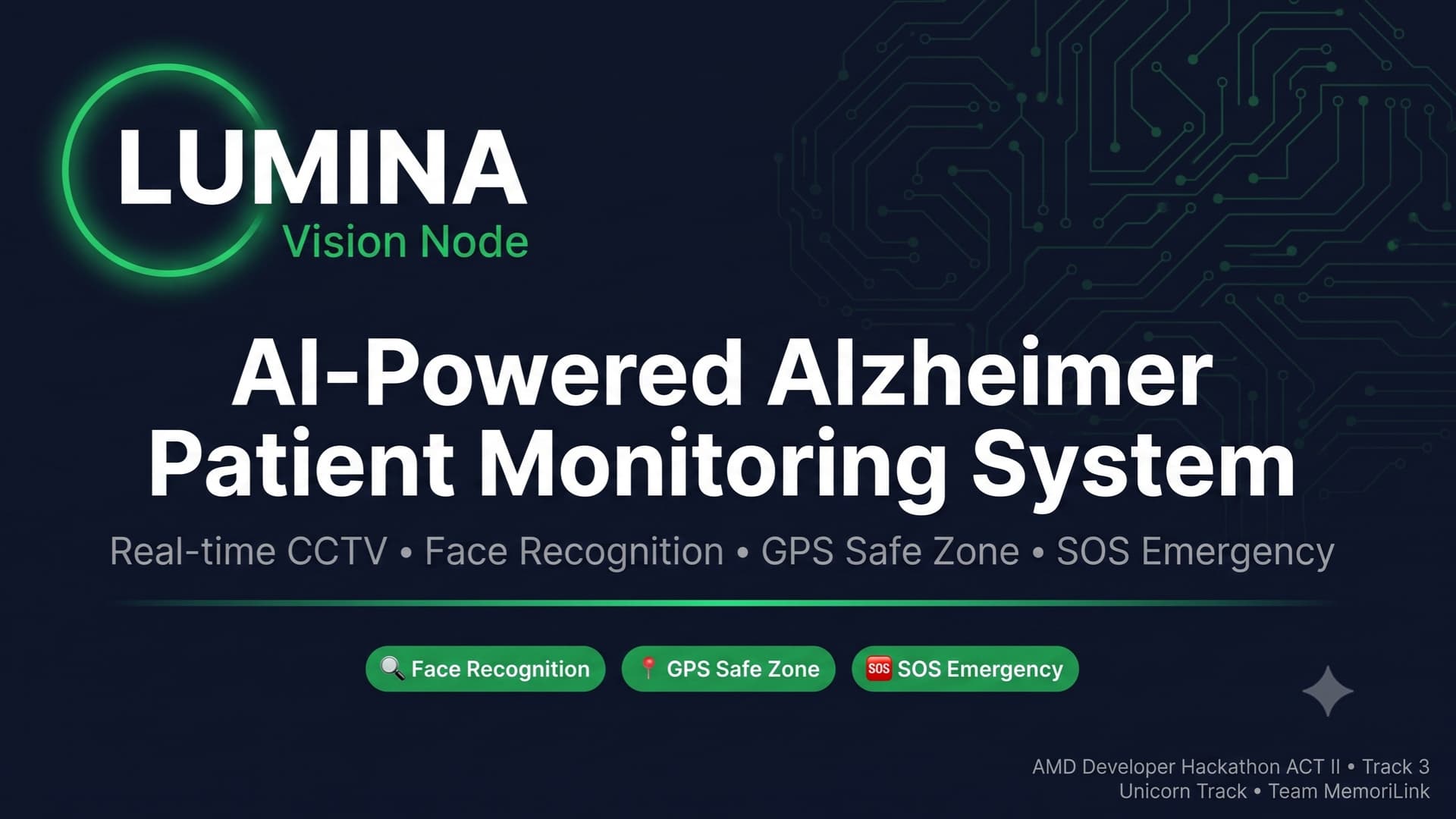
LUMINA Vision Node — Alzheimer AI Monitor

LUMINA Vision Node — Alzheimer AI Monitor

LUMINA Vision Node is an AI-powered patient safety system for Alzheimer and dementia patients. 55 million people worldwide live with Alzheimer's — families ask daily: "Is my loved one safe?" LUMINA answers automatically, in real time. CORE TECHNOLOGY: LUMINA uses a hybrid computer vision pipeline. Primary detection: face recognition via dlib-based 128-dimensional encodings. Fallback: clothing color fingerprinting using HSV histogram back-projection — tracks the patient even when face is not visible. This dual-layer approach minimizes false negatives without requiring wearable devices. KEY FEATURES: - Live CCTV Monitoring — MJPEG stream at 25 FPS with real-time bounding box overlay - Face Recognition — Patient confirmed via face encoding; prevents false positives from guests - Color Fingerprint Fallback — HSV back-projection tracks patient when face is not visible - GPS Safe Zone — Haversine-formula geofencing alerts family when patient leaves home radius - Emotion Detection — Automatic inference: calm, anxious, or confused from activity patterns - SOS Emergency — Single-tap emergency with GPS coordinates sent to family dashboard - Memory Gallery — Family uploads photos to help patient recall loved ones - Stage Adaptation — AI reports adapt to Alzheimer stage (1=Mild, 2=Moderate, 3=Severe) AMD INTEGRATION: LUMINA uses a provider-based architecture for vision inference. The system routes snapshot analysis to AMD Developer Cloud running LLaVA vision model via vLLM and ROCm. Switching to AMD hardware requires only updating two environment variables (AMD_VISION_URL, AMD_MODEL_NAME) — zero code changes needed. Architecture is deployment-ready for AMD MI300X with 192GB HBM3. IMPACT: Built for 160 million family caregivers worldwide who cannot afford 24/7 professional care. LUMINA works with existing CCTV — no new hardware required. All patient data stored locally for maximum privacy. Because dignity should not depend on wealth.