Meta

Meta, founded in 2004, is a global technology leader that revolutionizes how people connect and interact in the digital world. Originally known as Facebook, Meta is renowned for its pioneering advancements in social media, with platforms like Facebook, Instagram, and WhatsApp, which collectively reach billions of users worldwide. In addition to its social media prowess, Meta is a global technology company at the forefront of AI innovation, focusing on enhancing human connectivity and creating immersive digital experiences. Among its leading products related to AI technology are the LLaMA (Large Language Model Meta AI) series and Meta AI.

General
CompanyMeta Platforms, Inc.
FoundedJanuary 4, 2004
HeadquartersMenlo Park, California, U.S.
Repositoryhttps://github.com/facebook

Key Products and Research

Meta has developed a range of AI products designed to enhance various aspects of technology and user experience. Here’s a brief overview of these AI products:

LLaMA (Large Language Model Meta AI)

LLaMA is a series of large language models designed for natural language processing tasks. These models, including the latest LLaMA 3.1, are known for their advanced capabilities in text generation, understanding, and multilingual processing. They are available as open-source models, promoting innovation and research in AI​ Meta | Social Metaverse Company,Facebook.

Meta AI

Meta AI is an intelligent assistant integrated across Meta’s platforms, such as Facebook, Instagram, WhatsApp, and Messenger. Powered by LLaMA models, it helps users with tasks like content creation, information retrieval, and personalized interactions Meta | Social Metaverse Company.

PyTorch

PyTorch is an open-source machine learning library developed by Meta and widely used in both research and industry. It provides tools for building and training deep learning models and has become a standard framework in the AI community​ Facebook.

Meta AI Research (FAIR)

Meta’s AI research division, formerly known as FAIR (Facebook AI Research), focuses on advancing the field of AI through open research and collaboration. This division works on various AI challenges, including computer vision, natural language processing, and generative AI​ Facebook.

Meta AI in the Metaverse

Meta is also incorporating AI into its metaverse initiatives, using AI to create immersive experiences in virtual and augmented reality. This includes developing AI-driven avatars, enhancing virtual environments, and improving interaction within the metaverse​ Meta | Social Metaverse Company.

AI for Ads

Meta leverages AI to optimize ad targeting, delivery, and measurement across its platforms. AI algorithms analyze vast amounts of data to improve the effectiveness of advertising campaigns, making them more relevant to users and efficient for advertisers​ Meta | Social Metaverse Company.

LLaMA Impact Grants

The LLaMA Impact Grants program, launched by Meta, aims to support and encourage the innovative use of its LLaMA (Large Language Model Meta AI) models to address critical challenges in various sectors, including education, environmental sustainability, and public good. This initiative offers financial grants and resources to researchers, nonprofits, and other organizations that seek to leverage LLaMA models for impactful projects. The program highlights Meta’s commitment to responsible AI development and its belief in the potential of AI to drive positive social change.

For more details, visit the LLaMA Impact Grants page.

Meta AI Technologies top builders

Explore the top contributors showcasing the highest number of Meta AI Technologies app submissions within our community.

Meta AI Technologies Hackathon projects

Discover innovative solutions crafted with Meta AI Technologies, developed by our community members during our engaging hackathons.

SentinelMesh: Autonomous AI SOC on AMD GPU

SentinelMesh: Autonomous AI SOC on AMD GPU

SentinelMesh is an enterprise-grade, autonomous multi-agent AI Security Operations Center (SOC) purpose-built for on-premise execution on AMD Instinct GPUs using ROCm 6.2 and vLLM. Traditional SOCs struggle with catastrophic alert fatigue, high mean-time-to-respond (MTTR), and cloud API privacy risks. SentinelMesh solves this by deploying a collaborative team of specialized autonomous AI agents that detect, investigate, contain, and report cyber threats in seconds with 100% data sovereignty. Architecture & Multi-Agent Pipeline: 1. Triage Agent: Evaluates heterogeneous telemetry (Linux auth, Nginx, Windows Security Events) against in-memory sliding-window rules, filtering noise with high confidence. 2. Investigator Agent: Reconstructs causal kill-chain attack graphs, identifies affected assets, and maps adversary tactics to MITRE ATT&CK techniques via local vector RAG. 3. Threat Intel Agent: Assesses IOCs against local threat feeds with automated abuse scoring. 4. Responder Agent: Formulates surgical containment actions (IP firewall blocks, account lockouts) guarded by a Human-in-the-Loop approval gate with automated rollback commands. 5. Reporter Agent: Synthesizes bilingual executive briefings in technical English and native Urdu (Nastaliq RTL) with WeasyPrint PDF export. AMD ROCm Hardware Synergy: Accelerated by AMD Instinct MI250X (128GB HBM2e) with ROCm 6.2 and vLLM PagedAttention, SentinelMesh delivers 138.5 tokens/sec throughput, 42ms TTFT latency, and a 79.5% operational cost reduction compared to commercial cloud APIs. Telemetry never leaves the enterprise boundary.

Bid Pilot

Bid Pilot

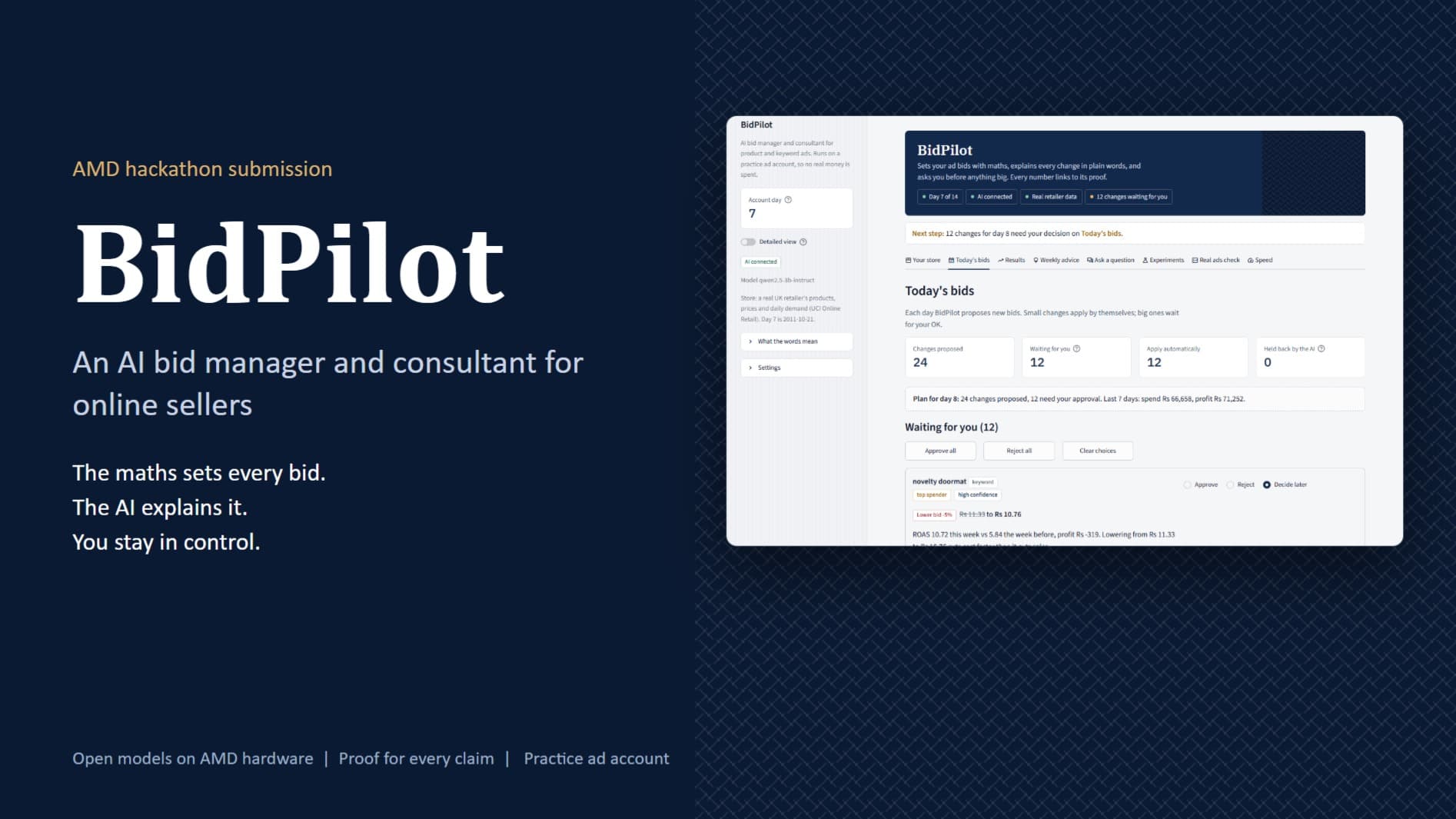
BidPilot is an AI bid manager and consultant for small online sellers who cannot afford a full-time ad specialist. Every day, its math optimizer fits a response curve for each ad and selects profitable bids within safe limits. Built-in safeguards prevent stockouts, statistically unjustified keyword pauses, excessive cuts to proven best-sellers, unprofitable bid increases, and persistent profit losses through automatic rollbacks. An open-source Qwen2.5 LLM plans the day and explains changes in plain language. Every numerical claim is validated against the data, and major changes require seller approval. Weekly, BidPilot acts as a consultant, safely runs analysis code in an isolated sandbox, researches the web, and produces ranked recommendations backed by verifiable data tables or exact source-page quotes. Switchback experiments identify genuinely incremental ad sales, helping sellers avoid paying for sales they would have made anyway. BidPilot runs on AMD hardware: Qwen2.5-3B currently runs on a Ryzen laptop with Radeon graphics using llama.cpp and Vulkan, while full deployment targets Qwen2.5-32B on AMD Instinct MI300X GPUs using ROCm and vLLM. In laptop testing, AI explanations covered 25 of 32 bid changes; safety checks replaced the other seven. The consultant produced four verified recommendations and caught one report containing invented numbers. Tested on a real UK retailer's products and daily demand, BidPilot also audited 1,143 real Facebook ads, identifying 7.5% of spend as statistically wasted. Across 14-day simulations, it outperformed fixed bids and simple rules on profit across every tested random seed and never advertised out-of-stock products. Its 131 automated tests cover 93% of the code and caught all 25 deliberately planted bugs in bidding, safety, and citation logic.