Microsoft

Founded in 1975 by Bill Gates and Paul Allen, Microsoft has grown to become one of the world's most influential technology companies. Originally known for its operating system, MS-DOS, and later, the Windows OS, Microsoft has continuously expanded its product portfolio to include a wide range of software, hardware, and cloud-based services. The company’s mission is to empower every person and organization on the planet to achieve more. Microsoft is a key player in the development and deployment of innovative technologies, including artificial intelligence (AI), cloud computing, and enterprise software. With a strong commitment to research and development, Microsoft is at the forefront of technological advancement, providing solutions that address the needs of both consumers and businesses around the world.

Over the decades, Microsoft has also made significant acquisitions, including LinkedIn and GitHub, enhancing its influence and capabilities in professional networking, software development, and open-source communities. The company continues to push the boundaries of technology with its Azure cloud platform, AI initiatives, and hardware offerings like the Surface series of devices.

General
CompanyMicrosoft
FoundedApril 4, 1975
Repositoryhttps://github.com/microsoft

Start Building with Microsoft’s Products

Microsoft offers a vast ecosystem of products and services that cater to developers, businesses, and consumers alike. From the Windows operating system to the Azure cloud platform, Microsoft’s technologies power everything from personal devices to large-scale enterprise applications. Whether you're building cutting-edge AI applications, developing business solutions, or creating consumer software, Microsoft provides the tools and platforms needed to succeed. Explore the apps created with these technologies during lablab.ai hackathons to see their potential in action.

Microsoft Products

Azure

Azure is Microsoft's cloud computing platform, providing a wide range of services including virtual machines, AI, analytics, and IoT. It supports businesses in building, managing, and deploying applications at scale. Learn more about Azure

GitHub

Acquired by Microsoft, GitHub is a platform for version control and collaboration, hosting millions of software projects. It’s essential for developers looking to manage code and collaborate with teams. Visit GitHub

Office 365

Office 365 is a suite of productivity tools that includes Word, Excel, PowerPoint, and Teams, among others. It’s designed to improve collaboration and productivity across organizations. Explore Office 365

Power BI

Power BI is a business analytics tool by Microsoft that provides interactive visualizations and business intelligence capabilities with an interface simple enough for end users to create their own reports and dashboards. Discover Power BI

AutoGen

AutoGen is an advanced open-source framework by Microsoft designed for building multi-agent systems powered by large language models (LLMs). Learn more about AutoGen

Visual Studio

Visual Studio is an integrated development environment (IDE) from Microsoft used to develop computer programs, websites, web apps, web services, and mobile apps. Explore Visual Studio

By leveraging Microsoft’s diverse range of products, developers and businesses can build powerful, scalable, and innovative solutions. Check out the apps created with Microsoft’s technologies during lablab.ai hackathons to see how they are being used in real-world scenarios.

Microsoft AI Technologies top builders

Explore the top contributors showcasing the highest number of Microsoft AI Technologies app submissions within our community.

Microsoft AI Technologies Hackathon projects

Discover innovative solutions crafted with Microsoft AI Technologies, developed by our community members during our engaging hackathons.

Fresno LUX: A Living City

Fresno LUX: A Living City

Fresno LUX is a prototype for a living intelligence layer across an entire city. Fresno already contains enormous amounts of intelligence: residents know where problems exist, nonprofits know where help is needed, businesses know where opportunities exist, educators understand gaps in learning, researchers generate knowledge, and government maintains critical infrastructure and data. The problem is that much of this intelligence is fragmented across disconnected systems. Fresno LUX connects those pieces. The platform creates a shared city graph where people, organizations, resources, needs, projects, observations, experiments, and outcomes become connected nodes. Instead of simply collecting data, LUX continuously asks: What is happening? What do we know? What is missing? What can we test? What changed? A community problem can become an observable signal. That signal can become an experiment. The experiment produces evidence. Evidence changes the system's understanding. That updated understanding informs the next action. Observe → Connect → Understand → Act → Measure → Learn → Converge. The goal is to move Fresno from disconnected information toward collective intelligence—a system where knowledge can travel across boundaries and successful solutions can be discovered, tested, measured, and replicated. LUX is designed to make the invisible connections visible: the relationship between a neighborhood and its resources, between a student and educational opportunity, between a business and workforce capacity, between environmental conditions and community health, and between an idea and measurable real-world impact. This hackathon prototype demonstrates the beginning of a Living Fresno Graph: a city that can observe itself, learn from evidence, and coordinate toward better outcomes.

AMD Instinct™ Orchestrating vLLM InferenceServices

AMD Instinct™ Orchestrating vLLM InferenceServices

# AMD Instinct™ Orchestrating vLLM Inference Services on GPUs with Kubernetes An enterprise-grade reference architecture for automated multi-node cluster provisioning, Layer-2 networking load-balancing, and high-throughput LLM serving (`vLLM`) optimized over **AMD Instinct™ MI300X CDNA3** acceleration systems. ## 🏗️ Repository Module Breakdown * **`check-system-enhanced.sh`**: Automatic environment verification tool checking process logs, lock bounds, and PCIe GPU links. * **`install-kubernetes.sh`**: Automated provisioning loop initializing `kubeadm control-plane` nodes and installing **Calico operators**. * **`deploy-vllm-inference.sh`**: Orchestrates Layer-2 IP pools (`MetalLB`) and deploys vLLM serving pods backed by persistent volume storage claims. * **`run-web-demo.sh`**: Launches automated service monitors, mock web interfaces, secure port-forwarding setups, and troubleshooting matrices. * **`manifests/`**: Cloud-native deployment metrics exposing raw hardware accelerators directly onto upstream schedulers. # AMD Instinct GPU Orchestration & Inference Routing Framework An enterprise production environment for running optimized inference workloads with the `Qwen3-Coder-30B-A3B-Instruct` model across AMD Instinct hardware footprints (CDNA modules, including the MI300X series) via AMD ROCm software environments. ## ⚡ Quickstart & Installation Ensure you have mapped your core devices (`/dev/kfd` and `/dev/dri`) before bootstrapping local application clusters. ```bash # Clone the repository git clone https://github.com cd AMD_Instinct # Install project dependencies with exact lockfile values pip install -r requirements.txt # Run the complete automated verification test suite locally pytest -v tests/ ``` ## 🔐 Environment Matrix Parameters Configure your system variables by creating a `.env` file based on `.env.example`. Do not commit credentials directly to the repository history.

Privacy-First AMD-Powered AI Coding Co-Pilot

Privacy-First AMD-Powered AI Coding Co-Pilot

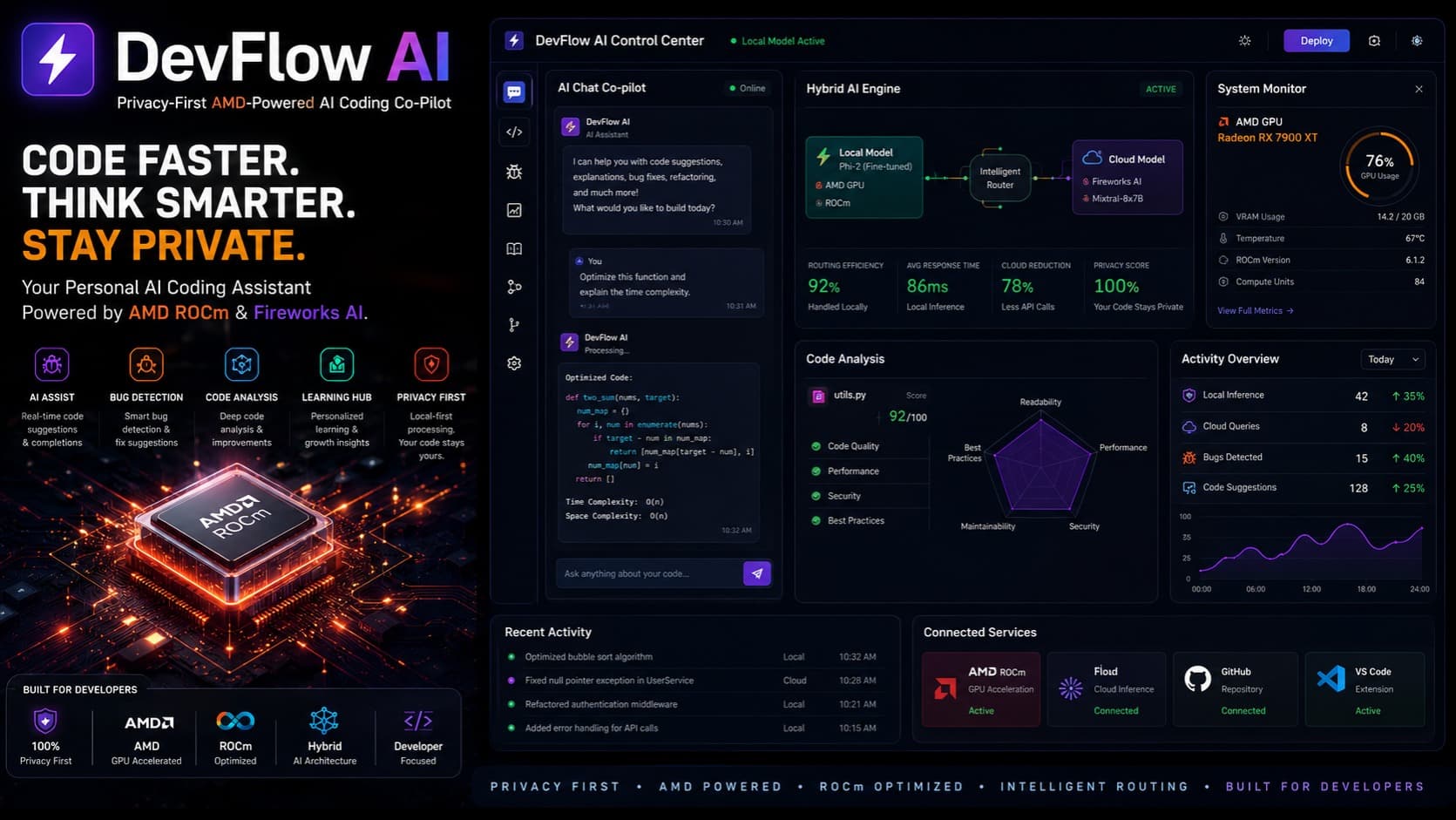
DevFlow AI is an intelligent hybrid AI coding assistant designed to demonstrate the power of the AMD AI ecosystem by combining AMD GPU acceleration, ROCm, and Fireworks AI into a seamless developer experience. Unlike traditional cloud-only coding assistants, DevFlow AI follows a local-first, privacy-first architecture. Routine coding tasks such as code completion, bug detection, explanations, documentation generation, and optimization are processed locally on AMD GPUs using a fine-tuned lightweight language model accelerated by AMD ROCm. This provides significantly lower latency, improved privacy, reduced API costs, and the ability to work even with limited internet connectivity. For more computationally demanding tasks—such as complex debugging, architecture design, multi-file code analysis, and advanced reasoning—DevFlow AI intelligently routes requests to Fireworks AI, ensuring developers receive the capabilities of powerful cloud models only when necessary. This hybrid routing approach minimizes cloud dependency while maintaining high-quality AI assistance. The project also includes a Personalized Learning Engine that analyzes coding habits, identifies recurring mistakes, reviews Git commit history, and generates tailored recommendations to help developers continuously improve their programming skills. Instead of acting only as a chatbot, DevFlow AI serves as a long-term AI mentor that adapts to each developer's workflow. Key Features 🚀 AMD GPU accelerated local AI inference using ROCm ⚡ Hybrid routing between local AI models and Fireworks AI 🔒 Privacy-first architecture with local code processing 🐞 Intelligent bug detection and debugging assistance 💡 Real-time code explanations and optimization suggestions 📚 Personalized learning recommendations based on coding patterns 📈 GitHub commit analysis and developer insights 💰 Reduced cloud API costs through intelligent request routing 🖥️ Designed for future VS Code integration and developer workflows

MaintainerAI: AI for GitHub Maintainers

MaintainerAI: AI for GitHub Maintainers

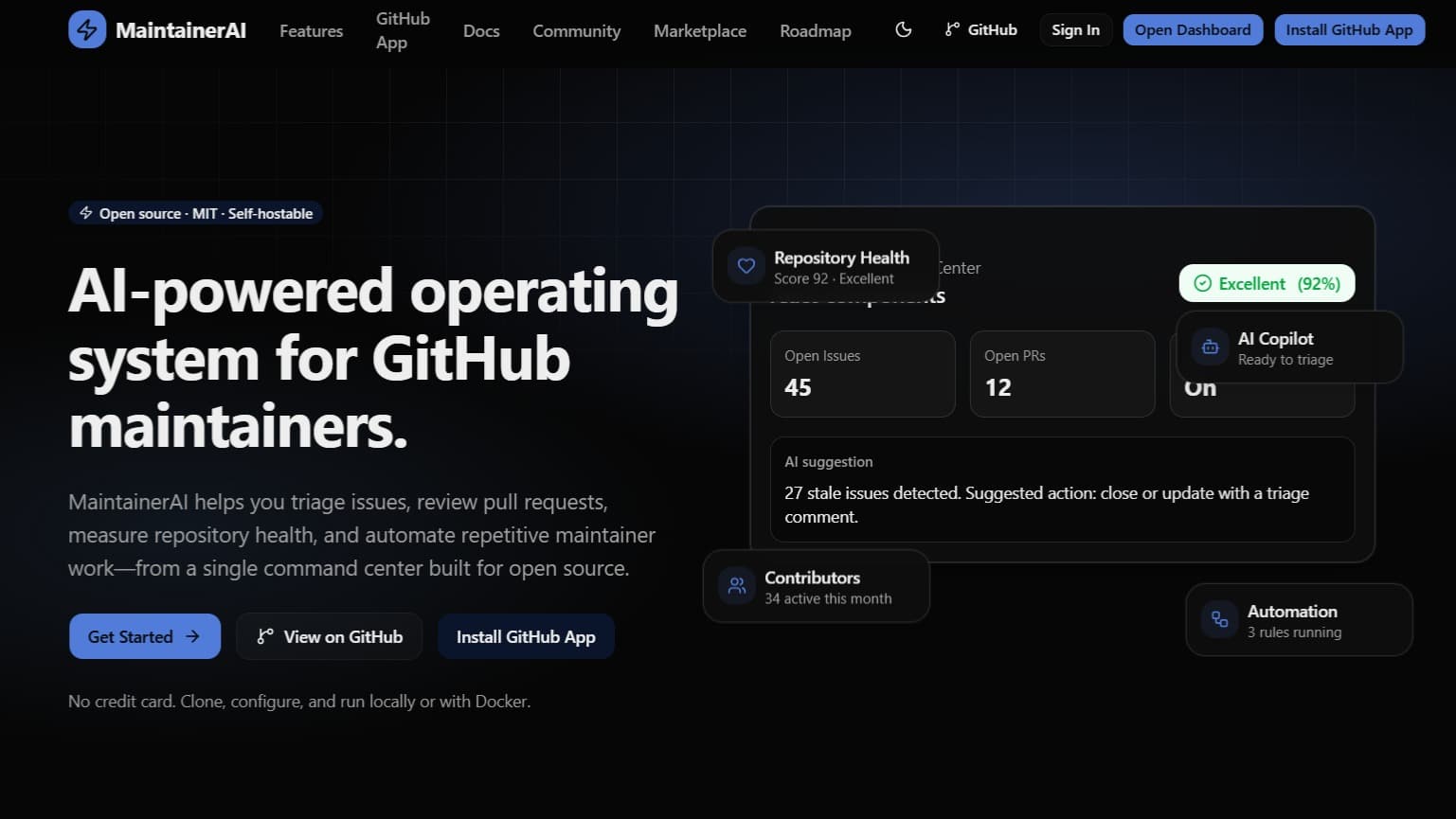
MaintainerAI is an AI-powered platform designed to simplify and modernize open-source project maintenance. Managing a growing GitHub repository often requires significant manual effort—from reviewing pull requests and organizing issues to onboarding contributors, tracking repository health, and maintaining project documentation. MaintainerAI brings these workflows together into a single intelligent workspace powered by AI. The platform provides an AI Copilot that assists maintainers with repository management, generates issue descriptions, summarizes pull requests, recommends labels, detects duplicate issues, and offers actionable insights for improving project quality. Repository analytics provide visibility into contributor activity, pull request health, issue backlog, documentation coverage, automation status, and overall repository health. MaintainerAI also includes a visual automation builder that enables maintainers to configure GitHub workflows without writing complex automation scripts. Planned integrations include GitHub Apps, Docker-based self-hosting, AI provider abstraction, and a plugin ecosystem that allows communities to extend the platform with custom automations and integrations. Our vision is to reduce repetitive maintenance work so that maintainers can focus on building software and growing healthy open-source communities. By combining AI-assisted workflows, intelligent repository insights, contributor analytics, and GitHub automation into a unified platform, MaintainerAI aims to become the operating system for modern open-source maintenance. During this hackathon, we are focusing on integrating advanced AI capabilities powered by AMD Developer Cloud to improve repository understanding, intelligent code review, issue generation, documentation assistance, and contributor recommendations. The result is a scalable, open-source platform that empowers maintainers, organizations, and developer communities to manage projects more efficiently.