n8n

n8n is a fair-code workflow automation platform designed for "agentic workflows." It features a visual node editor and supports custom code, offering over 400 integrations to connect various applications and services. This platform enables users to automate complex tasks and build sophisticated workflows with ease, making it a powerful tool for developers and automators alike.

General
Authorn8n GmbH
Release Date2019
Websitehttps://n8n.io/
Documentationhttps://docs.n8n.io/
Technology TypeWorkflow automation platform

Key Features

  • Visual Workflow Editor: Drag-and-drop interface for building complex workflows without writing extensive code.
  • 400+ Integrations: Connects with a vast array of applications, databases, and APIs.
  • Custom Code Support: Allows for JavaScript/TypeScript functions within workflows for advanced customization.
  • Fair-Code Licensing: Provides transparency and community contributions while maintaining commercial viability.
  • Agentic Workflows: Designed to facilitate advanced automation scenarios often found in AI-driven applications.
  • Data Transformation: Tools for manipulating and transforming data between different steps in a workflow.

Start Building with n8n

n8n offers powerful capabilities for automating tasks and integrating systems. Its visual editor and extensive integrations make it accessible for rapidly building "agentic workflows." Developers can leverage n8n to connect AI models, manage data flows, and automate responses across various platforms. Explore the official documentation and community examples to see how n8n can enhance your projects.

πŸ‘‰ Start building with n8n πŸ‘‰ n8n Integrations

n8n AI Technologies top builders

Explore the top contributors showcasing the highest number of n8n AI Technologies app submissions within our community.

n8n AI Technologies Hackathon projects

Discover innovative solutions crafted with n8n AI Technologies, developed by our community members during our engaging hackathons.

LeadFlow AI β€” commerce lead & order agent

LeadFlow AI β€” commerce lead & order agent

Small online shops in Central Asia sell through chat. Owners drown in mixed-language messages and lose hot buyers while answering price questions. LeadFlow AI is an agent that sits between the shop's channels and its owner. Every incoming message goes through an open LLM served on AMD GPUs through the AMD Token Factory API (OpenAI-compatible, DeepSeek-V4-Flash by default β€” one API key switches the app live). The same client can also be pointed at a self-hosted vLLM server on an AMD Instinct MI300X with ROCm for dedicated deployments. The agent classifies intent (order, quote, question, complaint, spam), extracts products, quantities, budget and urgency, writes a reply in the customer's own language, and when the customer wants to buy, creates an order draft automatically. Leads are ranked by a hybrid score: deterministic rules (contact quality, channel, keywords, de-duplication) plus model-extracted features, with a human-readable reason for every point. Model output is strictly validated, and if the LLM endpoint fails the system degrades to an offline analyzer instead of going down. An n8n workflow connects a Telegram shop bot: customer writes β†’ agent analyzes on AMD β†’ reply sent β†’ owner gets a ping for hot leads. A dashboard shows ranked leads, order drafts and live inference metrics (latency, tokens/s). Because the MI300X has 192 GB of memory, one GPU can serve many shops concurrently, or a much larger model without sharding β€” a cheap path to a multi-tenant SaaS for SMB commerce.

Dealership Brain

Dealership Brain

The Problem When a salesperson tells a customer "I'll call you back," that promise is easy to lose. Nothing records the deadline, nobody is alerted when it slips, and managers have no clear record of which promises were kept. Customers who write in Roman Urdu add one more gap for typical chat tools to handle. What I Built Dealership Brain is a dealership assistant built around callback promises. It includes SLA-tracked callbacks with automatic escalation, an Alert Log, a manager leaderboard, a customer neighborhood graph, smart lead matching, a follow-up agent, customer test-drive booking, an EMI calculator, trade-in valuation, and a chat that understands Roman Urdu. How It Works The app runs on Vercel with a Python FastAPI backend and FalkorDB. Each callback promise is tracked against an SLA, and when it is missed the system escalates automatically. Every alert attempt is written to the Alert Log with its status (sent, preview, or failed), so a manager can see what actually happened rather than assume. Customers can book a test drive, use the EMI calculator, request a trade-in valuation, and chat in Roman Urdu. The follow-up agent and smart lead matching support the sales team's day-to-day work. Why It Matters for Commerce In car sales, a callback is often the point where a deal moves forward or stalls. Tracking those promises and escalating the missed ones makes follow-through visible. Answering customers in the language they write in, and giving them EMI and trade-in tools, removes friction before they visit. What's Next I built this alone, and it is still a working prototype. Next I want to try it against real dealership workflows and fix what that shows. Live demo: dealership-brain.vercel.app Code: github.com/rossycoder/dealership-brain

Readback: Proof of Understanding at Discharge

Readback: Proof of Understanding at Discharge

Pilots read back safety-critical instructions before acting on them. Patients go home with a discharge sheet, and often nobody has time to check what they understood. Misunderstood medication and follow-up instructions are a preventable cause of harm and readmission. Nurses know that teach-back helps, but rarely have the minutes it takes. Readback is an AI agent that turns a discharge summary into proof of understanding. It reads the document (PDF or photo), builds a plain-language care plan in which every line links to the sentence it came from, and explains it to the patient in their own language, by voice or text. Then it does what a leaflet cannot: it asks the patient to explain the plan back (which medicine, how much, when, which warning signs, when to return) and checks each answer against the source. Gaps are explained again and re-asked. The nurse gets a one-page report: what the patient understood, what they got wrong, and what Readback could not verify. Readback never diagnoses and never adds advice; it only restates what the clinician wrote. Illegible, ambiguous or unsupported content is flagged, not guessed. High-risk medicines always go to human review, and a clinician signs off before the patient leaves. Every model is open-weight and runs on AMD GPUs in AMD Developer Cloud with ROCm and vLLM: a vision-language model reads the document, a language model grounds the plan and scores the teach-back, and speech models handle voice. Nothing is sent to a closed API, so patient data stays on infrastructure the hospital controls. The result is measurable: the share of key instructions a patient can correctly repeat before and after a session, and nurse minutes saved per discharge.

VoiceEstate AI for Real Estate Lead Qualification

VoiceEstate AI for Real Estate Lead Qualification

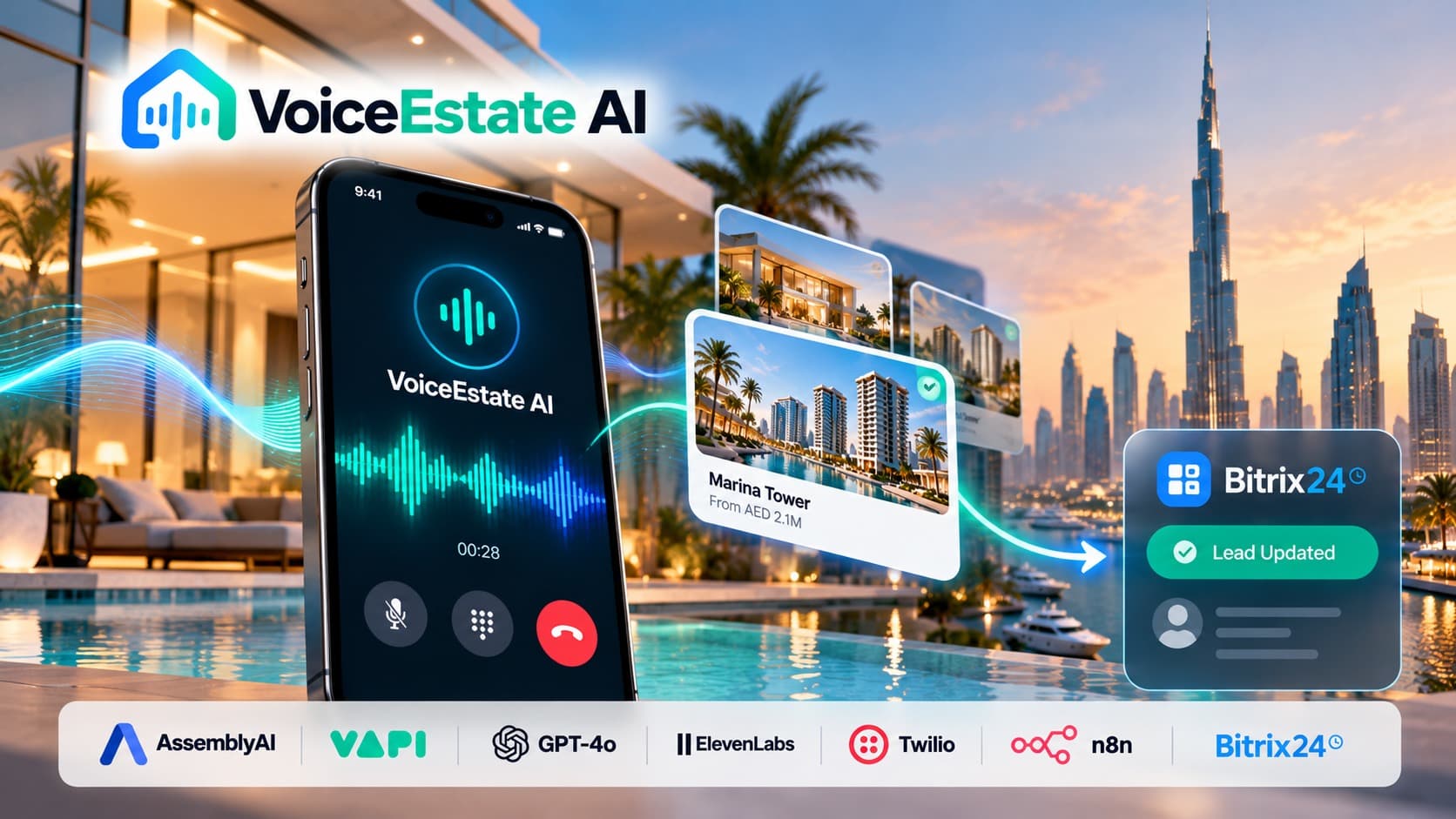
VoiceEstate AI is an AI voice agent built for Dubai real estate lead qualification, property discovery, and automated follow-up. When a new lead is assigned to the AI, it can automatically initiate an outbound phone call and have a natural conversation. The AI qualifies leads around investment vs. end-use, budget, preferred area, lifestyle, property type, bedrooms, project interest, and buying timeline. Instead of simply collecting information, it can use the lead's requirements to search Dubai off-plan property data of 2.5k+ records in real time and identify relevant projects. The AI can discuss matched projects using factual property information rather than inventing prices, features, or project details. After the conversation, Bitrix24 is updated with the lead's qualification data, call outcome, summary, and conversation context, giving the sales team useful AI-generated memory. Different outcomes are handled automatically, including qualified leads, callbacks, no-answer cases, not-interested leads, job enquiries, wrong numbers, and unreachable leads. Follow-up workflows can continue the conversation through scheduled AI call attempts and follow-up, reducing the amount of manual work required from sales teams. Qualified or interested leads can be moved toward a human sales consultant for the next stage of the sales process. AssemblyAI Universal 3.5 Pro powers real-time speech transcription, automatic language detection, and intelligent turn-taking inside the Vapi voice pipeline. GPT-4o handles conversation intelligence, ElevenLabs provides natural voice generation, Vapi manages the voice interaction, and Twilio handles phone connectivity. n8n orchestrates the automation while Bitrix24 remains the CRM and system memory for the lead lifecycle. The demo shows the complete journey: lead β†’ AI voice conversation β†’ qualification β†’ property matching β†’ CRM update β†’ follow-up β†’ human handoff.

KORA | Take Kora for a ride

KORA | Take Kora for a ride

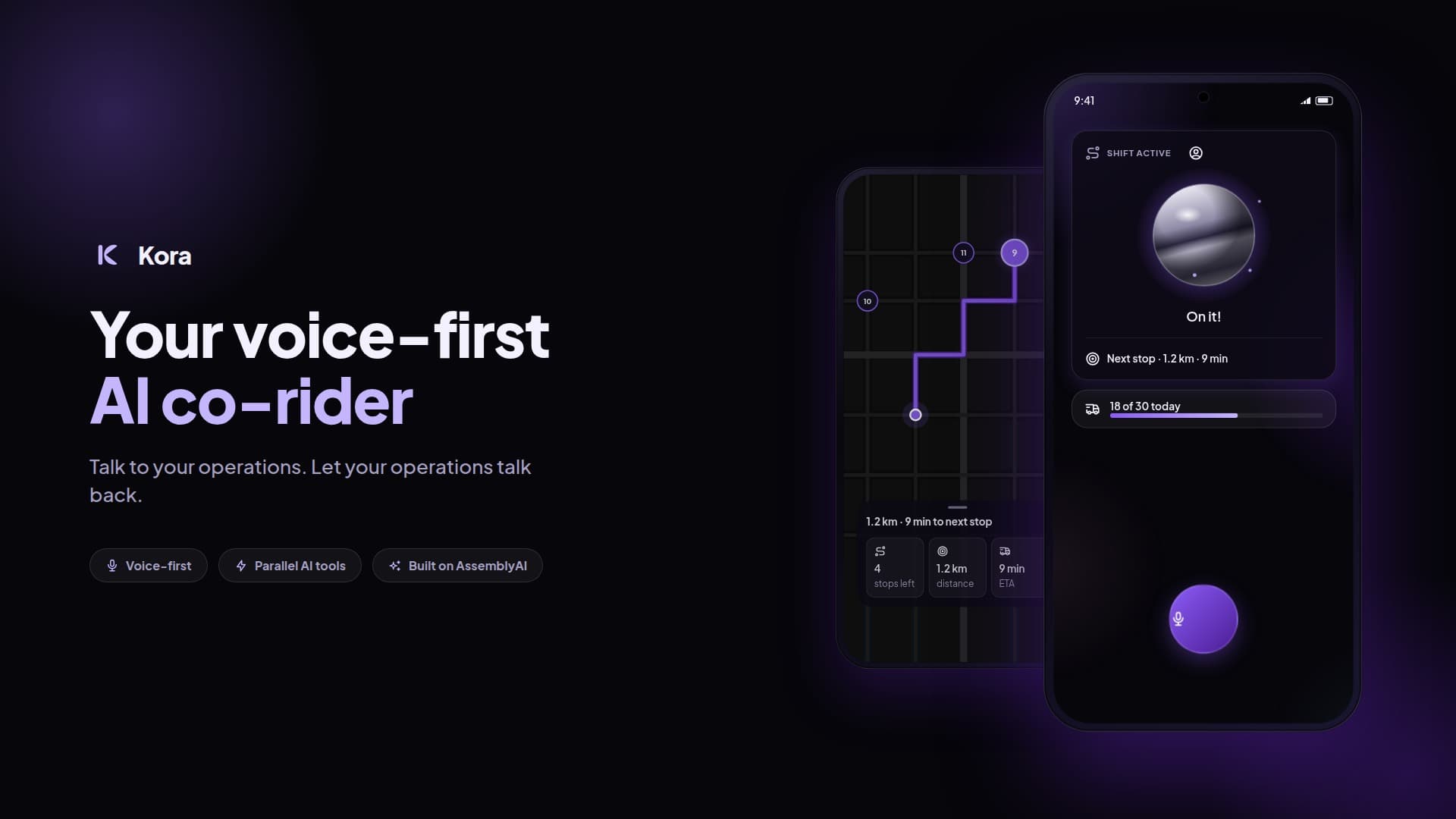
Delivery drivers spend their shifts juggling screens: checking the next address, following the route, calling customers, accepting orders and updating each delivery, often while moving. Every glance at the phone is a moment of distraction on the road. Kora is a voice-first AI co-rider that moves that work into conversation. Just say "Kora" and speak naturally. Ask for your next stop and Kora reads it out while drawing the route on the map. Accept or decline new orders by voice, call or message a customer, check your order queue, track your daily target and end your shift, all hands-free. After each reply Kora keeps listening for a few seconds, so follow-up questions do not need the wake word again. Behind the scenes, one request can trigger several actions at once. Kora runs its tools in parallel rather than one after another, and the driver hears one clear answer. The live conversation runs on AssemblyAI's Voice Agent, connected to 20 purpose-built tools for routes, orders and customer communication. When the shift ends, AssemblyAI LeMUR turns the day's conversation into a shift report. Kora is built with safety and control in mind: it waits for a clear yes before accepting an order, auto-accept only works when the driver switches it on, and new orders are offered near the driver's own location. Drivers can choose from eleven co-rider voices. This hackathon build is an Android prototype. Orders come from a simulator and the customer-call demo reaches no real person, so judges can try the full flow safely.