OpenClaw

OpenClaw is a personal AI assistant designed to automate tasks and interact with various applications and your local machine. It aims to streamline daily workflows by performing actions like managing emails, calendars, and flight check-ins directly through chat interfaces like WhatsApp, Telegram, and others. OpenClaw operates locally, offering flexibility with different AI models.

General
Release date2024
AuthorPeter Steinberger
Websitehttps://openclaw.ai/
Repositoryhttps://github.com/openclaw/openclaw
TypePersonal AI Assistant

Key Features of OpenClaw

  • Local Operation: Runs directly on your macOS, Windows, or Linux machine, keeping your data private.
  • Flexible AI Models: Supports various AI models including Anthropic, OpenAI, or local models.
  • Chat App Integration: Interact with OpenClaw through popular chat applications like WhatsApp, Telegram, Discord, Slack, Signal, and iMessage.
  • Persistent Memory: Learns and remembers your preferences and context over time to become a truly personalized assistant.
  • Browser and System Access: Capable of browsing the web, filling forms, extracting data, reading/writing files, and executing shell commands/scripts with optional sandboxed access.
  • Extensible with Skills & Plugins: Expand its capabilities with community-built skills, and it can even create new skills autonomously.
  • Proactive Task Management: Can perform scheduled tasks, set reminders, and manage background operations.

Start Building with OpenClaw

OpenClaw provides a powerful platform for personal automation and AI-driven task management. Its local-first approach combined with extensive integration capabilities makes it a versatile tool for enhancing productivity and privacy. Developers and users interested in leveraging autonomous AI agents can explore OpenClaw to build custom solutions or automate their daily digital lives.

While specific boilerplate or library examples are not yet widely available due to its nascent stage, the core functionality revolves around its API and integration points with chat applications and local system access.

OpenClaw Tutorials


OpenClaw Resources

Here are some valuable resources to help you get started with OpenClaw:


Openclaw AI Technologies top builders

Explore the top contributors showcasing the highest number of Openclaw AI Technologies app submissions within our community.

Openclaw AI Technologies Hackathon projects

Discover innovative solutions crafted with Openclaw AI Technologies, developed by our community members during our engaging hackathons.

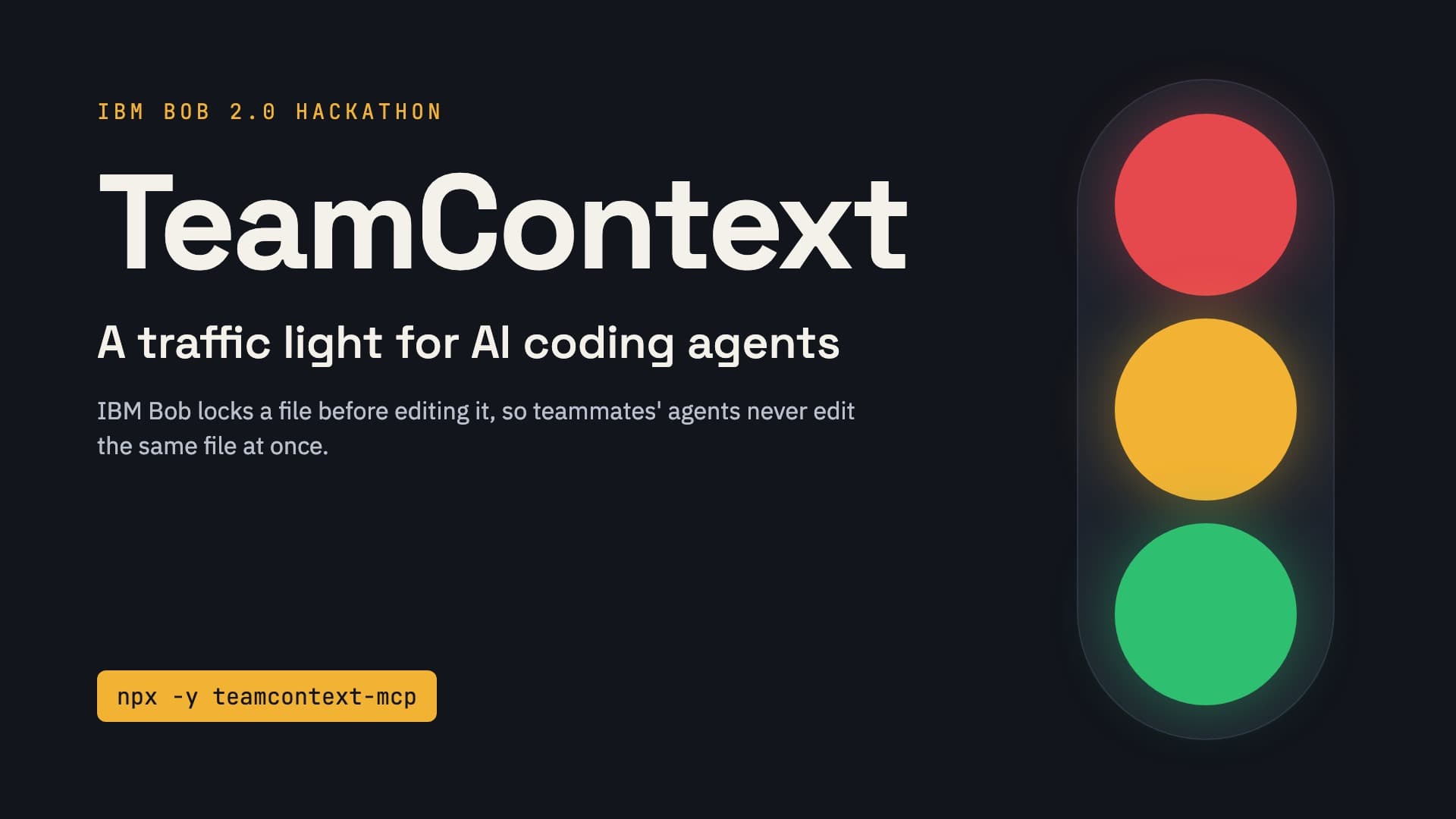
TeamContext: a traffic light for AI coding agents

TeamContext: a traffic light for AI coding agents

The problem. Teams no longer write code alone: each developer drives their own AI agent. The agents are fast, but blind to each other. Ask your agent to add a search box to the header while a teammate's agent adds a dark-mode toggle to the same header, and neither agent knows. Both edit src/header.js, both push, and the team finds out at merge time: a conflict, rework, and a conversation to reconstruct what the other agent changed. The faster the agents get, the more often this happens. The solution. TeamContext is a coordination layer — a traffic light — for AI-assisted teams. Before an agent edits a file, it asks for a lock. If a teammate's agent already holds it, the agent stops and tells its developer who is working on the file and since when, instead of creating a conflict. It has four parts: 1. A custom IBM Bob mode, "🚦 TeamContext". Its rules make Bob call the coordination tools on its own: check team status at the start of a task, lock each file before editing it, unlock it with a one-line summary of what changed, and leave a handoff note when the task ends. The developer just asks for the feature; they never mention locks. 2. An MCP server, published on npm as teamcontext-mcp. It exposes four tools (team_status, file_lock, file_unlock, release_all), detects the repository from git and normalizes paths so every teammate refers to the same file. It never crashes the agent: if the server is unreachable, it says so. 3. A central server on Vercel with Supabase Postgres. Lock acquisition is a single atomic Postgres function, so two requests can never be granted the same file. Locks expire automatically after a TTL, so a crashed session never blocks the team. 4. A live dashboard showing who is editing which file, conflicts avoided, and a feed of handoff notes written by the agents. Target users. Small and medium teams where several developers use AI coding agents on the same repository — especially during fast iterations such as hackathons, feature sprints and pair work across time zones. How they use it. One npx line in Bob's MCP configuration and the custom mode in the project's .bob/ folder. From then on, developers work exactly as before; Bob coordinates for them. Impact. In our before/after demo, the same two tasks on the same file produced a merge conflict without TeamContext. With TeamContext, the second agent stopped at the lock, retried after the first finished, and edited the updated file: zero merge conflicts, and the handoff note told the second developer exactly what changed. Why it is new. Existing tools resolve conflicts after they happen (merge tools) or rely on humans announcing what they are working on (chat, tickets). TeamContext moves coordination to the moment of editing and gives it to the agents themselves, so it scales with how fast AI agents now write code.

Voice Market Agent

Voice Market Agent

Voice Market Agent is a voice-first market copilot for Telegram. Market updates normally demand your eyes and your hands: a terminal, a chart, a few indicators. When your hands are busy, those minutes are simply lost. This agent needs only your voice. You send a voice message. AssemblyAI turns the recording into text — we use the universal-3-5-pro model together with a keyterms_prompt glossary (RSI, Bollinger Bands, timeframe, price, volume), so domain terms are transcribed reliably even in short, quiet clips. The transcript then goes to an LLM with tool calling, which decides for itself which data it needs: current price, SMA20, RSI(14), Bollinger Bands, volume ratio, the market Fear and Greed index, or a freshly rendered candlestick chart. The answer comes back in two layers: a short spoken summary is synthesised with ElevenLabs and returned as a Telegram voice note, while the numbers and levels arrive as text you can re-read. Nothing is pre-scripted — the model chooses the tools from the wording of the question, so "what is Bitcoin doing today" and "show me a daily Ether chart" take different paths through the same agent. Under the hood: AssemblyAI for speech recognition, an LLM with function calling for reasoning, the public Binance API for market data, ElevenLabs for speech synthesis, matplotlib for charts and python-telegram-bot as the interface. Telegram was chosen deliberately: it is installed on more than a billion devices, and a voice message is a familiar gesture there. The project is open source under MIT. Code: bunin78-netizen/voice-market-agent. The working bot is @VoiceMarketAgentBot, and the demo video shows a complete conversation: three spoken questions, three spoken answers, two freshly generated charts.

Fresno LUX: A Living City

Fresno LUX: A Living City

Fresno LUX is a prototype for a living intelligence layer across an entire city. Fresno already contains enormous amounts of intelligence: residents know where problems exist, nonprofits know where help is needed, businesses know where opportunities exist, educators understand gaps in learning, researchers generate knowledge, and government maintains critical infrastructure and data. The problem is that much of this intelligence is fragmented across disconnected systems. Fresno LUX connects those pieces. The platform creates a shared city graph where people, organizations, resources, needs, projects, observations, experiments, and outcomes become connected nodes. Instead of simply collecting data, LUX continuously asks: What is happening? What do we know? What is missing? What can we test? What changed? A community problem can become an observable signal. That signal can become an experiment. The experiment produces evidence. Evidence changes the system's understanding. That updated understanding informs the next action. Observe → Connect → Understand → Act → Measure → Learn → Converge. The goal is to move Fresno from disconnected information toward collective intelligence—a system where knowledge can travel across boundaries and successful solutions can be discovered, tested, measured, and replicated. LUX is designed to make the invisible connections visible: the relationship between a neighborhood and its resources, between a student and educational opportunity, between a business and workforce capacity, between environmental conditions and community health, and between an idea and measurable real-world impact. This hackathon prototype demonstrates the beginning of a Living Fresno Graph: a city that can observe itself, learn from evidence, and coordinate toward better outcomes.