Qwen3-MT

Qwen3-MT is a machine translation model developed by Alibaba Cloud's Qwen team, released on July 25, 2025. It is fine-tuned from Qwen3 with a lightweight Mixture-of-Experts backbone and trained on trillions of multilingual tokens spanning formal, technical, and conversational text. The model covers 92 major languages and prominent dialects, reaching over 95% of the global population.

General
Release date25 Jul 2025
DeveloperQwen / Alibaba Cloud
TypeMachine translation model (MoE fine-tune)
LicenseCommercial API
DocumentationAlibaba Cloud Model Studio
APIDashScope via Qwen API Platform

Core Features

  • 92 languages: covers major world languages and prominent dialects, reaching 95% of the global population.
  • Terminology control: allows custom terminology dictionaries to keep brand names, technical terms, and product names consistent.
  • Domain prompting: a domain hint lets the model adapt output style for legal, medical, technical, or conversational text.
  • Translation memory: integrates past translation pairs so repeated segments stay consistent across large documents.
  • Competitive pricing: priced at $0.5 per million tokens, significantly lower than dense large models for translation workloads.

Performance

Qwen3-MT outperforms comparably-sized models on translation benchmarks, including GPT-4.1-mini and Gemini-2.5-Flash, while remaining competitive with larger models like GPT-4.1 and Gemini-2.5-Pro on translation quality metrics.


Tools and Resources


Ecosystem and Integrations

  • Served through Alibaba Cloud DashScope, accessible with the OpenAI-compatible endpoint or the native DashScope SDK.
  • Supports batch translation for high-volume document workflows.
  • Term dictionaries and translation memory integrate via API request parameters, requiring no custom fine-tuning.

Get started by generating an API key on the Qwen API Platform and following the Model Studio translation guide.

Qwen3-MT top builders

Explore the top contributors showcasing the highest number of Qwen3-MT app submissions within our community.

Qwen Qwen3-MT AI technology Hackathon projects

Discover innovative solutions crafted with Qwen3-MT, developed by our community members during our engaging hackathons.

Phoenix: Evidence-Driven AI Modernization

Phoenix: Evidence-Driven AI Modernization

Rewriting banking software is easy to demonstrate and difficult to trust. A replacement can serve the same endpoints while changing transfer fees, duplicate-request handling or ledger behaviour. Phoenix makes those differences visible before a migration is accepted. Phoenix uses an agent workflow to discover a legacy service, extract business rules and invariants, capture its behaviour, generate a replacement and compare the results. Its inspector connects claims to source citations, captured expectations, verification reports and implementation artifacts. Our demonstrated migration takes a Java/Spring Boot banking service to Node.js and TypeScript. The recorded run contains five business rules, two invariants, ten scenarios and 662 assertions. Examples cover online fee thresholds, account-age waivers, repeated transfers using an idempotency key, batch settlement and settled-transfer corrections. The first replacement produced 80 mismatches, including JSON numbers emitted as strings. A recorded autonomous repair produced a new implementation artifact, followed by verification with zero mismatches across all ten scenarios. We then deliberately changed a replacement transfer fee from 0.50 to 1.00. Phoenix detected seven mismatches across two scenarios, including the resulting balance and ledger differences. After restoration, all ten scenarios matched again. The evidence does not establish that this fee restoration was autonomous. Phoenix demonstrates evidence-driven modernization of a tested banking slice. The result is an inspectable record of what changed, what matched and which behaviours still need further validation.

Fresno LUX: A Living City

Fresno LUX: A Living City

Fresno LUX is a prototype for a living intelligence layer across an entire city. Fresno already contains enormous amounts of intelligence: residents know where problems exist, nonprofits know where help is needed, businesses know where opportunities exist, educators understand gaps in learning, researchers generate knowledge, and government maintains critical infrastructure and data. The problem is that much of this intelligence is fragmented across disconnected systems. Fresno LUX connects those pieces. The platform creates a shared city graph where people, organizations, resources, needs, projects, observations, experiments, and outcomes become connected nodes. Instead of simply collecting data, LUX continuously asks: What is happening? What do we know? What is missing? What can we test? What changed? A community problem can become an observable signal. That signal can become an experiment. The experiment produces evidence. Evidence changes the system's understanding. That updated understanding informs the next action. Observe → Connect → Understand → Act → Measure → Learn → Converge. The goal is to move Fresno from disconnected information toward collective intelligence—a system where knowledge can travel across boundaries and successful solutions can be discovered, tested, measured, and replicated. LUX is designed to make the invisible connections visible: the relationship between a neighborhood and its resources, between a student and educational opportunity, between a business and workforce capacity, between environmental conditions and community health, and between an idea and measurable real-world impact. This hackathon prototype demonstrates the beginning of a Living Fresno Graph: a city that can observe itself, learn from evidence, and coordinate toward better outcomes.

StoryForge AI

StoryForge AI

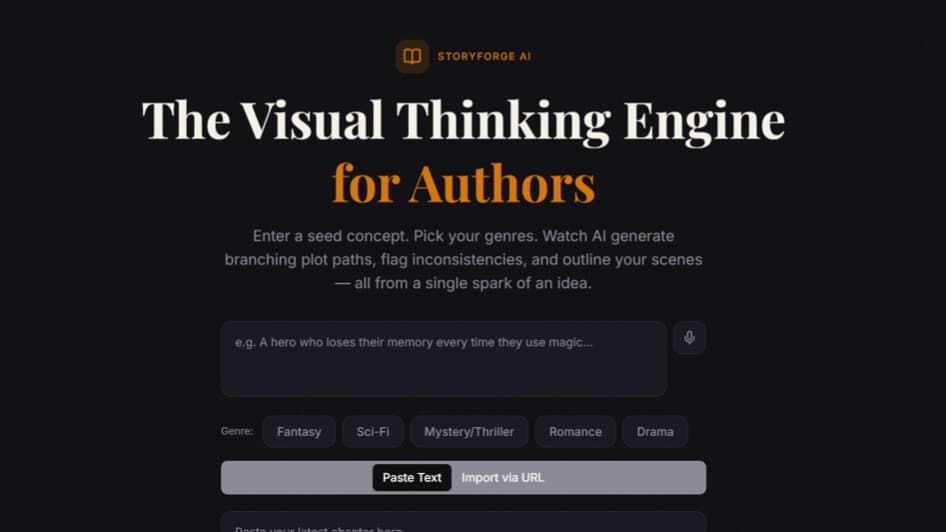
When fiction writers experience writer's block, standard Chat LLMs often try to write the prose directly for them. This approach strips away the author's unique creative voice and introduces sterile text alongside factual hallucinations. StoryForge AI solves this issue by serving as a visual co-pilot—building story scaffolding, branching plot paths, and scene outlines while keeping full creative control in the writer's hands. Our platform features three core capabilities: 1. Branching Plot Paths: Visually explore alternative narrative twists, story directions, and character arcs generated from a single seed concept. 2. Scene Outlines & Emotional Beats: Break chapters down into actionable chunks with structured tension scaling and emotional beats. 3. Plot Hole & Inconsistency Radar: An automated watchdog that flags logical, scientific, and historical flaws in world-building before prose drafting begins. To ensure maximum reliability, StoryForge AI relies on a robust multi-agent architecture. Bright Data executes real-time web scraping to cross-reference world-building claims against real-world scientific and historical databases, ensuring story lore remains airtight. Featherless AI serves as our serverless inference backbone, tapping into high-performance open-source models like Qwen and Mistral with zero API rate-limit bottlenecks. Finally, Google Antigravity provides an agentic sandbox to run autonomous Python scripts that verify spatial reasoning, complex timelines, and narrative logic in real time. StoryForge AI empowers creators to build rich, consistent worlds without losing their creative agency.

Probably runs on Samsung S25

Probably runs on Samsung S25

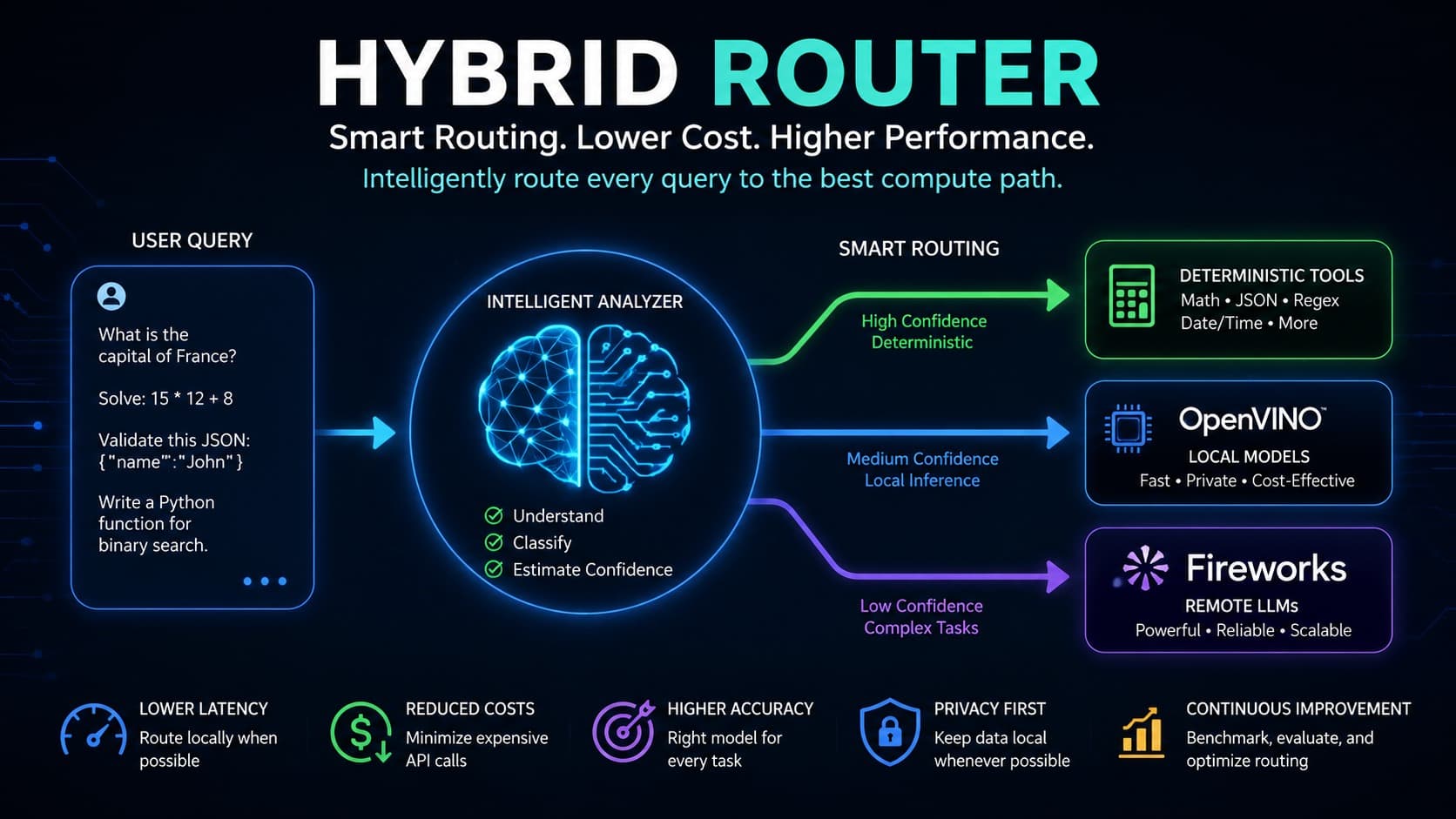
Hybrid Router is an intelligent AI inference system that dynamically selects the best execution path for each user query instead of relying on a single large language model. The system first analyzes the incoming prompt to identify the task type, estimate its complexity, and determine whether it can be solved deterministically or requires generative AI. For structured tasks such as mathematical calculations, JSON validation, regular expression verification, and date/time operations, the router invokes specialized deterministic tools that produce fast, accurate, and reproducible results without consuming LLM tokens. For more complex natural language and coding tasks, the router attempts local inference using OpenVINO-optimized models running on Intel hardware, reducing latency and API costs. If the local model is unlikely to provide a sufficiently reliable answer or the task exceeds its capabilities, the system automatically falls back to Fireworks AI models for high-quality remote inference. The routing decisions are driven by task classification, confidence estimation, and configurable thresholds, allowing the system to balance accuracy, response time, and operational cost. The architecture is modular, making it easy to add new tools, local models, or routing strategies in the future. The project also includes benchmarking and evaluation components that measure routing accuracy, latency, model utilization, and fallback frequency to continuously improve routing performance. By combining deterministic tools, local inference, and cloud-based language models into a single adaptive pipeline, Hybrid Router delivers efficient, scalable, and cost-aware AI inference while maintaining high response quality across a wide range of tasks.