Stability AI

Stability AI stands at the forefront of the generative AI revolution. Founded by visionary Emad Mostaque, this company is reshaping the landscape of artificial intelligence by offering open-source, cutting-edge AI models. Their work spans across imaging, language, code, and audio, aiming to unlock global creativity, innovation, and productivity.

General
Relese date2019
WebsiteLink
TypeOpen Source Generative AI Model

Stability AI has made significant strides in the field of generative artificial intelligence, providing a range of models that cater to diverse aspects of AI application. Under the leadership of founder Emad Mostaque, the company has been dedicated to democratizing AI technology, making it accessible to a broader audience. Their suite of models demonstrates this commitment, each serving a unique purpose in the AI ecosystem.

Key Models Developed by Stability AI:

1. Stable Diffusion XL

2. Stable Audio

  • Focus: Audio generation and manipulation.
  • Details: Stable Audio.

3. Stable LM (Language Model)

4. Stable Video

5. Stable Code

6. Stable Beluga

7. Japanese Stable LM

Overview of Stability AI's Approach

Stability AI's range of models showcases their expertise in various AI domains, from visual arts and audio to language processing and coding. The company's open-source approach not only fosters community involvement but also ensures widespread dissemination of AI benefits. Each model serves as a testament to Stability AI's commitment to innovation and their goal of activating humanity's potential through AI technology.

Stability AI AI Technologies top builders

Explore the top contributors showcasing the highest number of Stability AI AI Technologies app submissions within our community.

Stability AI AI Technologies Hackathon projects

Discover innovative solutions crafted with Stability AI AI Technologies, developed by our community members during our engaging hackathons.

Dependency Blackout

Dependency Blackout

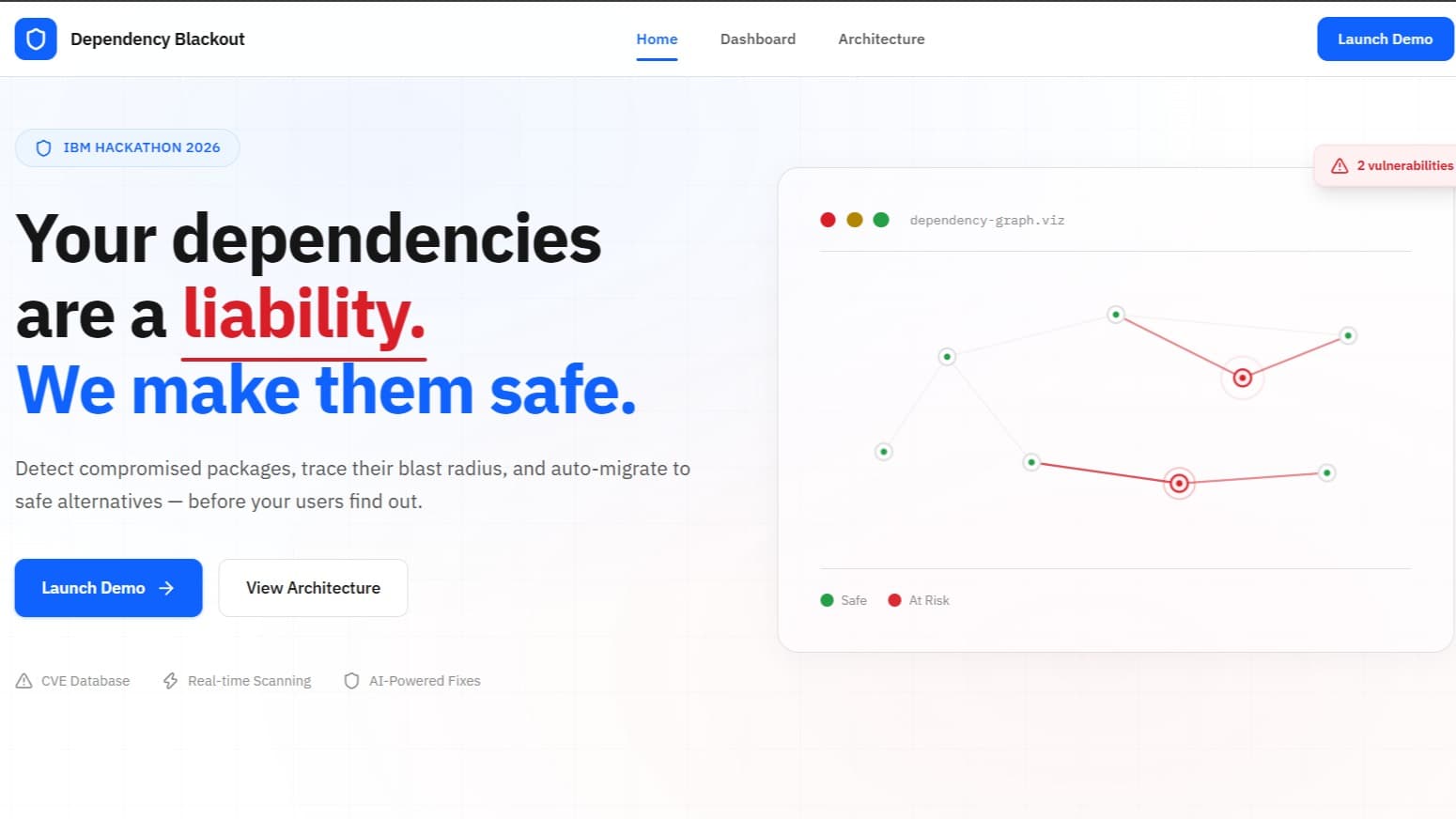
Dependency Blackout tackles an issue that many software projects face today. New applications use a lot of open‑source packages. If one of those packages is weak, broken or old it can expose the codebase to danger. Regular scanners can point out weak packages but developers still have to figure out how bad the problem is, look for a better option change the code and test that everything still runs. Dependency Blackout brings all those steps into a workflow. It scans a projects dependencies and spots packages that are known to have security or maintenance problems. When it finds a dependency it draws an impact graph that shows where that dependency is used in the application. This helps developers see the spread of the risk instead of just getting a simple alert. Dependency Blackout then suggests replacement options and gives a confidence score so developers can judge the choices. After a replacement is chosen Dependency Blackout helps move the code over and shows a clear before‑and‑after diff that tells exactly what changed. At the end it runs tests to make sure the fix does not create issues. The main users of Dependency Blackout are software developers, security engineers, DevSecOps teams and any development group that manages applications with dependencies. They use a dashboard to choose a repository run a scan look into vulnerabilities examine the impact pick alternatives run the migration and check the outcome. What sets Dependency Blackout apart is that it does more than just find a vulnerability. It links detection, impact analysis fixing moving to a package and verification into one workflow. This cuts down the work that developers normally do when dealing with dependency problems and gives them a clearer route from spotting a security issue to safely fixing it. In short Dependency Blackout helps developers spot dependencies see what they touch swap them safely and confirm the fix—all, in one system.

Fresno LUX: A Living City

Fresno LUX: A Living City

Fresno LUX is a prototype for a living intelligence layer across an entire city. Fresno already contains enormous amounts of intelligence: residents know where problems exist, nonprofits know where help is needed, businesses know where opportunities exist, educators understand gaps in learning, researchers generate knowledge, and government maintains critical infrastructure and data. The problem is that much of this intelligence is fragmented across disconnected systems. Fresno LUX connects those pieces. The platform creates a shared city graph where people, organizations, resources, needs, projects, observations, experiments, and outcomes become connected nodes. Instead of simply collecting data, LUX continuously asks: What is happening? What do we know? What is missing? What can we test? What changed? A community problem can become an observable signal. That signal can become an experiment. The experiment produces evidence. Evidence changes the system's understanding. That updated understanding informs the next action. Observe → Connect → Understand → Act → Measure → Learn → Converge. The goal is to move Fresno from disconnected information toward collective intelligence—a system where knowledge can travel across boundaries and successful solutions can be discovered, tested, measured, and replicated. LUX is designed to make the invisible connections visible: the relationship between a neighborhood and its resources, between a student and educational opportunity, between a business and workforce capacity, between environmental conditions and community health, and between an idea and measurable real-world impact. This hackathon prototype demonstrates the beginning of a Living Fresno Graph: a city that can observe itself, learn from evidence, and coordinate toward better outcomes.

Fresno LUX: A Living City

Fresno LUX: A Living City

Fresno LUX is a prototype for a living intelligence layer across an entire city. Fresno already contains enormous amounts of intelligence: residents know where problems exist, nonprofits know where help is needed, businesses know where opportunities exist, educators understand gaps in learning, researchers generate knowledge, and government maintains critical infrastructure and data. The problem is that much of this intelligence is fragmented across disconnected systems. Fresno LUX connects those pieces. The platform creates a shared city graph where people, organizations, resources, needs, projects, observations, experiments, and outcomes become connected nodes. Instead of simply collecting data, LUX continuously asks: What is happening? What do we know? What is missing? What can we test? What changed? A community problem can become an observable signal. That signal can become an experiment. The experiment produces evidence. Evidence changes the system's understanding. That updated understanding informs the next action. Observe → Connect → Understand → Act → Measure → Learn → Converge. The goal is to move Fresno from disconnected information toward collective intelligence—a system where knowledge can travel across boundaries and successful solutions can be discovered, tested, measured, and replicated. LUX is designed to make the invisible connections visible: the relationship between a neighborhood and its resources, between a student and educational opportunity, between a business and workforce capacity, between environmental conditions and community health, and between an idea and measurable real-world impact. This hackathon prototype demonstrates the beginning of a Living Fresno Graph: a city that can observe itself, learn from evidence, and coordinate toward better outcomes.