SuperAGI

SuperAGI is a dev-first, open-source autonomous AI agent framework - Enabling developers to build, manage & run useful autonomous agents quickly and reliably. Users can extend Agent capabilities with tools such as GitHub, Jira, Slack, Twitter, etc., and also run multiple agents concurrently.

SuperAGI also provides users with a GUI to easily configure and monitor their agents. Users can access organization, run, and user-level metrics via the Agent Performance Monitoring (APM) dashboard to get actionable insights about improving their agents.

General
Repositoryhttps://github.com/TransformerOptimus/SuperAGI
TypeLarge Language Model Framework

SuperAGI - Resources

Resources to get started with SuperAGI

SuperAGI - Video Walkthroughs

SuperAGI - Use cases

Use cases for SuperAGI

SuperAGI top builders

Explore the top contributors showcasing the highest number of SuperAGI app submissions within our community.

SuperAGI AI technology page Hackathon projects

Discover innovative solutions crafted with SuperAGI, developed by our community members during our engaging hackathons.

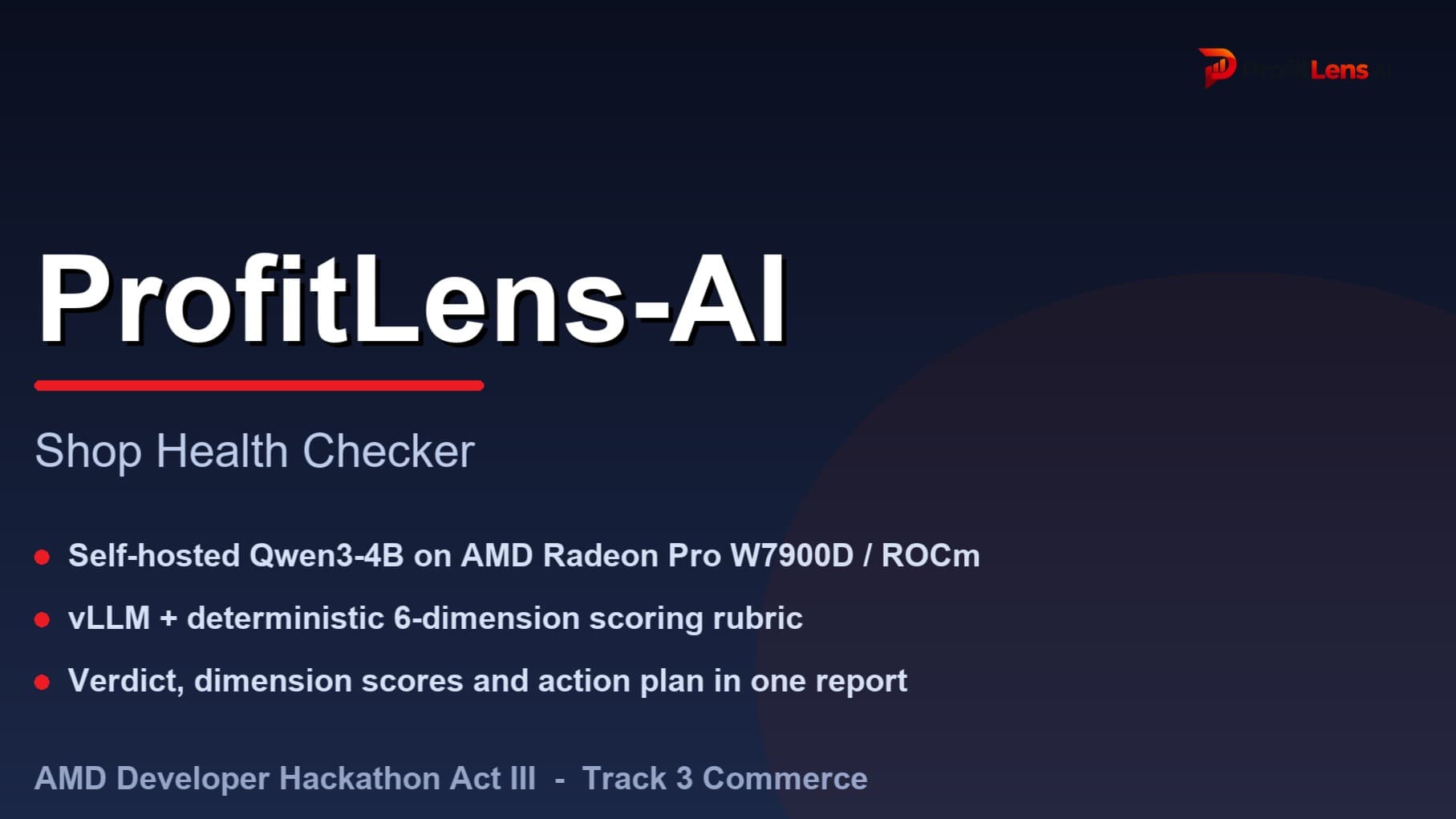
 ProfitLens-AI — Shop Health Checker

ProfitLens-AI — Shop Health Checker

Small online shops drown in raw numbers — price, reviews, sales, refunds — but never get an answer to the only question that matters: "Is my shop healthy, and what should I fix first?" ProfitLens-AI answers it in one click. Paste in a shop's metrics, and the app returns a structured Health Report: an overall score from 0-100, a verdict badge (healthy / watch / critical), six weighted dimension scores (price competitiveness, review quality, 30-day sales trend, service, listing completeness, activity), a plain-language summary, and prioritized recommendations. The architecture is a Next.js dashboard feeding a deterministic scoring engine (rubric v0.2, fully auditable, validated 10/10 against the organizer's answer key). On top of that skeleton sits a dual-engine prose layer: when an AMD GPU endpoint is available, Qwen3-4B served by vLLM generates the summary, per-dimension comments and recommendations; when it is unreachable, the app transparently falls back to built-in rule-based prose with identical scores — it never breaks. The AI runs entirely on our own hardware: Qwen/Qwen3-4B served by vLLM (OpenAI-compatible API) on an AMD Radeon Pro W7900D (gfx1100, RDNA3) on the AMD Anrui ROCm notebook instance. Every report triggers real GPU inference — verifiable live with rocm-smi showing utilization and VRAM spikes on each request. Try it now: https://profit-lens-ai.vercel.app (demo account [email protected] / demo1234, pre-loaded with ten test shops). Source: https://github.com/zxy-666666Max/ProfitLens-AI

Fresno LUX: A Living City

Fresno LUX: A Living City

Fresno LUX is a prototype for a living intelligence layer across an entire city. Fresno already contains enormous amounts of intelligence: residents know where problems exist, nonprofits know where help is needed, businesses know where opportunities exist, educators understand gaps in learning, researchers generate knowledge, and government maintains critical infrastructure and data. The problem is that much of this intelligence is fragmented across disconnected systems. Fresno LUX connects those pieces. The platform creates a shared city graph where people, organizations, resources, needs, projects, observations, experiments, and outcomes become connected nodes. Instead of simply collecting data, LUX continuously asks: What is happening? What do we know? What is missing? What can we test? What changed? A community problem can become an observable signal. That signal can become an experiment. The experiment produces evidence. Evidence changes the system's understanding. That updated understanding informs the next action. Observe → Connect → Understand → Act → Measure → Learn → Converge. The goal is to move Fresno from disconnected information toward collective intelligence—a system where knowledge can travel across boundaries and successful solutions can be discovered, tested, measured, and replicated. LUX is designed to make the invisible connections visible: the relationship between a neighborhood and its resources, between a student and educational opportunity, between a business and workforce capacity, between environmental conditions and community health, and between an idea and measurable real-world impact. This hackathon prototype demonstrates the beginning of a Living Fresno Graph: a city that can observe itself, learn from evidence, and coordinate toward better outcomes.

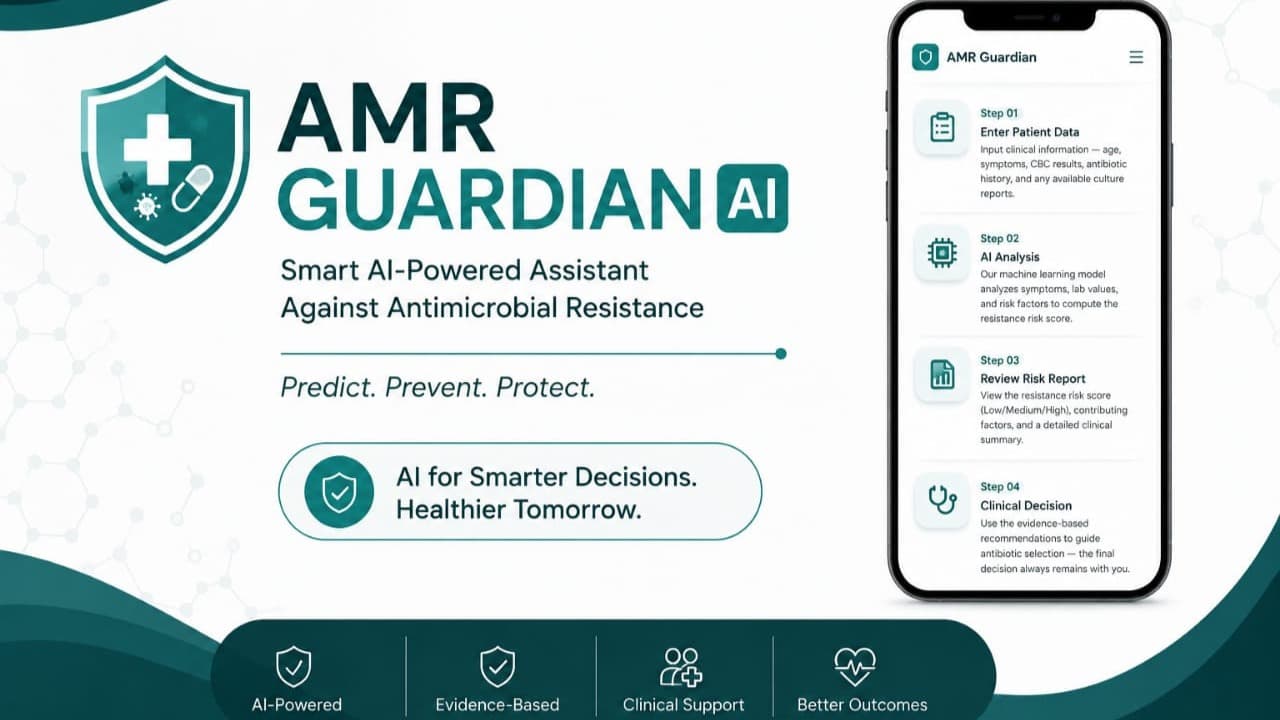
AMR Guardian AI Antimicrobial Resistance Predictor

AMR Guardian AI Antimicrobial Resistance Predictor

AMR Guardian AI is an AI powered clinical decision support system designed to help healthcare professionals identify and assess the risk of antimicrobial resistance at an early stage. The project addresses a critical healthcare challenge where inappropriate or unnecessary antibiotic use can contribute to the development and spread of resistant infections. The system analyzes multiple patient specific factors, including age, symptoms, basic laboratory results, previous antibiotic use, and culture information. It combines these inputs to generate an antimicrobial resistance risk assessment and presents the results through a clear, user friendly dashboard. The platform provides a risk score, risk level, infection category, severity assessment, clinical summary, confidence score, key findings, major risk factors, and feature importance. It also provides culture testing, follow up, isolation, and antibiotic stewardship recommendations. These explainable outputs help users understand why a patient may have an elevated resistance risk instead of receiving a simple unexplained prediction. AMR Guardian AI uses React for the frontend, Supabase for authentication and database management, and AI powered analysis for generating clinically relevant insights. The dashboard presents patient analyses, AMR risk trends, infection distributions, and recent assessment records in an organized interface. The project is designed as a decision support prototype. Its purpose is to demonstrate how AI can support earlier risk assessment, improve antimicrobial stewardship, and encourage more informed antibiotic use. AMR Guardian AI combines biotechnology, clinical data analysis, artificial intelligence, and modern web development into one practical solution. It demonstrates how intelligent data driven tools can support healthcare professionals in addressing antimicrobial resistance and building more responsible approaches to antibiotic treatment.

ArchMind: AI Software Architect

ArchMind: AI Software Architect

ArchMind is an AI-powered software architecture intelligence platform that helps developers understand, analyze, and evolve complex codebases. Instead of treating source code as plain text, ArchMind parses repositories into Abstract Syntax Trees (ASTs), extracts structural relationships, and constructs an architecture knowledge graph representing modules, classes, functions, dependencies, and execution flow. An AI agent reasons over this graph to answer architectural questions that traditional code search cannot. Developers can ask natural language questions such as "How does authentication work?", "What will break if I modify this service?", "Which components depend on this module?", or "Where are the architectural bottlenecks?". The platform performs dependency analysis, impact prediction, dead-code detection, architecture visualization, and automatic documentation generation. ArchMind leverages AMD Developer Cloud for scalable graph processing and Fireworks AI models running on AMD hardware for intelligent reasoning. The system combines symbolic program analysis with large language models, enabling more accurate software understanding while reducing hallucinations common in text-only approaches. The project is designed for software engineers, architects, and engineering teams working with large and evolving repositories. By combining program analysis, graph intelligence, and AI agents into a single platform, ArchMind significantly reduces onboarding time, improves maintainability, accelerates refactoring, and enables architecture-aware software development.

Lodestar — Offline AI Survival Copilot

Lodestar — Offline AI Survival Copilot

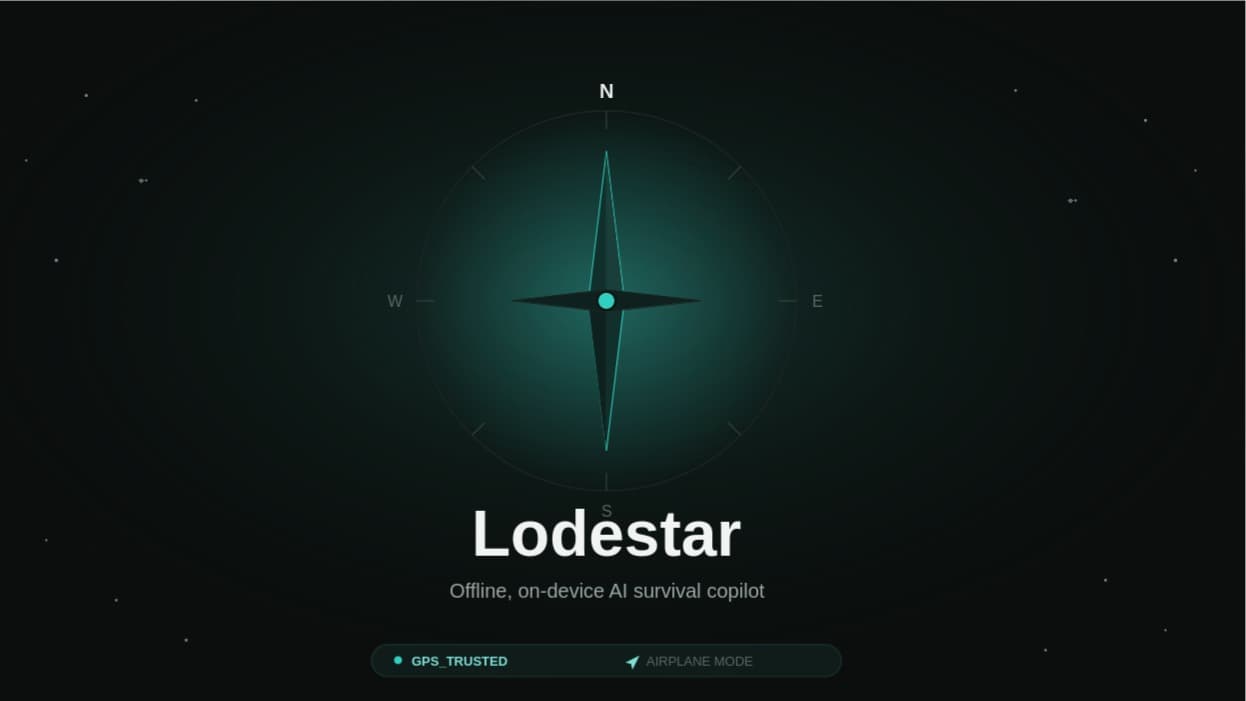
GPS denial is no longer rare: Poland logged 2,732 jamming incidents in one month in early 2025, and an EU Commission President's plane lost GPS near Bulgaria and landed on paper maps. When navigation fails, everything built on top tends to fail at once including medical guidance, since most first-aid apps assume connectivity that may not exist when it matters most. Lodestar is an offline, on-device AI survival copilot built for that moment. It runs on Snapdragon hardware via ExecuTorch, requesting no INTERNET permission at all, across three capabilities: TREAT — describe an injury by voice or text and get a severity-ranked, source-cited first-aid response. Severity comes from a deterministic safety-tree engine, not the language model, so the system can't be talked into downgrading a critical call by ambiguous phrasing. The model explains and cites a TCCC/MARCH corpus but cannot override the verdict underneath. We tested negation handling ("hasn't stopped" vs. "has stopped now"), the failure mode that matters in the field — and caught and fixed a real bug here during testing. ORIENT — true north without a satellite. By day, a solar compass derives heading from the sun's position, verified against documented sunrise, sunset, and solar-noon directions. By night, on-device star plate-solving matches a photographed sky against a catalog. A status strip shows the active position source — GPS_TRUSTED, DEAD_RECKONING, SOLAR_FIX, or STAR_FIX — and flips in real time if GPS is spoofed, freezing to the last trusted fix. COMMUNICATE — medic-casualty translation plus a one-tap SOS card from the TREAT conversation. Every model-backed capability sits behind one interface, so the app was built and tested against a stub before the real models landed swapping to production is a one-line change. We're upfront about what's tested today (safety tree, solar math, spoof detection all pass automated tests) versus what's in progress (corpus coverage, runtime integration)