Together AI

Together AI is AI cloud platform which drives AI innovation. It contributes to open-source research, empowering developers to deploy AI models.

General
AuthorTogether AI
TypeAI platform

Key Features

  • Unmatched performance: Its research and developments introduce advanced efficiencies in training and inference processes which grows along with user's requirements. The Together Inference Engine has the swiftest inference stack currently available.
  • High scalability: It is a horizontally scalable platform which is delivering peak performance based on user's traffic demands.
  • Rapid integration: Integrates into existing applications with minimal setup with its easy-to-use API.
  • Topnotch support: Their expert team is there to assist users in the preparation and optimization of datasets to ensure accuracy and providing support in training personalized AI models.

Start building with Together AI's products

Dive into the possible solutions from Together AI to ensure flawless building of your app. Explore the apps created with Together AI technology showcased during hackathons and innovation challenges!

List of Together AI's products

Together Inference

Together Inference is the fastest inference stack available, delivering speeds up to 3 times faster than competitors like TGI, vLLM, or other inference APIs such as Perplexity, Anyscale, or Mosaic ML. Run leading open-source models like Llama-2 with lightning-fast performance, all at a cost 6 times lower than GPT 3.5 Turbo when using Llama2-13B.

Together Custom Models

Together Custom Models is designed to assist you in training your own advanced AI model. You can use state-of-the-art optimizations for the better performance in the Together Training stack, such as FlashAttention-2. Once completed, the model belongs to you. Also, you will be able to maintain the whole ownership of the model and deploy it wherever you want to.

Together GPU Clusters

Together AI provides top-performing computing clusters designed for training and refining purposes. Their clusters come equipped with the lightning-fast Together Training stack, ensuring seamless operation. Additionally, their AI experts team of is readily available to offer any kind of assistance. With a renewal rate higher than 95%, Together GPU Clusters ensure reliability and performance.

System Requirements

Together AI is compatible with major operating systems, including Windows, macOS, and Linux. A minimum of 4 GB of RAM is recommended for optimal performance. Complimentary is having access to a GPU can which significantly enhances performance of model training.

Together AI top builders

Explore the top contributors showcasing the highest number of Together AI app submissions within our community.

Together AI AI technology page Hackathon projects

Discover innovative solutions crafted with Together AI, developed by our community members during our engaging hackathons.

DevFlow AI

DevFlow AI

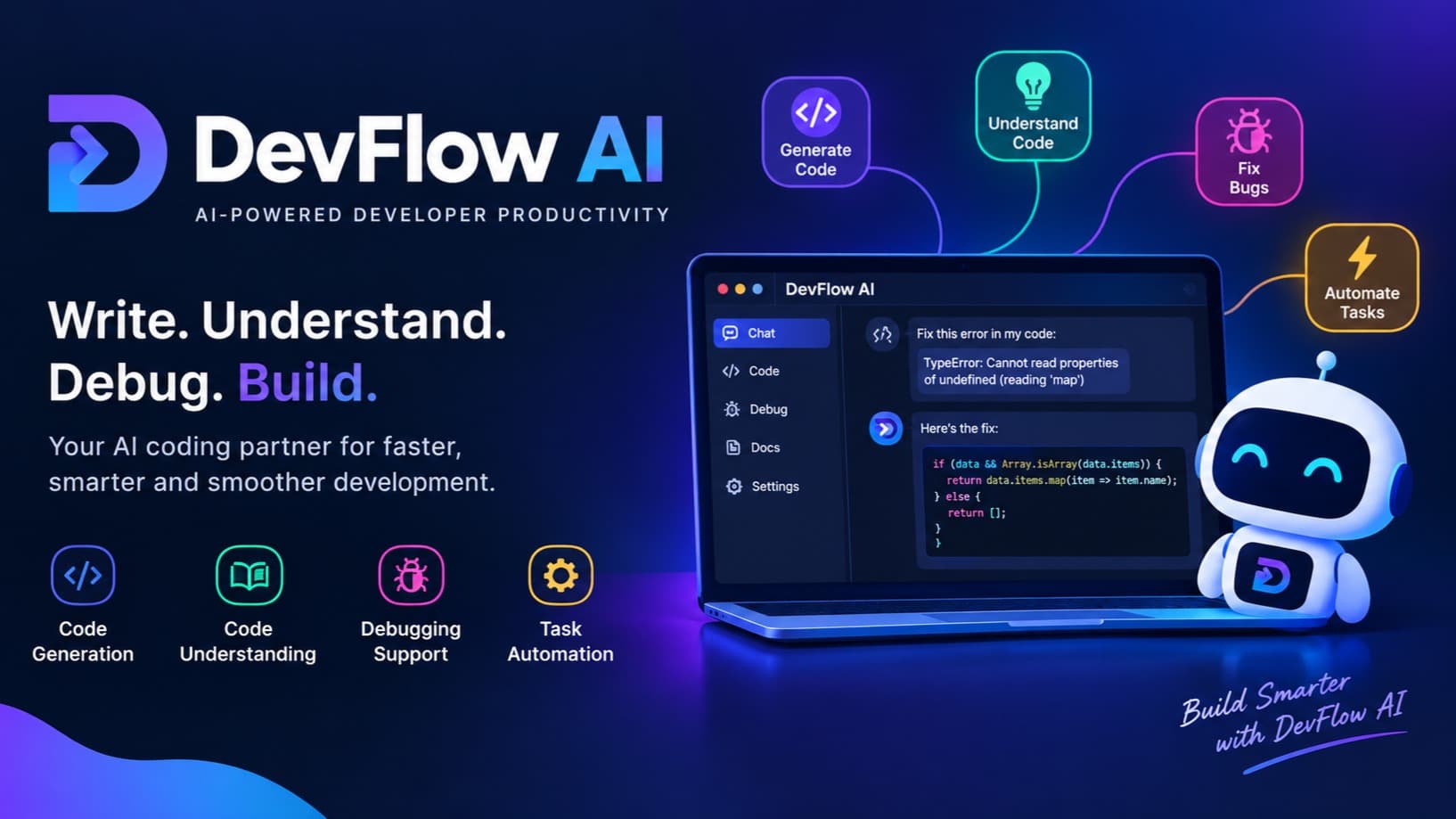
DevFlow AI is an AI-powered developer productivity platform designed to help developers spend less time on repetitive development tasks and more time solving meaningful problems. Problem: Developers often spend significant time understanding unfamiliar code, debugging errors, writing repetitive code, creating documentation, and performing routine development tasks. These activities can slow development, increase the chance of mistakes, and make it harder for developers to maintain productivity, especially when working on larger or unfamiliar projects. Solution: DevFlow AI provides an intelligent workspace that assists developers throughout their development workflow. Developers can use the platform to understand code, generate and improve code, identify and troubleshoot errors, and receive AI-assisted guidance while working on software projects. By bringing these capabilities into one developer-focused workflow, DevFlow AI reduces repetitive manual effort and helps developers move from a problem to a working solution more efficiently. Target Users: The primary users are software developers, students learning programming, individual developers, and development teams who want to improve their everyday coding workflow. How Users Interact: A developer can use DevFlow AI by providing a coding task, describing a problem, asking for an explanation, or requesting help with implementation and debugging. The system analyzes the developer's request and provides useful AI-assisted output that can be reviewed and applied to the project. Creativity and Uniqueness: DevFlow AI focuses on developer productivity rather than being only a general-purpose chatbot. Its purpose is to support multiple stages of the software development workflow in a single environment, helping developers understand, create, debug, and improve software. Impact: By reducing repetitive work and providing contextual AI assistance, DevFlow AI can help developers save time, reduce manual effort, improve consistency, and focus more on designing and building useful software. The project demonstrates how AI-assisted development can be integrated into practical developer workflows.

Gainfuel

Gainfuel

PROBLEM Millions of Indian college students are underweight and genuinely try to gain weight, but fail because they never know how many calories they actually eat versus how many they need. Existing fitness apps make this harder for them, not easier: food databases are western (searching "dal" or "panipuri" fails or gives wrong values), every meal must be typed by hand, portions are fixed (you ate 2 kachori, the app logs 4), calorie targets are one-size-fits-all (a flat 2000 kcal), and progress data is trapped in a single browser session — lost the moment the device or link changes. SOLUTION GainFuel is an offline-first calorie & weight-gain tracker built specifically for Indian student life, with its own backend database. 1. Personalised targets: onboarding collects gender, age, height, weight, activity and goal, then computes BMR (Mifflin-St Jeor), TDEE (activity factors) and a goal-adjusted daily target. A 21-year-old male, 175 cm, 45 kg, sedentary gets BMR 1444 / TDEE 1733 / target ~2483 kcal. The home screen always shows Target vs Intake vs Remaining side by side with carb/protein/fat bars. 2. Zero-typing meal logging: the full weekly hostel mess menu is built in as one-tap presets that route to the correct meal; street-food favourites (panipuri x5 for Rs.10, aloo tikki, samosa x2, momos, chowmein) are single-tap. Every quantity is editable with -/+ steppers, so users always log what they actually ate. 3. Menu upload: the user pastes the day's menu as plain text ("lunch: 1 katori dal, 2 roti, rice"); the parser strips meal headers, detects each dish and quantity, prefers cooked variants for katori/bowl servings, and shows a review list before adding. 4. 155-food Indian database with automatic unit sensing from natural text ("150g rice", "1 glass milk", "7 to 8 raisins") across g, ml, pieces, katori, bowl, cup, glass and tbsp. 5. Statistics: daily/weekly/monthly graphs, a macro donut, a weight-trend chart with goal ETA, and streaks. 6. Data that never disappears: the app runs fully offline as an installable PWA (service worker), and auto-syncs to its own backend — a zero-dependency Python server (standard library only) with SQLite storage, email/password accounts and PBKDF2-hashed passwords. Logging in on any device restores everything; every change autosyncs within 4 seconds. TARGET USERS Underweight students in hostels and messes, gym beginners, and anyone in India who wants structured weight gain without the counting friction. CREATIVITY & UNIQUENESS Mess-menu-first logging does not exist in mainstream trackers. The cooked-vs-dry resolution (1 katori dal = cooked dal, not raw), Rs.-based street-food presets, the "everything is editable" philosophy, and a from-scratch backend using zero paid services make GainFuel genuinely different. The entire frontend is a single HTML file with hand-built Canvas charts — no frameworks — and the backend starts with just "python3 server.py", so any student can host it on a zero budget. EFFECTIVENESS & EFFICIENCY Scientifically grounded (Mifflin-St Jeor math validated against reference values), friction-free (most days need zero keyboard input), reliable (10-case test matrix passed: signup/login/sync round-trip, offline mode, security checks), and extremely lightweight (~120 KB frontend + ~11 KB backend).

Fresno LUX: A Living City

Fresno LUX: A Living City

Fresno LUX is a prototype for a living intelligence layer across an entire city. Fresno already contains enormous amounts of intelligence: residents know where problems exist, nonprofits know where help is needed, businesses know where opportunities exist, educators understand gaps in learning, researchers generate knowledge, and government maintains critical infrastructure and data. The problem is that much of this intelligence is fragmented across disconnected systems. Fresno LUX connects those pieces. The platform creates a shared city graph where people, organizations, resources, needs, projects, observations, experiments, and outcomes become connected nodes. Instead of simply collecting data, LUX continuously asks: What is happening? What do we know? What is missing? What can we test? What changed? A community problem can become an observable signal. That signal can become an experiment. The experiment produces evidence. Evidence changes the system's understanding. That updated understanding informs the next action. Observe → Connect → Understand → Act → Measure → Learn → Converge. The goal is to move Fresno from disconnected information toward collective intelligence—a system where knowledge can travel across boundaries and successful solutions can be discovered, tested, measured, and replicated. LUX is designed to make the invisible connections visible: the relationship between a neighborhood and its resources, between a student and educational opportunity, between a business and workforce capacity, between environmental conditions and community health, and between an idea and measurable real-world impact. This hackathon prototype demonstrates the beginning of a Living Fresno Graph: a city that can observe itself, learn from evidence, and coordinate toward better outcomes.

Thesis - AI Startup Validator

Thesis - AI Startup Validator

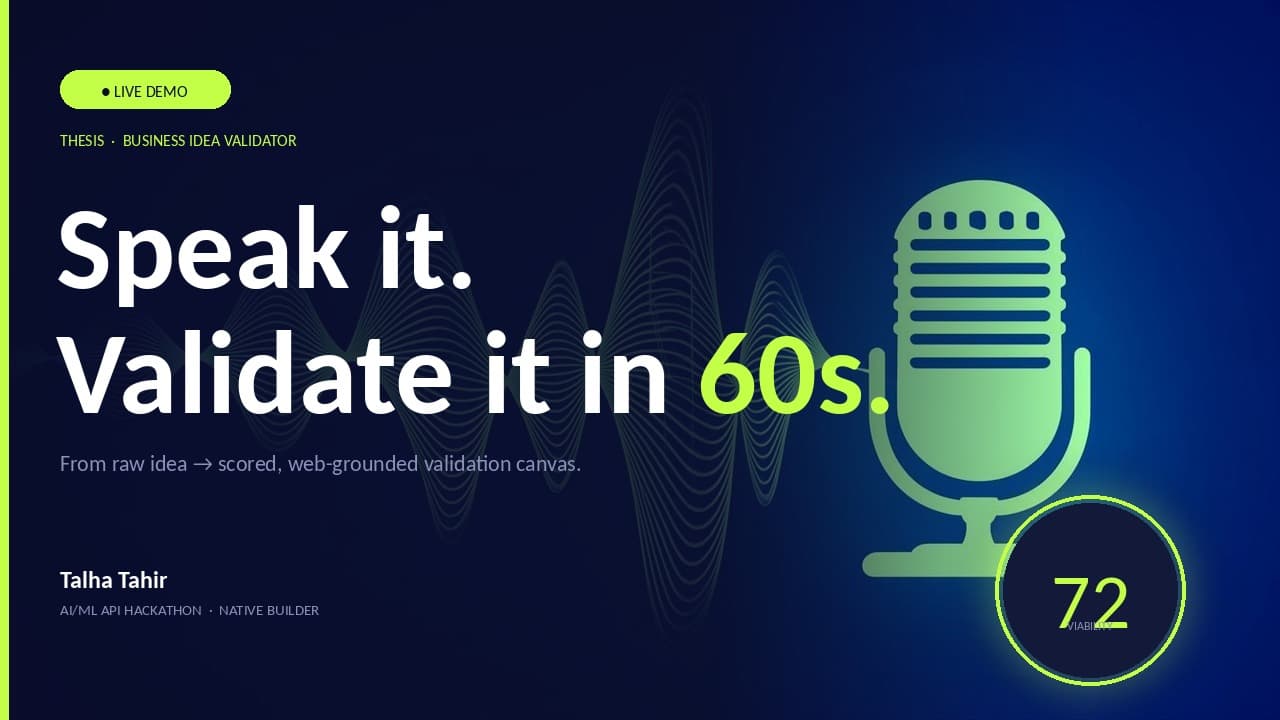
Ninety percent of startups fail — most because the idea was never properly validated. Founders with a raw idea face weeks of manual work: mapping the competitor landscape, surfacing hidden assumptions, and scoping an MVP by hand. Worse, ideas are born as speech; by the time the research is done, the spark is gone. Thesis fixes this. It turns a spoken, raw business idea into a structured, web-grounded validation report in under 60 seconds. Speak your idea, and a single AI orchestration pipeline produces six analysis dimensions — a summary, testable hypotheses, real competitors, critical questions, an MVP scope, and a 1–100 viability score with rationale — all rendered on a shareable, interactive canvas. The pipeline is grounded in four production-grade APIs working together. Speechmatics handles real-time voice transcription, so founders can speak ideas while they're fresh instead of typing them out. Tavily live web search grounds every competitor and market signal in real, citable sources — no hallucinations. The AI/ML API orchestrates the LLM call that produces all six analysis dimensions in a single pass. Supabase handles auth, persistence, and storage, so every canvas is saved and revisit-able. Beyond the initial report, the canvas is interactive: founders can drill into any section with follow-up questions, each answered with a fresh web search where relevant. The result is a tool that collapses weeks of validation work into a minute — and produces a shareable artifact a founder can return to, refine, and act on.