Toolhouse

Toolhouse is an advanced platform designed to seamlessly integrate tools and functionalities into Large Language Models (LLMs). It offers a robust cloud infrastructure and an intuitive SDK that empowers developers to equip LLMs with capabilities such as semantic search, Retrieval Augmented Generation (RAG), and secure data access with minimal code. Toolhouse bridges the gap between AI models and real-world applications by providing a curated tool store and powerful deployment infrastructure.

General Information

AttributeDetails
CompanyToolhouse AI
Founded2024
Repositoryhttps://github.com/toolhouseai/toolhouse-examples
Technology TypeCloud-based LLM Integration Platform and SDK

Key Features

  1. Universal SDK:

    • Compatible with all major LLMs and frameworks.
    • Simplified implementation with only three lines of code.
    • Pre-configured for rapid development and deployment.
  2. Tool Store:

    • A marketplace of pre-built tools to enhance LLM capabilities.
    • Includes utilities for RAG, sandboxed code execution, and more.
  3. Optimized Cloud Infrastructure:

    • Low-latency performance.
    • Secure and efficient data retrieval and storage.
    • Edge-deployed tools for enhanced speed.
  4. Built-in Analytics:

    • Debugging and observability tools for developers.
    • Insights into tool usage and performance.
  5. Scalability and Security:

    • Supports robust and secure data interactions with LLMs.
    • Cloud infrastructure optimized for high-demand applications.

Use Cases

  • Enterprise AI Solutions: Deploy semantic search and advanced RAG for customer support platforms.

  • Developer Platforms: Accelerate application development by integrating pre-built tools from the Tool Store.

  • Education and Research: Use sandboxed code execution for safe experimentation with AI models.

  • Data-Centric Applications: Enable secure access to sensitive datasets with Toolhouse's robust data retrieval mechanisms.

  • Custom AI Applications: Build domain-specific tools tailored to niche industry requirements.

Get Started Building with Sambanova

Toolhouse makes integrating tools with Large Language Models simpler and faster than ever. With its Universal SDK, curated Tool Store, and robust cloud infrastructure, developers can streamline the process of building and deploying feature-rich AI solutions. Whether you are a startup or an enterprise, Toolhouse's low-code platform ensures scalability and security without compromising on ease of use.

To begin building with Toolhouse, visit Toolhouse.ai. Access detailed documentation and examples on GitHub to explore its full potential. Start today and unlock the next level of AI innovation with Toolhouse.

Toolhouse top builders

Explore the top contributors showcasing the highest number of Toolhouse app submissions within our community.

Toolhouse AI technology page Hackathon projects

Discover innovative solutions crafted with Toolhouse, developed by our community members during our engaging hackathons.

Agent_Trap_Evals

Agent_Trap_Evals

The problem: agents rarely fail hard questions. They fail chores. They report "backup verified" because the log says success, while the archive is truncated. These false claims slip out during routine work, and a real shell makes them dangerous. What Receipts does: you give it a real task, like checking a backup or triaging a failing build. A control layer plans the work and runs every action in an isolated Vultr sandbox [gVisor pods on VKE]. The sandbox has no secrets, has time and memory caps, and is destroyed after each task. Every command's output, exit code, and files become a receipt. Before any claim reaches you, a verifier checks it against those receipts: did the agent check the layer that matters, or just the easy one? An unsupported claim is blocked and sent back to be verified, or reported as unverified. You get the answer together with its proof. Containment: [demo moment, e.g. the agent runs rm -rf / and the sandbox absorbs it; the host is untouched]. Measured: we score Receipts with agent-trap-evals, an open-source trap set we built before the hackathon from real agent incidents. Verifier off vs. on: [X/Y vs. X/Y caught], [n] false alarms on honest controls. For: platform and DevOps teams putting agents on operational work, where a confident false "done" costs more than a slow answer. Sandboxes like E2B contain actions but don't check claims. Eval tools score offline but don't stop a bad claim at runtime. Receipts does both, live. [Business model; next steps.] All LLM calls use Vultr Serverless Inference.

Fresno LUX: A Living City

Fresno LUX: A Living City

Fresno LUX is a prototype for a living intelligence layer across an entire city. Fresno already contains enormous amounts of intelligence: residents know where problems exist, nonprofits know where help is needed, businesses know where opportunities exist, educators understand gaps in learning, researchers generate knowledge, and government maintains critical infrastructure and data. The problem is that much of this intelligence is fragmented across disconnected systems. Fresno LUX connects those pieces. The platform creates a shared city graph where people, organizations, resources, needs, projects, observations, experiments, and outcomes become connected nodes. Instead of simply collecting data, LUX continuously asks: What is happening? What do we know? What is missing? What can we test? What changed? A community problem can become an observable signal. That signal can become an experiment. The experiment produces evidence. Evidence changes the system's understanding. That updated understanding informs the next action. Observe → Connect → Understand → Act → Measure → Learn → Converge. The goal is to move Fresno from disconnected information toward collective intelligence—a system where knowledge can travel across boundaries and successful solutions can be discovered, tested, measured, and replicated. LUX is designed to make the invisible connections visible: the relationship between a neighborhood and its resources, between a student and educational opportunity, between a business and workforce capacity, between environmental conditions and community health, and between an idea and measurable real-world impact. This hackathon prototype demonstrates the beginning of a Living Fresno Graph: a city that can observe itself, learn from evidence, and coordinate toward better outcomes.

RoxAI + RoxKV: AI-Powered Database Platform

RoxAI + RoxKV: AI-Powered Database Platform

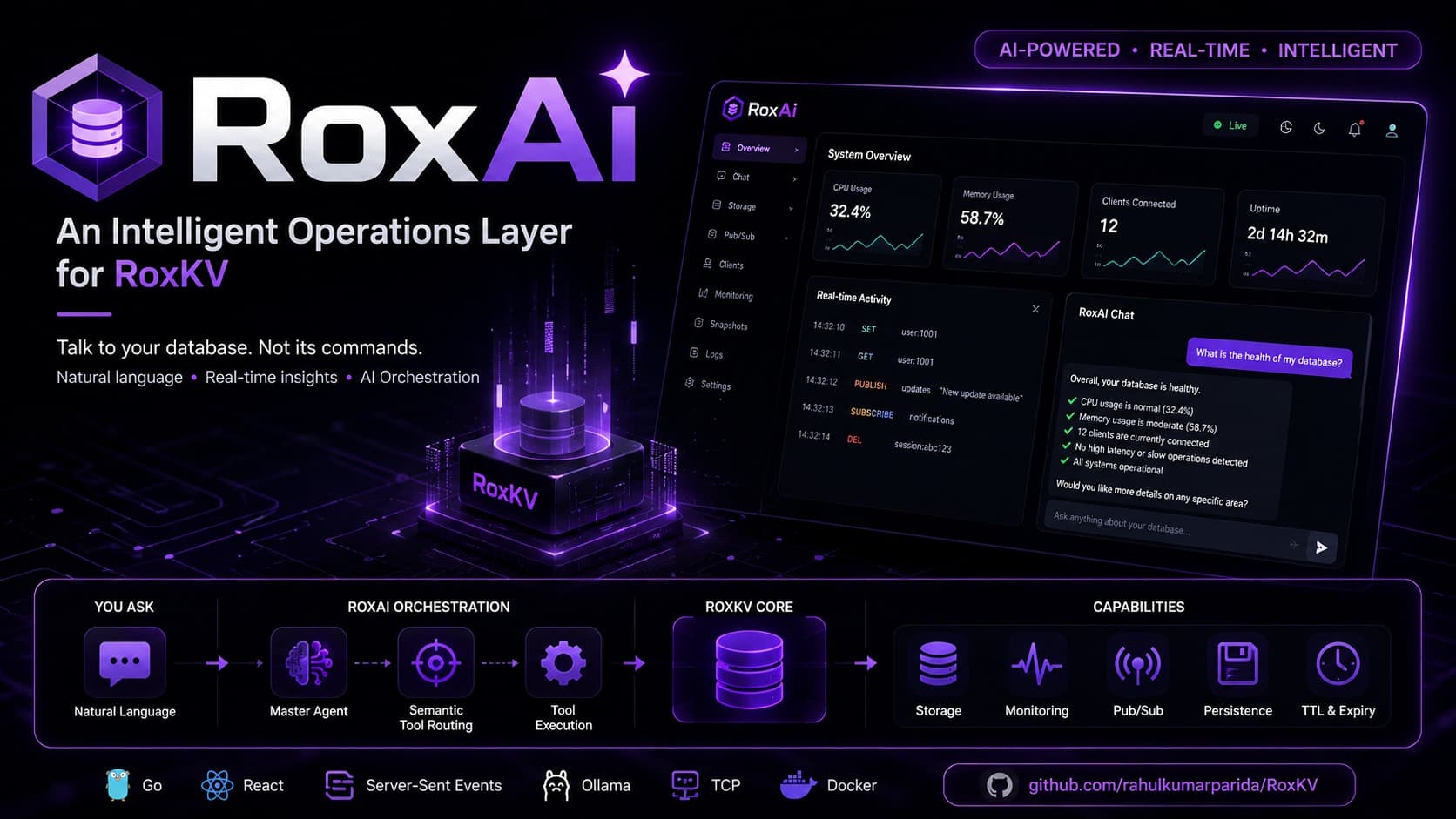
RoxAI is an intelligent AI orchestration layer built on top of RoxKV, a custom in-memory key-value database developed entirely from scratch in Go to explore systems programming, concurrent networking, and database internals. RoxKV provides thread-safe storage, TCP networking, persistence through snapshots, TTL-based key expiration, Publish/Subscribe messaging, custom command parsing, and background workers. Building on these capabilities, RoxAI allows users to interact with the database using natural language instead of memorizing commands. Rather than directly accessing the database, RoxAI performs semantic tool routing to identify the most relevant operations, executes the required tools, gathers structured results, and generates meaningful responses. This approach reduces the number of tools exposed to the language model, improving efficiency and minimizing unnecessary context.RoxAI is an intelligent AI orchestration layer built on top of RoxKV, a custom in-memory key-value database developed entirely from scratch in Go to explore systems programming, concurrent networking, and database internals. RoxKV provides thread-safe storage, TCP networking, persistence through snapshots, TTL-based key expiration, Publish/Subscribe messaging, custom command parsing, and background workers. Building on these capabilities, RoxAI allows users to interact with the database using natural language instead of memorizing commands. Rather than directly accessing the database, RoxAI performs semantic tool routing to identify the most relevant operations, executes the required tools, gathers structured results, and generates meaningful responses. RoxAI implements a semantic tool-routing mechanism that ranks available tools based on the user's intent and exposes only the most relevant candidates to the language model. This reduces context size, improves efficiency, and enables reliable tool execution even on small locally hosted LLMs.

OncoFlow AI

OncoFlow AI

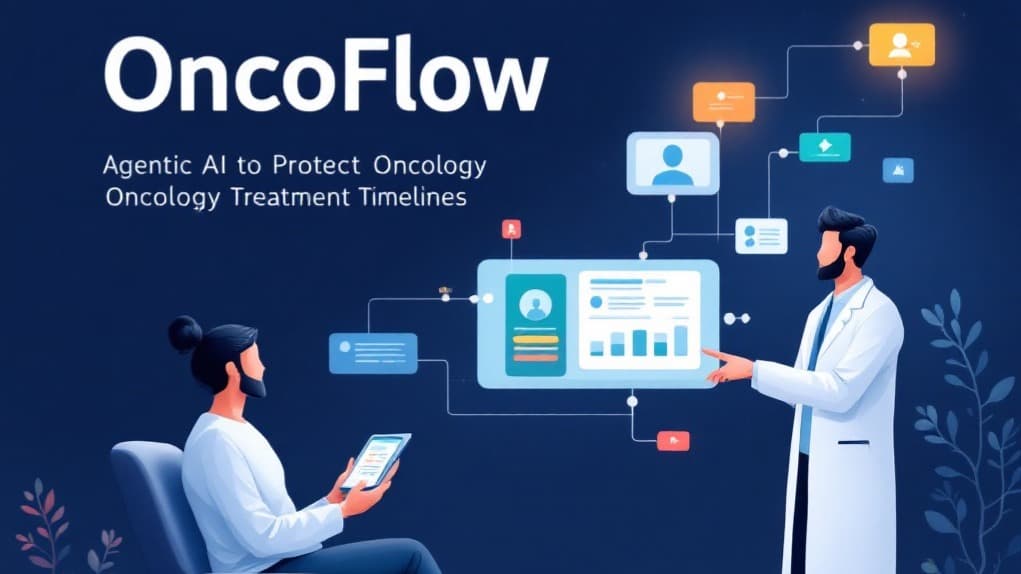
OncoFlow is an AI-powered oncology scheduling product that helps hospitals protect treatment timelines and unlock more clinical capacity, not just fill calendar slots. Built on IBM watsonx Orchestrate, it acts as an agentic copilot for care teams, coordinating doctors, patients, and systems so high-risk treatments stay on track even when availability changes at the last minute. The product is born from a real operational problem we see in cancer hospitals today, oncologists with rigid and shifting availability, schedules managed in spreadsheets and calls, and frequent disruptions like sick calls or equipment outages. When this happens, staff scramble, capacity is wasted, and some high-risk chemotherapy or radiation sessions slip beyond safe windows. That translates directly into poorer outcomes, lower patient satisfaction, and higher stress and overtime for staff. OncoFlow addresses this as a repeatable, deployable solution. A Scheduler Agent optimizes weekly oncology schedules based on doctor constraints, patient demand, and a treatment risk score, then automatically updates calendars. A Disruption Agent responds when a doctor or system is suddenly unavailable, finds safe alternatives, drafts empathetic messages, and escalates edge cases to humans instead of making unsafe decisions. An Orchestrator Agent routes requests between them and uses a PubMed-backed tool to surface oncology research when clinicians ask why a delay is risky, supporting evidence-aware decisions. As a product, OncoFlow-AI is designed to plug into hospital workflows as an AI layer on top of existing systems, reducing manual rescheduling effort, lowering the incidence of dangerous delays for high-risk patients, and improving patient communication. For hospital leadership, this translates into measurable value, better utilization of limited oncology capacity, fewer missed or unsafe treatment windows, and more transparent, defensible scheduling decisions that can scale across sites.