Vectorboard

Vectorboard is an open-source framework for optimizing and evaluating embedding and retrieval-based machine learning models, particularly those built around RAG (Retrieval-Augmented Generation).

RAG is a methodology that enhances machine learning models by combining generative and retrieval-based aspects.

Importance of Good Embeddings Good embeddings are vital for the successful execution of RAG applications. They serve as the basis for retrieving contextually relevant information.

How Vectorboard Helps

Vectorboard simplifies the complex task of optimizing these embeddings by trying different hyperparameters (chunk size, overlap, splitting function, embedding algorithm, etc,) in a structured framework.

In the end, Vectorboard provides you with a Results Dashboard that allows you to compare the performance of different embeddings and hyperparameters, ran on your own data.

General
Relese dateSep, 2023
AuthorVectorboard
Repositoryhttps://github.com/VectorBoard/vectorboard/
TypeEval and Hyperparameter Optimization for embeddings

Vectorboard - Resources

Resources to get stared with Vectorboard:


Vectorboard Libraries

A curated list of libraries and technologies to help you build great projects with Vectorboard.


Vectorboard πŸ’› top builders

Explore the top contributors showcasing the highest number of Vectorboard πŸ’› app submissions within our community.

Vectorboard πŸ’› AI technology page Hackathon projects

Discover innovative solutions crafted with Vectorboard πŸ’›, developed by our community members during our engaging hackathons.

Fresno LUX: A Living City

Fresno LUX: A Living City

Fresno LUX is a prototype for a living intelligence layer across an entire city. Fresno already contains enormous amounts of intelligence: residents know where problems exist, nonprofits know where help is needed, businesses know where opportunities exist, educators understand gaps in learning, researchers generate knowledge, and government maintains critical infrastructure and data. The problem is that much of this intelligence is fragmented across disconnected systems. Fresno LUX connects those pieces. The platform creates a shared city graph where people, organizations, resources, needs, projects, observations, experiments, and outcomes become connected nodes. Instead of simply collecting data, LUX continuously asks: What is happening? What do we know? What is missing? What can we test? What changed? A community problem can become an observable signal. That signal can become an experiment. The experiment produces evidence. Evidence changes the system's understanding. That updated understanding informs the next action. Observe β†’ Connect β†’ Understand β†’ Act β†’ Measure β†’ Learn β†’ Converge. The goal is to move Fresno from disconnected information toward collective intelligenceβ€”a system where knowledge can travel across boundaries and successful solutions can be discovered, tested, measured, and replicated. LUX is designed to make the invisible connections visible: the relationship between a neighborhood and its resources, between a student and educational opportunity, between a business and workforce capacity, between environmental conditions and community health, and between an idea and measurable real-world impact. This hackathon prototype demonstrates the beginning of a Living Fresno Graph: a city that can observe itself, learn from evidence, and coordinate toward better outcomes.

Autonomous Enterprise AI Auditor

Autonomous Enterprise AI Auditor

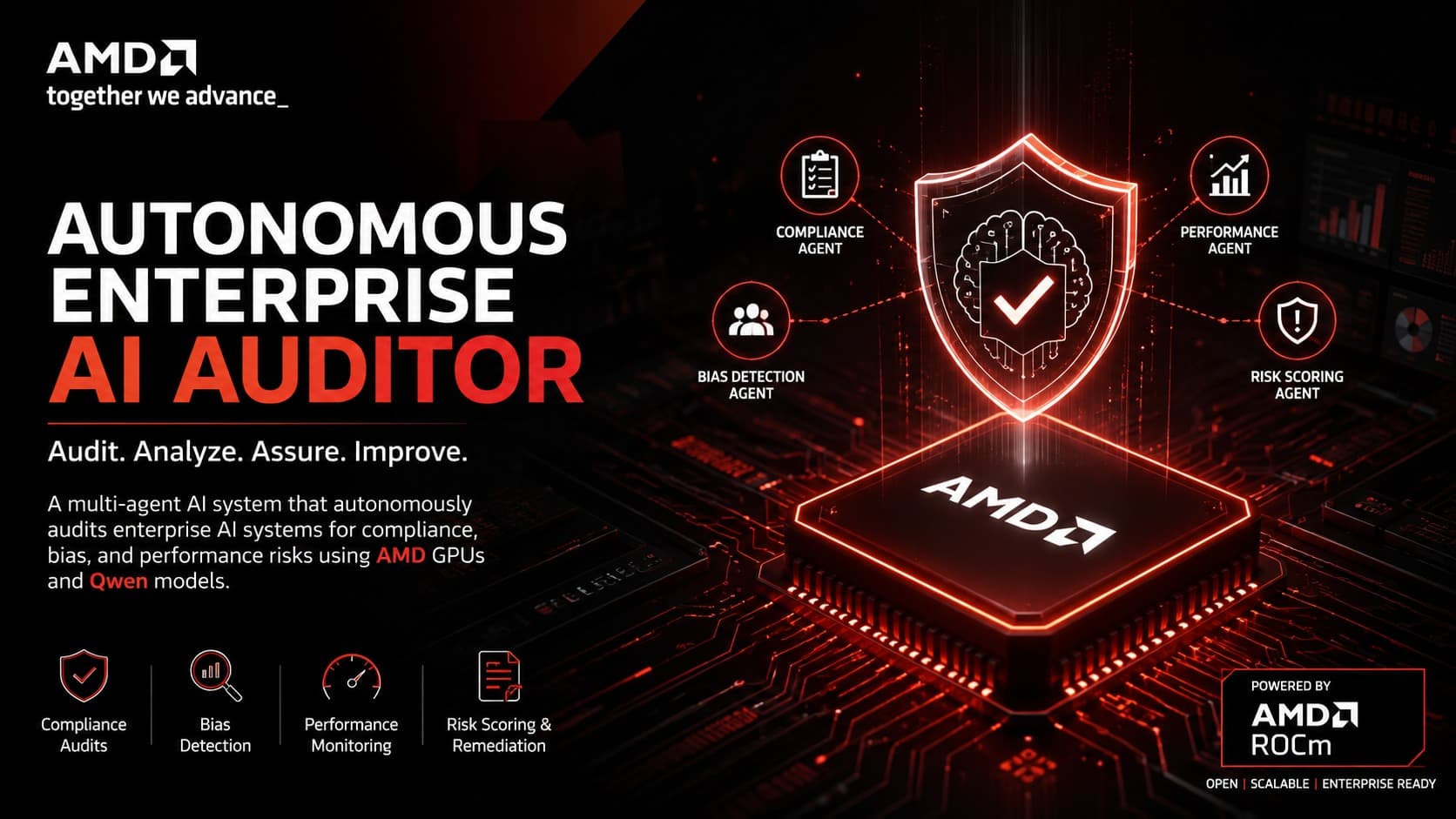
Autonomous Enterprise AI Auditor is a multi-agent AI governance and compliance platform designed to help enterprises automatically audit, monitor, and improve their AI systems in real time. As organizations rapidly adopt generative AI and autonomous agents, enterprises face increasing challenges related to compliance, hallucinations, bias, transparency, security, and operational reliability. Our solution addresses these challenges by providing an intelligent auditing layer powered by advanced AI agents running on AMD GPU infrastructure. The platform uses multiple specialized AI agents working collaboratively to analyze enterprise AI systems from different perspectives. A Compliance Agent evaluates outputs against organizational policies and regulatory requirements. A Bias Detection Agent identifies unfair or potentially harmful responses. A Performance & Reliability Agent measures hallucination risks, consistency, latency, and output quality. A Risk Scoring Agent aggregates findings into a unified enterprise risk score with explainable insights and remediation recommendations. The system is powered by open-source Qwen models accelerated with AMD ROCm and AMD GPU infrastructure, enabling scalable and cost-efficient inference for enterprise workloads. Using AMD Developer Cloud and optimized inference pipelines, the platform delivers real-time auditing capabilities suitable for modern AI-powered applications, customer support systems, enterprise copilots, and internal AI agents. Our goal is to build a trustworthy AI auditing framework that helps enterprises confidently deploy AI systems while improving governance, transparency, and operational safety. By combining multi-agent orchestration, explainable AI analysis, and AMD-accelerated infrastructure, Autonomous Enterprise AI Auditor demonstrates how AI can be used to responsibly monitor and govern other AI systems at scale.

Autopsy investigates why companies fail

Autopsy investigates why companies fail

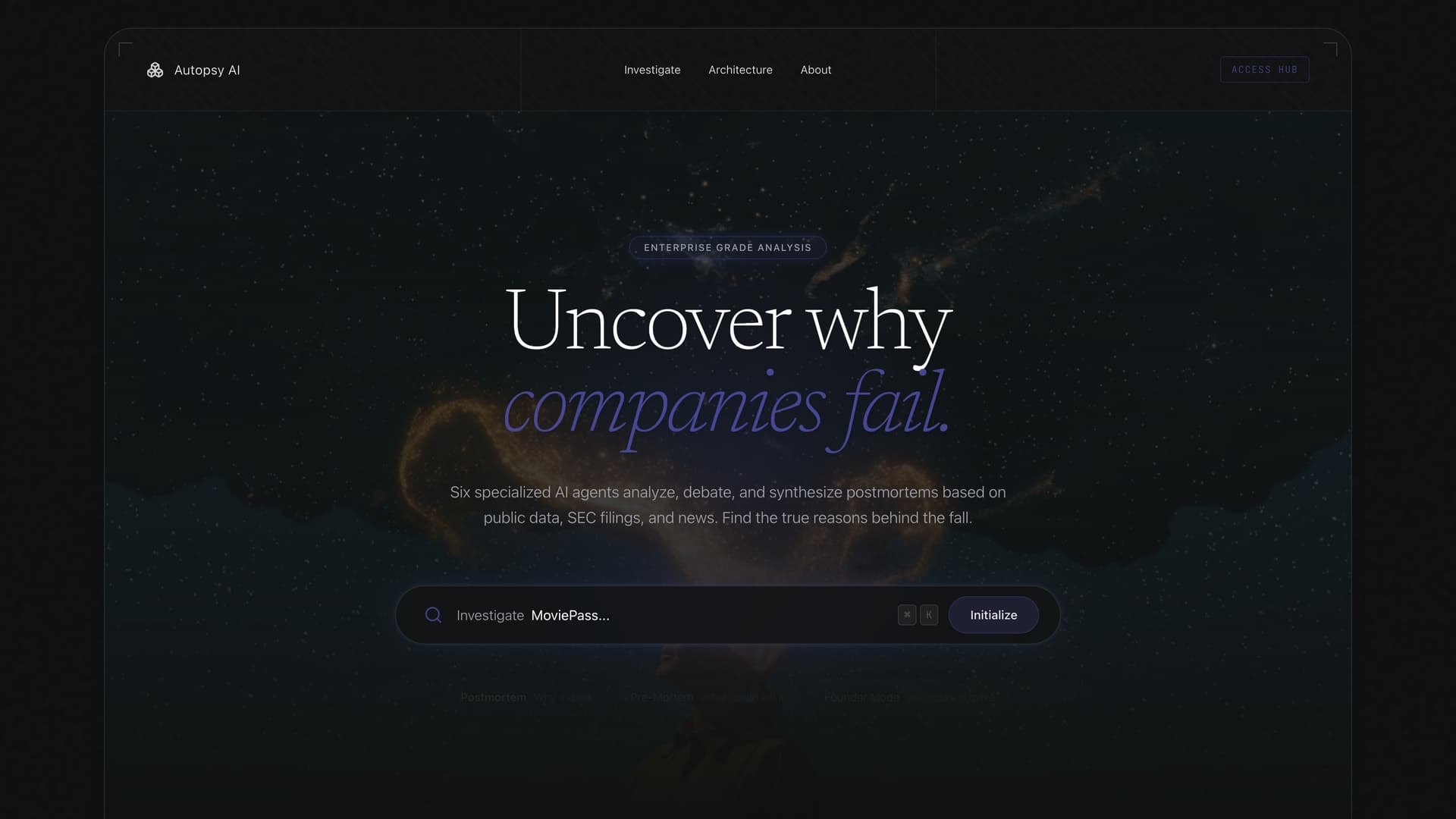
What it is Autopsy investigates why companies fail β€” and what could have saved them. Six specialized AI agents per mode research in parallel, debate each other's findings, and produce a forensic verdict in ~22 seconds. Four modes: Postmortem β€” investigate why a company failed Pre-Mortem β€” predict what could kill a living company Founder Mode β€” analyze your own startup before it fails Counterfactual β€” explore alternate histories: "What if they made a different decision?" Counterfactual Mode The 4th mode asks: What if [company] had made a different decision? Six counterfactual agents reason about what didn't happen: CF Market Analyst β€” skeptical about internal decisions changing external market realities CF Operator β€” assesses whether the alternate decision could actually be executed CF Money Trail β€” models the financial impact of the alternate path CF Customer Voice β€” evaluates whether users would have responded differently CF Engineer β€” honest about technical complexity vs. leadership beliefs CF Historian β€” finds real precedents (requires 2+ historical cases as evidence) Each agent must: understand the actual causal chain, identify the decision point, model the alternate chain, find real precedents, and assess second-order consequences (butterfly effects). The synthesizer renders one of five verdicts: would have survived, would have delayed failure, would have failed differently, would have made no difference, or could have transformed the company. Preset scenarios: Blockbuster/Netflix, Kodak/Digital, Yahoo/Google, Quibi/TV, Theranos/Real Science, MySpace/Better Tech.