Webots

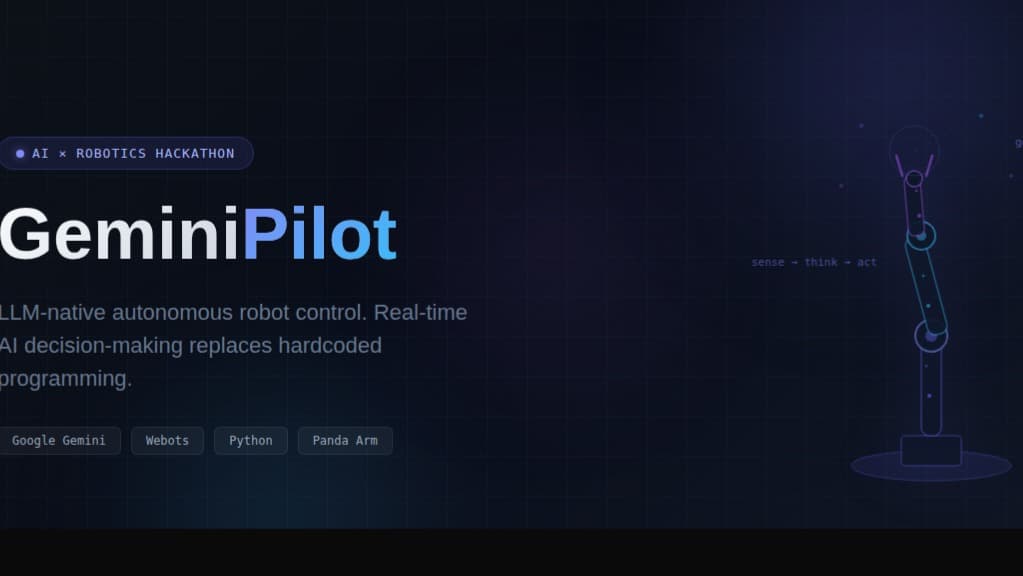
Webots is a professional, open-source 3D robot simulator that offers a comprehensive development environment for modeling, programming, and simulating robots. It is widely used for AI-driven control testing, allowing researchers and developers to design and evaluate robotic systems in a realistic virtual setting before deploying them in the physical world.

General
AuthorCyberbotics Ltd.
Release Date1998
Websitehttps://cyberbotics.com/
Documentationhttps://cyberbotics.com/doc/guide/index
Repositoryhttps://github.com/cyberbotics/webots
Technology Type3D robot simulator

Key Features

  • Realistic 3D Simulation: Provides accurate physics and rendering for a wide range of robot models and environments.
  • Robot Modeling: Tools for designing and importing various robot types, sensors, and actuators.
  • Programming Interface: Supports multiple programming languages (C/C++, Python, Java, MATLAB, etc.) for controlling robots.
  • AI Integration: Ideal for testing AI algorithms, machine learning, and neural networks in robotic control.
  • Open-Source: Freely available for research and development, fostering community contributions.
  • Cross-Platform: Runs on Windows, Linux, and macOS.

Start Building with Webots

Webots is an essential tool for anyone working on robotics and AI. Its ability to simulate complex robotic systems in a controlled environment allows for rapid prototyping, testing, and iteration of AI control algorithms. Explore the user guide and GitHub repository to get started with modeling your own robots and implementing AI-driven control strategies.

👉 Webots User Guide 👉 Webots GitHub Repository

WEBOTS AI Technologies top builders

Explore the top contributors showcasing the highest number of WEBOTS AI Technologies app submissions within our community.

WEBOTS AI Technologies Hackathon projects

Discover innovative solutions crafted with WEBOTS AI Technologies, developed by our community members during our engaging hackathons.

Flowback: AI-Powered Work-Context Recovery System

Flowback: AI-Powered Work-Context Recovery System

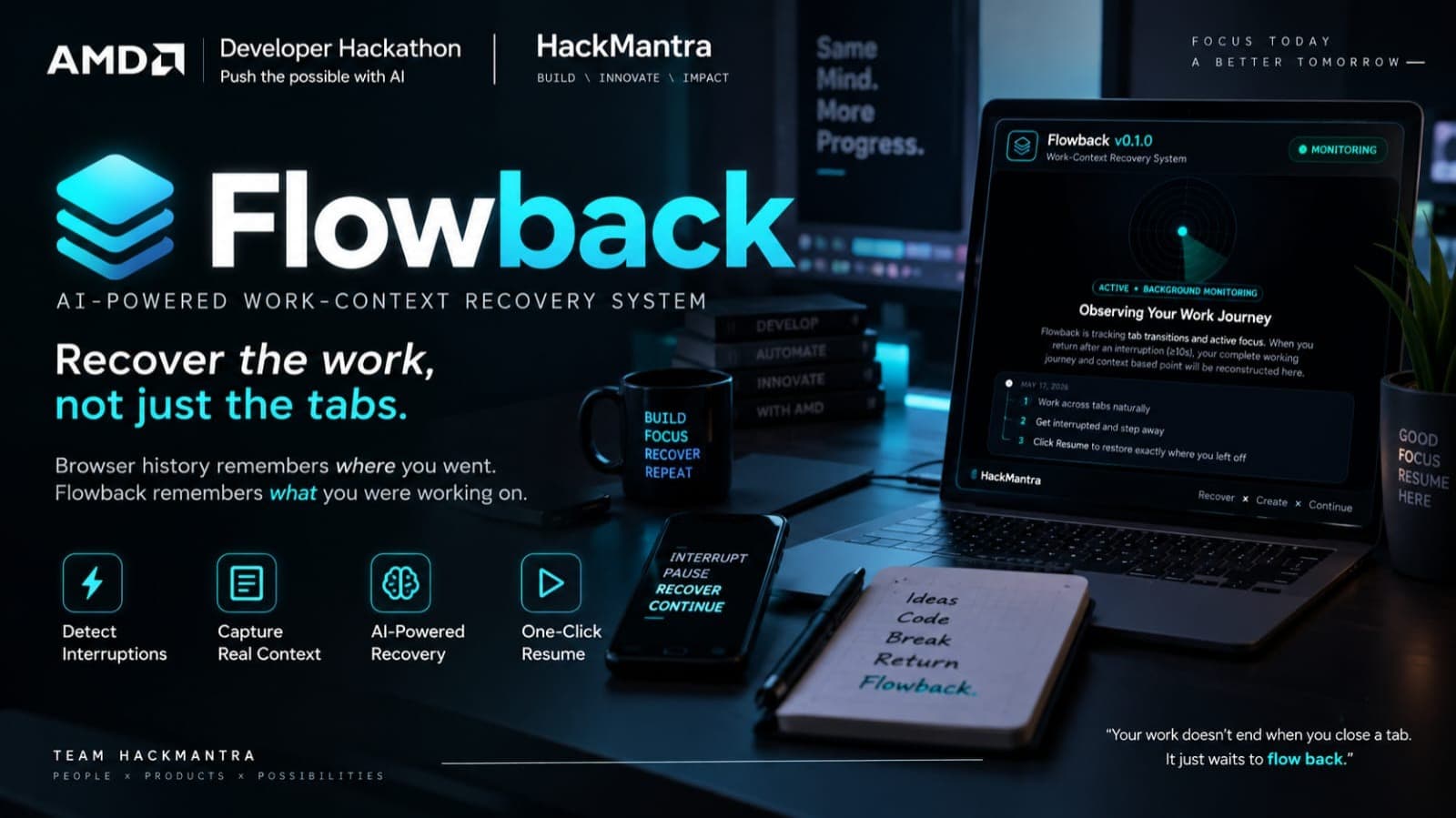
Flowback is an AI-powered Work-Context Recovery System built by HackMantra to solve a problem that traditional browser history does not address: losing the mental context of work after an interruption. Modern work is fragmented across documentation, code, research, AI tools, GitHub, and communication tabs. When an interruption happens, users often remember the website they were on but not what they were doing, what they already tried, where they stopped, or what they should do next. Flowback observes meaningful browser context and detects interruptions, then reconstructs a structured recovery capsule containing what the user was working on, what they tried or referenced, where they left off, and a recommended next step. The user can resume the original tab and scroll position with one action. The current MVP is a Chrome Manifest V3 extension with background monitoring, context extraction, deterministic recovery logic, a recovery UI, resume functionality, and optional AI enhancement. AI is treated as an enhancement rather than a single point of failure, with deterministic fallback when AI or backend services are unavailable. Our architecture is designed for accelerated AI inference and future deployment on AMD infrastructure. During the hackathon, HackMantra aims to experiment with AMD GPU acceleration, optimized local/hosted inference, and benchmarking to determine where AMD compute provides the greatest benefit to Flowback's recovery intelligence. Flowback's long-term direction is to evolve from browser recovery into cross-device work continuity, helping users preserve work context across desktop and mobile environments. Team: HackMantra.

Fresno LUX: A Living City

Fresno LUX: A Living City

Fresno LUX is a prototype for a living intelligence layer across an entire city. Fresno already contains enormous amounts of intelligence: residents know where problems exist, nonprofits know where help is needed, businesses know where opportunities exist, educators understand gaps in learning, researchers generate knowledge, and government maintains critical infrastructure and data. The problem is that much of this intelligence is fragmented across disconnected systems. Fresno LUX connects those pieces. The platform creates a shared city graph where people, organizations, resources, needs, projects, observations, experiments, and outcomes become connected nodes. Instead of simply collecting data, LUX continuously asks: What is happening? What do we know? What is missing? What can we test? What changed? A community problem can become an observable signal. That signal can become an experiment. The experiment produces evidence. Evidence changes the system's understanding. That updated understanding informs the next action. Observe → Connect → Understand → Act → Measure → Learn → Converge. The goal is to move Fresno from disconnected information toward collective intelligence—a system where knowledge can travel across boundaries and successful solutions can be discovered, tested, measured, and replicated. LUX is designed to make the invisible connections visible: the relationship between a neighborhood and its resources, between a student and educational opportunity, between a business and workforce capacity, between environmental conditions and community health, and between an idea and measurable real-world impact. This hackathon prototype demonstrates the beginning of a Living Fresno Graph: a city that can observe itself, learn from evidence, and coordinate toward better outcomes.

RescueOrch - Orchestration platform for simulation

RescueOrch - Orchestration platform for simulation

RescuOrch integrates Webots R2025a simulation with DJI Mavic 2 Pro drones, TIAGo++ ground robots and the Gemini 3 Flash LLM to orchestrate multi‑agent rescue operations. Its current demo tackles a kitchen fire, but the same platform can simulate active‑shooter drills, FEMA‑style flood recovery, massive fires in dense areas like Mumbai’s Dharavi, pipeline or oil‑rig accidents and high‑magnitude earthquakes. Gemini produces real‑time plans, so drones scout hazards, ground robots execute tasks and the plan adjusts as conditions change. These simulations address real gaps: U.S. fire‑response times average 6–8 minutes in cities and exceed 10 minutes in rural areas; Mumbai’s fire brigade reports response times of ~10 minutes in the city and 20 minutes in suburbs. Globally, over 180,000 people die from burn injuries each year and 86,473 people died in disasters in 2023. Last year 89 U.S. firefighters died on duty, underscoring the dangers responders face. After earthquakes, survival drops from about 90 % in the first day to 5–10 % after 72 hours, so rapid coordination saves lives. By running “what‑if” scenarios—larger or multi‑room fires, stronger earthquakes or multiple hazards—RescuOrch helps agencies test strategies and decide if additional drones or rugged robots would improve outcomes. With 27,000 U.S. fire departments and 23 oil refineries in India, there is a broad user base for physics‑based simulation training. In short, RescuOrch offers a versatile AI‑driven testbed to help responders plan, train and procure the right equipment for complex emergencies.