01.AI's Yi Series Large Language Models

Engineered from scratch by 01.AI developers, the Yi series models stand as a testament to cutting-edge language understanding and processing capabilities.

General
Author01.AI
Repositoryhttps://github.com/01-ai/Yi
TypeLarge Language Models

Yi LLMs Overview

Developers can leverage two standout models within the Yi series, each offering distinct capabilities in language processing:

Yi-34B

This model flaunts exceptional performance across various evaluations such as MMLU and comprehensive LLM assessments. It outperforms larger counterparts like LLaMA2-70B and Falcon-180B while remaining cost-effective for diverse applications.

Yi-6B

With robust language processing abilities, the Yi-6B model plays a crucial role in innovative projects and diverse applications.

Opportunities

01.AI's Yi series models are engineered to cater to developers' needs, offering advanced language processing capabilities for varied applications.


01.AI, founded by AI luminary Kai-Fu Lee, introduces the Yi-34B and Yi-6B models, surpassing performance benchmarks and setting new standards in language understanding.

Reports highlight the Yi series' superior performance compared to larger pre-trained LLMs across benchmarks like common reasoning, reading comprehension, and MMLU. This exceptional performance, combined with cost-effectiveness, positions the Yi series as an optimal choice for diverse use cases.

01.AI aims to democratize AI innovation, providing open access for academic research while requiring permissions for free commercial use. As 01.AI continues to redefine language understanding, the Yi series models serve as a beacon of advancement in the AI landscape.

Yi LLMs Tutorials


Yi LLMs Resources


Yi-LLMS top builders

Explore the top contributors showcasing the highest number of Yi-LLMS app submissions within our community.

Yi-LLMS AI technology page Hackathon projects

Discover innovative solutions crafted with Yi-LLMS, developed by our community members during our engaging hackathons.

Ego-Driven Code Refactorer

Ego-Driven Code Refactorer

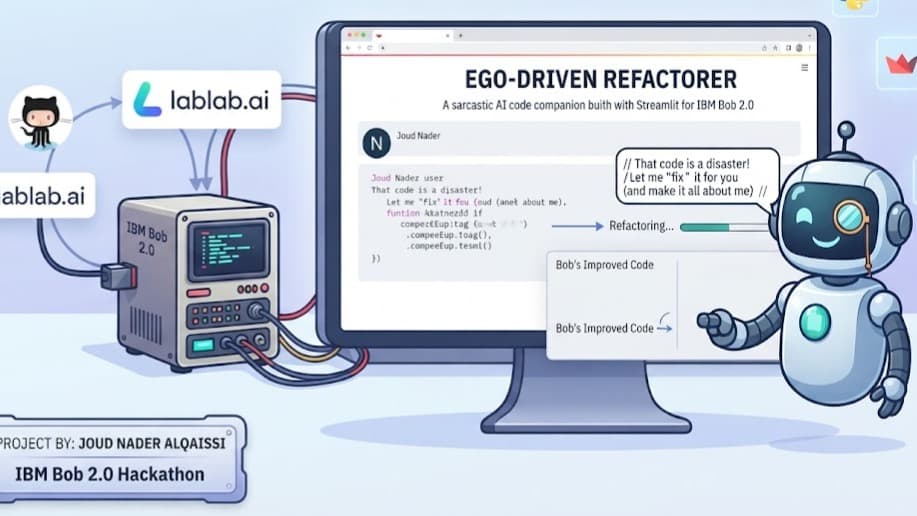
The Problem: Developers often write messy, unmaintainable, and chaotic code under intense deadlines. Traditional linters, formatters, and standard AI coding assistants are overly polite, dry, and lack personality when pointing out code smells, poor variable naming, and architectural anti-patterns, failing to truly engage the programmer. The Solution: Ego-Driven Code Refactorer transforms mundane code reviews into an entertaining, highly motivating, and ego-crushing experience. Built using Python and Streamlit, the application leverages IBM Bob 2.0 to analyze user-submitted code snippets, detect poor practices, and rewrite them into clean, production-ready code while delivering sharp, dramatic, and sarcastic commentary targeted directly at the developer's pride. Target Users & Interaction: The target users include frontend developers, software engineers, and programming students. Users interact with the application through an intuitive Streamlit web interface by pasting their problematic code snippets, choosing a sarcasm level, and receiving both an optimized code block and a witty critique. Creativity & Uniqueness: Unlike conventional code formatters that simply correct syntax, this project merges high-end AI code analysis with psychological gamification and humor. It turns code refactoring into an addictive, memorable, and enjoyable learning process that bridges technical precision with entertainment. Efficiency & Impact: By providing instant automated fixes alongside humorous feedback, it saves debugging time while ensuring code maintainability and best practices are met efficiently.

DevFlow AI

DevFlow AI

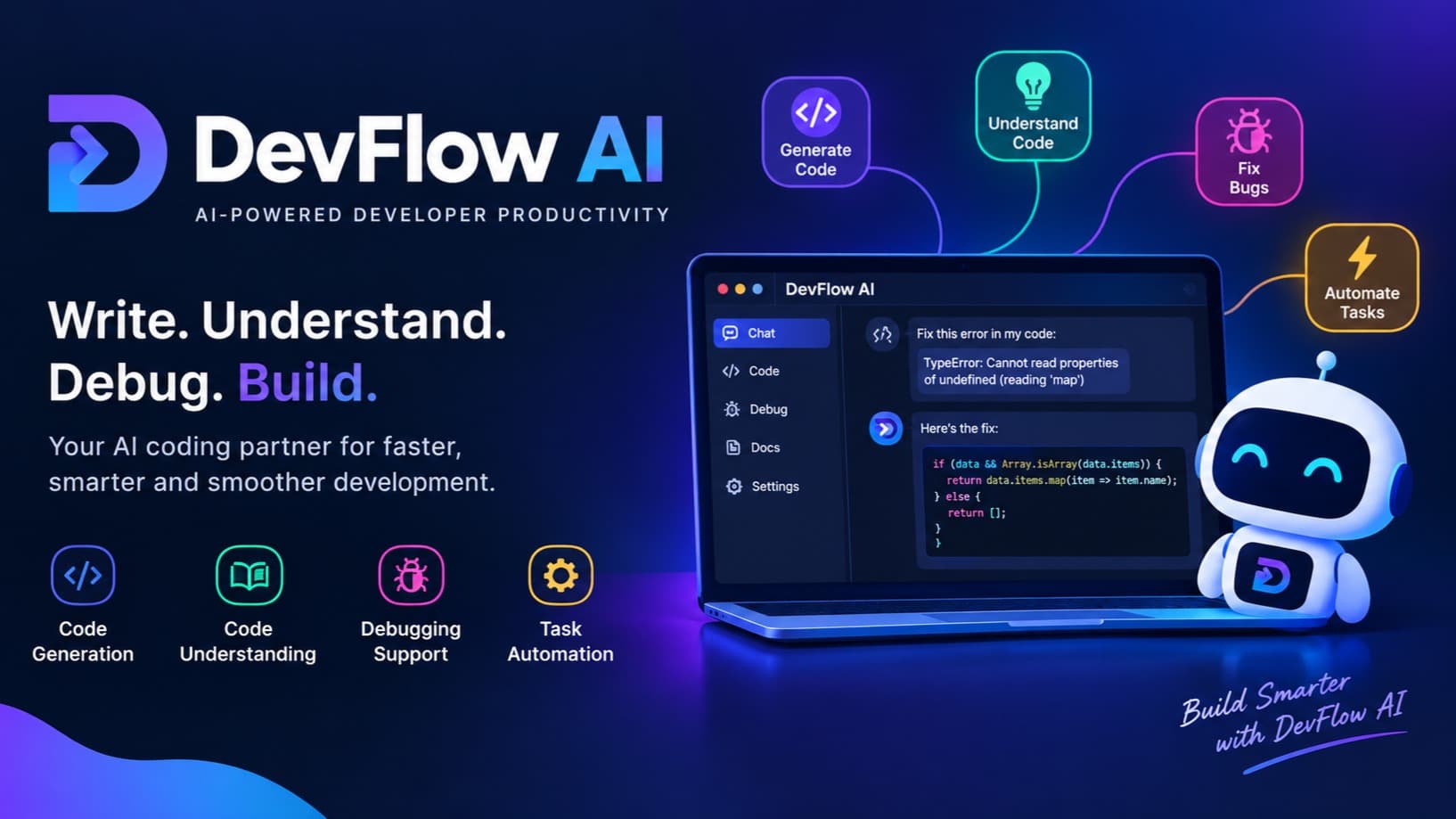
DevFlow AI is an AI-powered developer productivity platform designed to help developers spend less time on repetitive development tasks and more time solving meaningful problems. Problem: Developers often spend significant time understanding unfamiliar code, debugging errors, writing repetitive code, creating documentation, and performing routine development tasks. These activities can slow development, increase the chance of mistakes, and make it harder for developers to maintain productivity, especially when working on larger or unfamiliar projects. Solution: DevFlow AI provides an intelligent workspace that assists developers throughout their development workflow. Developers can use the platform to understand code, generate and improve code, identify and troubleshoot errors, and receive AI-assisted guidance while working on software projects. By bringing these capabilities into one developer-focused workflow, DevFlow AI reduces repetitive manual effort and helps developers move from a problem to a working solution more efficiently. Target Users: The primary users are software developers, students learning programming, individual developers, and development teams who want to improve their everyday coding workflow. How Users Interact: A developer can use DevFlow AI by providing a coding task, describing a problem, asking for an explanation, or requesting help with implementation and debugging. The system analyzes the developer's request and provides useful AI-assisted output that can be reviewed and applied to the project. Creativity and Uniqueness: DevFlow AI focuses on developer productivity rather than being only a general-purpose chatbot. Its purpose is to support multiple stages of the software development workflow in a single environment, helping developers understand, create, debug, and improve software. Impact: By reducing repetitive work and providing contextual AI assistance, DevFlow AI can help developers save time, reduce manual effort, improve consistency, and focus more on designing and building useful software. The project demonstrates how AI-assisted development can be integrated into practical developer workflows.

AIForge — Autonomous AI Engineering Workspace

AIForge — Autonomous AI Engineering Workspace

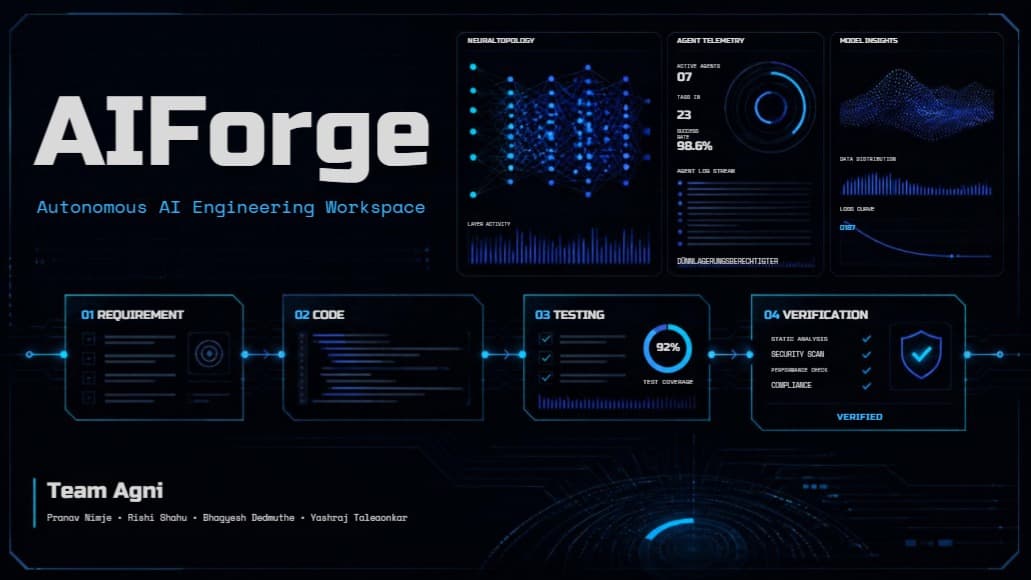
Software development involves much more than generating code. Developers need to understand requirements, plan the implementation, work across multiple files, run tests, debug failures, verify security, and prepare the final application for deployment. Managing all of these steps manually can be slow and repetitive, especially for students, small teams, and developers working on rapidly changing projects. AIForge is our attempt to bring this complete workflow into one engineering workspace. Instead of asking an AI only for a piece of code, users can give AIForge a complete software requirement in natural language. The autonomous engineering agent first understands the requirement and existing project context, identifies relevant files, creates an implementation plan, and then executes the changes across the project. It can run tests, detect failures, perform bounded automated repairs, and repeat verification before considering the task complete. The platform also includes project generation, existing-project modification, security and secret scanning, application startup verification, API verification, ZIP packaging, and independent artifact verification. This means the goal is not simply to produce code, but to produce a project that has actually gone through an engineering validation process. AIForge also provides a multi-LLM architecture. Gemini is supported alongside OpenAI and Anthropic Claude, allowing users to configure and switch AI providers instead of being permanently dependent on a single model. API credentials are handled through secure configuration and are not exposed to generated projects or frontend responses. Beyond software generation, AIForge includes a Dataset & ML workspace for inspecting datasets, training machine-learning models, evaluating metrics such as accuracy, precision, recall and F1 score, and experimenting through an inference playground. A technical Report Intelligence workspace turns the development run into a structured report containing architecture, process telemetry, testing, repair activity, security checks, and artifact information. Our target users are developers, students, researchers, startups, and engineering teams who want to move from an idea to a validated software project faster while keeping visibility into what the AI is actually doing. What makes AIForge different is the focus on the complete engineering loop rather than code generation alone: Requirement → Understanding → Planning → Implementation → Testing → Repair → Security → Verification → Packaging → Report We designed the interface as a scientific/cyberpunk engineering workspace so that users can see the AI agent's progress, project files, test results, provider status, ML experiments, and verification information instead of treating AI development as a black box.

TestFlow AI

TestFlow AI

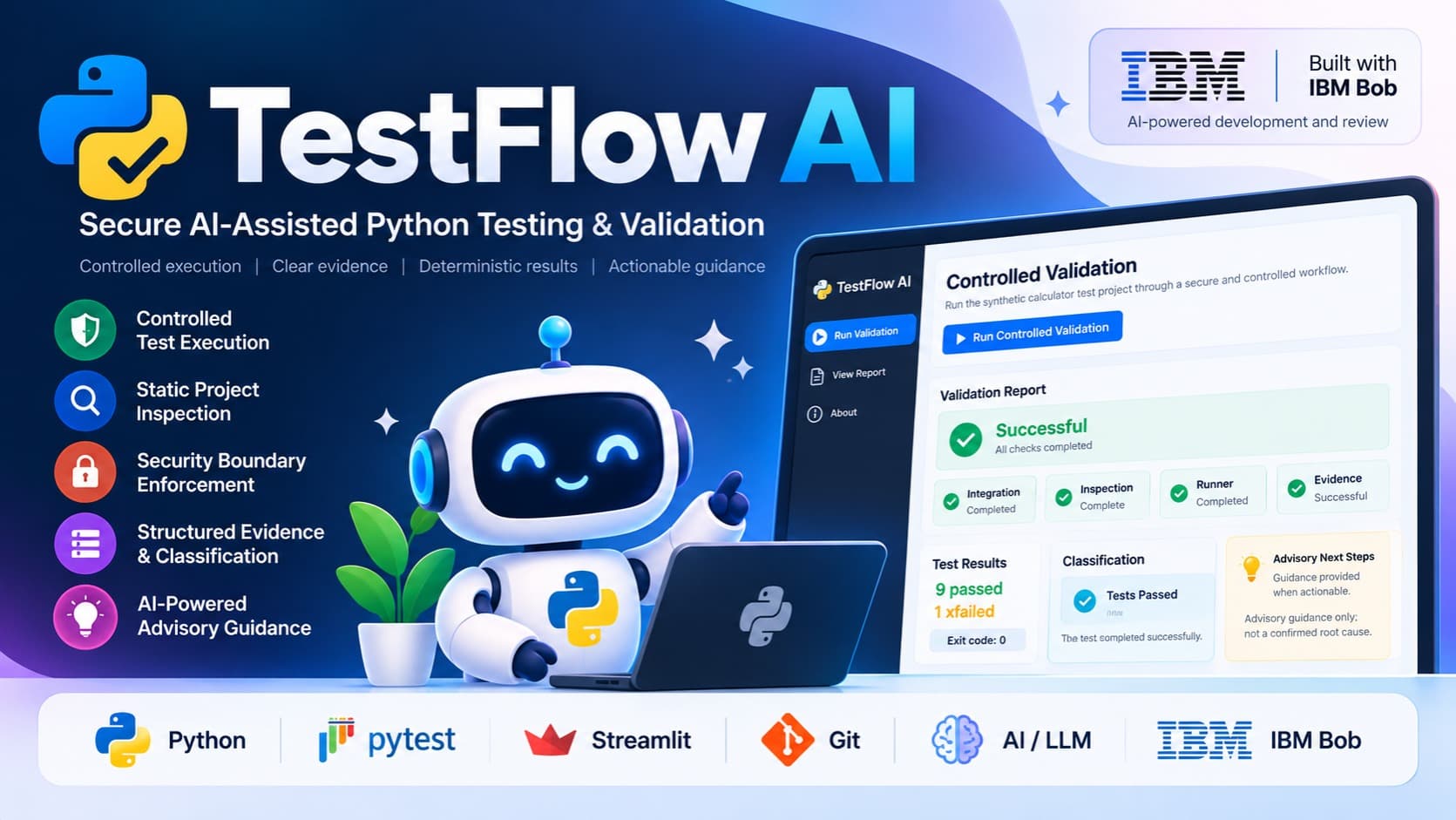
TestFlow AI is a secure, controlled Python testing and validation assistant designed to make software testing safer, clearer, and easier to understand. The project focuses on executing a predefined synthetic calculator test project through a controlled pytest workflow rather than exposing arbitrary command execution or unrestricted project paths. The system validates the project boundary before execution, performs static inspection without executing inspected code, applies security checks such as path containment and symlink restrictions, controls the execution environment, enforces timeouts, and bounds captured output. Test execution results are then normalized into structured evidence and deterministically classified into meaningful validation states. A Streamlit interface provides a simple workflow for running the controlled validation, viewing the resulting evidence and classification, and receiving advisory next steps when the evidence indicates an actionable problem. Advisory guidance is intentionally separated from the test evidence and does not claim a confirmed root cause. The project is built with Python and pytest and includes automated regression and security-boundary tests covering the core execution, evidence, reporting, integration, and interface behavior. The demonstration uses synthetic calculator-project data and is designed to show how a testing assistant can combine safety controls, deterministic evidence handling, and understandable validation results.

ScamLens – AI Digital Safety Copilot

ScamLens – AI Digital Safety Copilot

Problem: Digital scams are becoming increasingly convincing, using urgency, impersonation, fake offers, suspicious links, payment requests, and social engineering to pressure people into making quick decisions. Many users can recognize obvious scams but struggle to determine whether a realistic-looking message, job offer, payment request, QR code, or website is trustworthy. Existing approaches often reduce the problem to a simple “scam/not scam” classification, which does not teach users what to look for or what to do next. Solution: ScamLens is an AI-powered “second pair of eyes” for everyday digital interactions. Users can paste a message, upload a screenshot, check a link, or provide other suspicious digital content. ScamLens analyzes the content for multiple risk signals such as urgency, impersonation, suspicious domains, credential requests, payment requests, emotional pressure, unrealistic offers, and unusual instructions. Instead of simply declaring something a scam, ScamLens provides an understandable risk assessment and explains exactly why specific signals were detected. It then provides three practical steps: STOP – what the user should avoid doing; VERIFY – how the claim can be independently checked; and PROTECT – the safest next action. Example: If a user receives a message claiming that their bank account will be blocked unless they click a link, ScamLens can identify urgency, potential impersonation, suspicious-domain characteristics, and credential requests. It can then recommend accessing the bank through its official application or independently verified contact channel instead of following the message's link. Target Users: ScamLens is designed for everyday digital users, including students, working professionals, parents, senior citizens, online shoppers, and people who may not have cybersecurity expertise. Multilingual explanations can make the system more accessible to users who are more comfortable in regional languages. Innovation: ScamLens focuses on explainable protection rather than black-box classification. Its core experience is “Give this a Second Look”: analyze the content, identify warning signals, explain them in simple language, and provide safe verification steps. This turns AI from a passive answer generator into a proactive decision-support layer for everyday digital safety. Efficiency: The prototype is designed around a focused pipeline: input capture, text/image understanding, risk-signal extraction, AI reasoning, explainable assessment, and recommended safety actions. The modular architecture allows future expansion into real-time browser protection, email analysis, QR-code analysis, voice-call transcription, and multilingual assistance. ScamLens does not claim that an AI assessment is definitive proof of fraud. Instead, it helps users recognize potential warning signs and encourages independent verification before sensitive actions such as clicking, paying, sharing credentials, or transferring money.