YOLOv6

YOLOv6 has a series of models for various industrial scenarios, including N/T/S/M/L, which the architectures vary considering the model size for better accuracy-speed trade-off. And some Bag-of-freebies methods are introduced to further improve the performance, such as self-distillation and more training epochs. For industrial deployment, we adopt QAT with channel-wise distillation and graph optimization to pursue extreme performance. YOLOv6-N hits 35.9% AP on COCO dataset with 1234 FPS on T4. YOLOv6-S strikes 43.5% AP with 495 FPS, and the quantized YOLOv6-S model achieves 43.3% AP at a accelerated speed of 869 FPS on T4. YOLOv6-T/M/L also have excellent performance, which show higher accuracy than other detectors with the similar inference speed.

General
Relese dateJune, 2022
AuthorYOLO
Repositoryhttps://github.com/meituan/YOLOv6
TypeReal time object detection

Libraries

Discover YOLOv6

  • YOLOv6 Web demo Gradio demo for YOLOv6 for object detection on videos. To use it, simply upload your video or click one of the examples to load them. Read more at the links below.
  • YOLOv6 NCNN Android app demo This is a sample ncnn android project, it depends on ncnn library and opencv

YOLOv6 top builders

Explore the top contributors showcasing the highest number of YOLOv6 app submissions within our community.

YOLO YOLOv6 AI technology Hackathon projects

Discover innovative solutions crafted with YOLOv6, developed by our community members during our engaging hackathons.

Fresno LUX: A Living City

Fresno LUX: A Living City

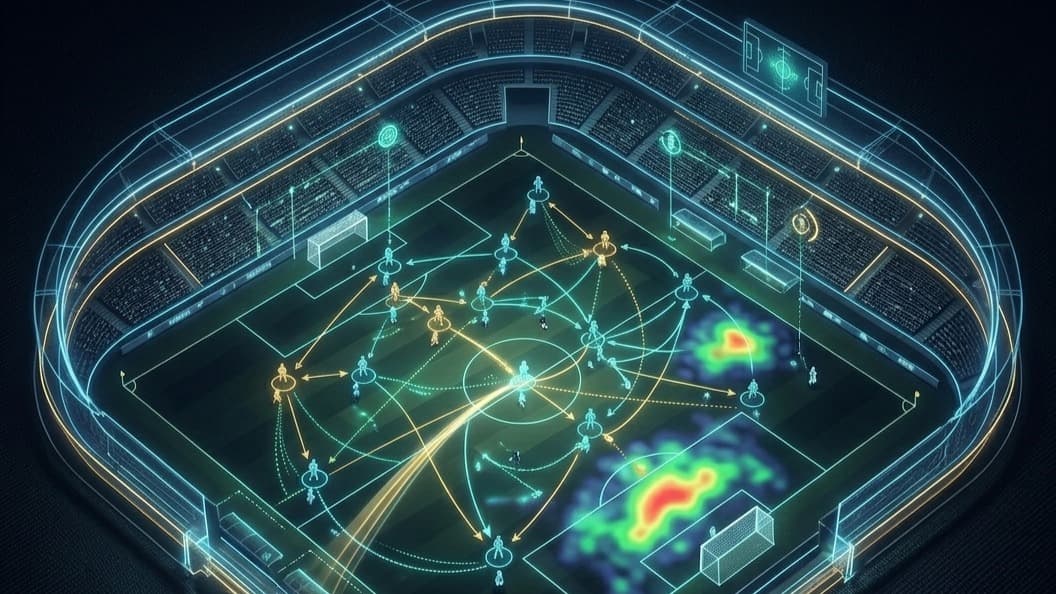
Fresno LUX is a prototype for a living intelligence layer across an entire city. Fresno already contains enormous amounts of intelligence: residents know where problems exist, nonprofits know where help is needed, businesses know where opportunities exist, educators understand gaps in learning, researchers generate knowledge, and government maintains critical infrastructure and data. The problem is that much of this intelligence is fragmented across disconnected systems. Fresno LUX connects those pieces. The platform creates a shared city graph where people, organizations, resources, needs, projects, observations, experiments, and outcomes become connected nodes. Instead of simply collecting data, LUX continuously asks: What is happening? What do we know? What is missing? What can we test? What changed? A community problem can become an observable signal. That signal can become an experiment. The experiment produces evidence. Evidence changes the system's understanding. That updated understanding informs the next action. Observe → Connect → Understand → Act → Measure → Learn → Converge. The goal is to move Fresno from disconnected information toward collective intelligence—a system where knowledge can travel across boundaries and successful solutions can be discovered, tested, measured, and replicated. LUX is designed to make the invisible connections visible: the relationship between a neighborhood and its resources, between a student and educational opportunity, between a business and workforce capacity, between environmental conditions and community health, and between an idea and measurable real-world impact. This hackathon prototype demonstrates the beginning of a Living Fresno Graph: a city that can observe itself, learn from evidence, and coordinate toward better outcomes.

NikaAI — AI Quality Copilot for MSME Manufacturing

NikaAI — AI Quality Copilot for MSME Manufacturing

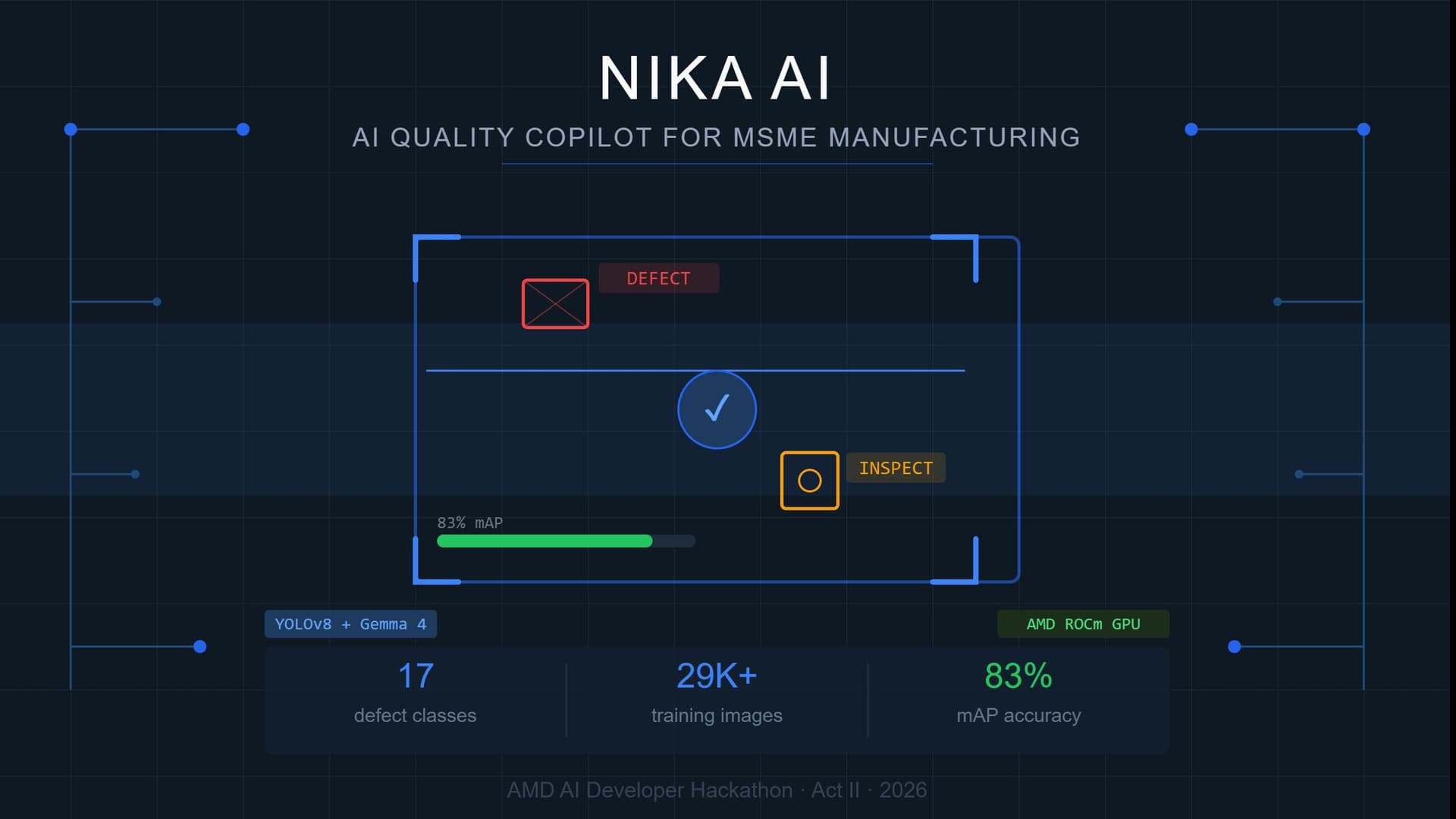
Manufacturing defects cost the global economy $2.9 trillion annually. Enterprise vision systems cost $40,000–$200,000 — completely out of reach for the 63 million MSMEs in India alone that employ over 110 million people. Nika AI solves this by turning a smartphone into a full-stack AI quality control station. Any factory worker can capture or upload an image and instantly receive a defect analysis powered by a YOLOv8s model trained on 29,354 real industrial images across 7 merged datasets, achieving 83% mAP across 17 defect classes. What makes Nika AI genuinely different is the Hallucination Shield — Monte Carlo Dropout uncertainty quantification running 30 stochastic forward passes, classifying AI confidence as High / Moderate / Low / UNCERTAIN. Instead of giving a wrong answer confidently, Nika AI tells workers when NOT to trust it. On top of detection, Gemma 4 (via Fireworks AI) acts as a domain expert, not a chatbot — delivering structured output covering Root Cause, Severity, Repairability, Prevention Strategy, and Recommended Action for every defect found. The product is complete: JWT-secured multi-role auth (Admin / Supervisor / Worker), full inspection history with filters, an analytics dashboard with defect trends, PDF report downloads per inspection, and deployment on AMD Developer Cloud using ROCm GPU acceleration with $100 hackathon credits. Stack: React 18 + TypeScript (frontend) · FastAPI + Python 3.11 (backend) · YOLOv8s + MC Dropout · Gemma 4 via Fireworks AI · PostgreSQL + SQLAlchemy · ReportLab PDF · Docker + AMD ROCm.