
Abdullah Jameel@AbdullahBhatti308
25
Events attended
19
Submissions made
Pakistan
1 year of experience
About me
Software Engineer. Passionate about AI/ML. 5x Hackathon Winner. Participate in almost 30+ Hackathons. Always open to experiment new things. Feel free to chat. LinkedIN: https://www.linkedin.com/in/abdullahjameel94/ GitHub: https://github.com/abdullahxyz85
🤝 Top Collaborators


🤓 Latest Submissions
Aatam
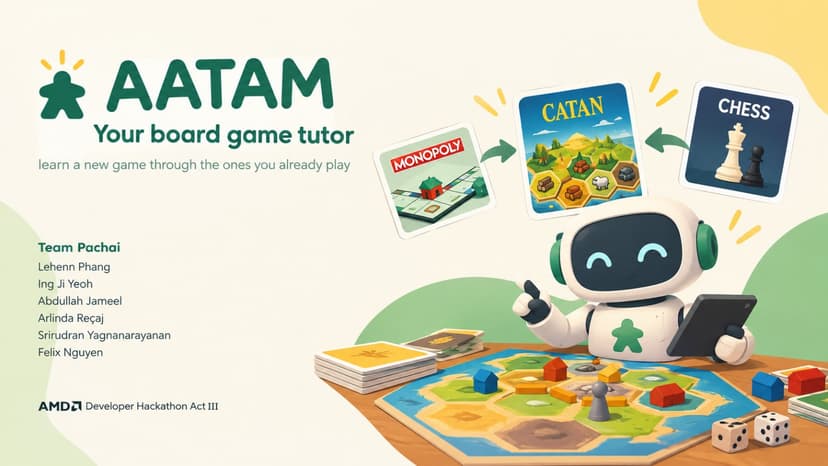
Imagine you are at a friend's place and they bring out a board game you don't know. Traditionally, that would mean your friend has to explain it or you have to painstakingly read the manual for a solid hour to grasp what the game is about! That's where our project Aatam comes in. It can help you learn the game very quickly with a chatbot and video generator that explains the new game based on games you may have played before. It is powered by powerful Gemma model running on AMD servers. Gemma because it is the smartest model in it's category(based on number of parameters), and AMD because it is cheap scalable and replicable. We hope you find good use for it and learn fun, new boardgames along the way!
18 Oct 2026
ML-Dive - ML Codebase & Log Debugger
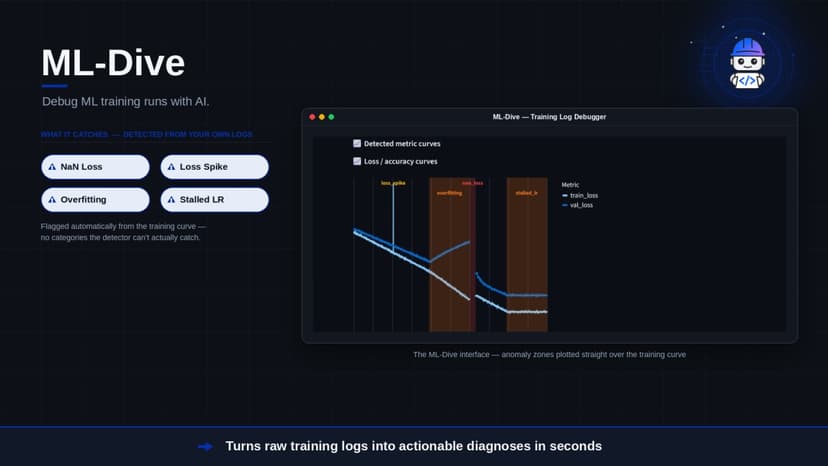
Machine learning engineers often face two time-consuming problems when joining or debugging an ML project: understanding an unfamiliar codebase and finding the cause of a failed training run. ML-Dive is an AI assistant built specifically for these workflows. It uses IBM Bob 2.0 as the analysis engine and presents the results through a Streamlit application designed for ML engineers. The first workflow is Codebase Onboarding. A user provides a computer-vision repository, such as a Detectron2-style project. Bob analyzes the repository structure, important files, configuration, entry points, data locations, and training/inference workflow, then produces an onboarding report that gives the engineer a practical map of the project instead of requiring them to manually explore hundreds of files. The second workflow is Training Log Triage. A user provides a training log and its run configuration. Bob analyzes the run and produces a human-readable diagnosis together with structured anomaly data. ML-Dive surfaces issues such as loss spikes, overfitting, NaN/Inf loss, and stalled learning rates. Each detected anomaly can be presented with its severity, iteration range, and numerical evidence. The target users are machine learning engineers, computer-vision researchers, ML students, and developers joining existing ML projects or debugging model-training runs. ML-Dive combines both workflows into one interface instead of treating repository understanding and training debugging as separate tools. Bob performs the reasoning and analysis, while ML-Dive converts that output into an ML-focused interface with readable reports, loss charts, anomaly bands, learning-rate visualization, zoomed-in problem areas, and diagnosis cards. A key part of the design is the separation between analysis and presentation. The Streamlit application does not perform the anomaly detection itself. It renders structured outputs produced by the analysis workflow, making the interface easy to test and allowing the same rendering pipeline to work with both verified reference data and IBM Bob output. The project was built in Python using Streamlit, pandas, NumPy, and Altair. The repository also includes validation tests, structured anomaly schemas, prompts, demo data, and IBM Bob integration. ML-Dive turns a process that can require hours of manual repository exploration and log inspection into a guided workflow: provide the project and training data, let Bob analyze it, and get an actionable view of what the ML engineer needs to understand next.
27 Sep 2026

Butler AI: Bimanual Physical AI
Butler AI is a bimanual Physical AI system designed to turn natural-language instructions into coordinated robotic actions for everyday manipulation tasks. The system targets a dinner-table setting in a MuJoCo simulation using two SO-101 robotic arms. The pipeline begins with a voice or text instruction describing a multi-step task, such as setting a table with plates and mugs and pouring water. Butler AI structures the instruction into actionable steps, identifies objects and their positions, selects an appropriate bimanual control strategy, and executes the sequence in simulation. For perception, the system uses ArUco markers and homography-based mapping to estimate object locations relative to the tabletop coordinate frame. The bimanual controller coordinates both SO-101 arms for actions such as picking, holding, pouring, and placing objects. Verification checks are used to determine whether intended actions were completed and to support recovery or retry behavior. We also evaluate robustness using randomized robot-demo trials and investigate Intel-oriented inference optimization with OpenVINO. Our current evaluation includes 10 successful trials out of 10 randomized robot-demo trials. An Intel Core Ultra 7 270K Plus ACT smoke benchmark measured 30.5 ms per 100-action chunk on the CPU, while FP16 NPU inference measured 571.7 ms per chunk. Butler AI provides a reproducible simulation-first foundation for exploring multimodal reasoning, bimanual manipulation, verification, robustness, and edge AI deployment for physical robotics.
16 Sep 2026
QuantNova
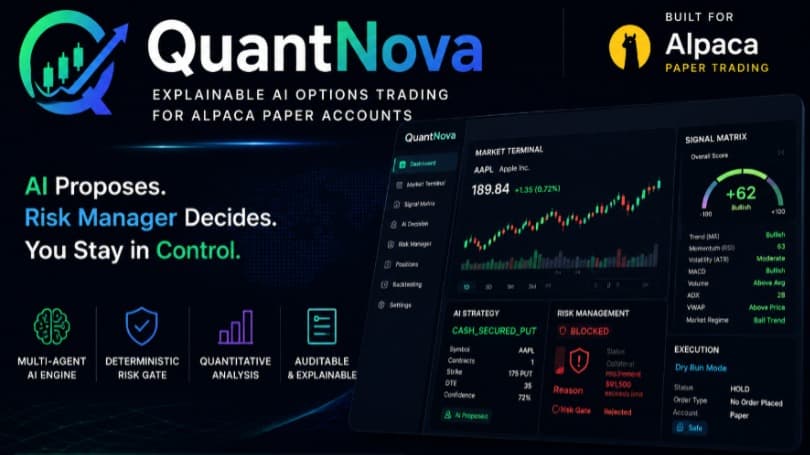
QuantNova is an explainable options-trading research terminal built for Alpaca paper accounts. It combines quantitative market analysis, market-regime detection, specialized AI agents, structured trade decisions, real option-contract resolution, and deterministic risk controls into one end-to-end workflow. QuantNova uses Alpaca market data and calculates technical indicators including moving averages, RSI, ATR, MACD, Bollinger Bands, ADX, momentum, realized volatility, volume ratio, VWAP, support, and resistance. These signals are combined into an eight-factor market score and used to classify market conditions. The multi-agent decision engine includes a Market Analyst, Opportunity Scanner, Options Strategist, and Devil's Advocate. The AI proposes a trade, while the deterministic risk manager decides whether execution is allowed. The system validates account conditions, portfolio exposure, position size, collateral requirements, strategy support, confidence, contract validity, and maximum loss. Invalid decisions fail closed to HOLD. QuantNova supports dry-run cycles, backtesting, and Alpaca paper execution while keeping trading auditable and risk-aware.
4 Sep 2026

MarketScout AI
MarketScout AI is an autonomous multi-agent platform built for the AMD Developer Hackathon Act II to help entrepreneurs, researchers, innovators, and investors validate startup ideas faster and make data-driven decisions with confidence. Validating a startup idea typically requires hours or days of manual research across competitor websites, scientific publications, patent databases, funding platforms, and market reports. This fragmented process slows innovation and makes it difficult to identify truly promising opportunities. MarketScout AI solves this challenge through a team of 12 autonomous AI agents that collaborate to automate the entire validation workflow. Starting from a single startup idea, the platform performs competitor analysis, scientific literature review, patent discovery, funding research, market trend analysis, research gap identification, innovation scoring, business validation, strategic planning, knowledge graph generation, and automated report creation. The platform delivers an interactive dashboard with competitor insights, market opportunities, SWOT analysis, funding recommendations, innovation scores, strategic guidance, and a visual knowledge graph that connects technologies, research, competitors, and investments into one unified view. Powered by Fireworks AI running advanced large language models on AMD Cloud Infrastructure with AMD Instinct GPUs, and built using Next.js and Tailwind CSS, MarketScout AI provides fast, scalable, and autonomous AI reasoning. As part of the Expected Unicorn Track, our vision extends beyond validating ideas. We aim to help founders discover high-potential, billion-dollar startup opportunities by combining autonomous AI research with actionable business intelligence. MarketScout AI acts as an AI startup co-pilot, reducing research time from days to minutes while helping innovators identify market gaps, evaluate opportunities, and build the next generation of unicorn startups.
13 Jul 2026
StoreScope AI – Agentic Retail Economy on Arc
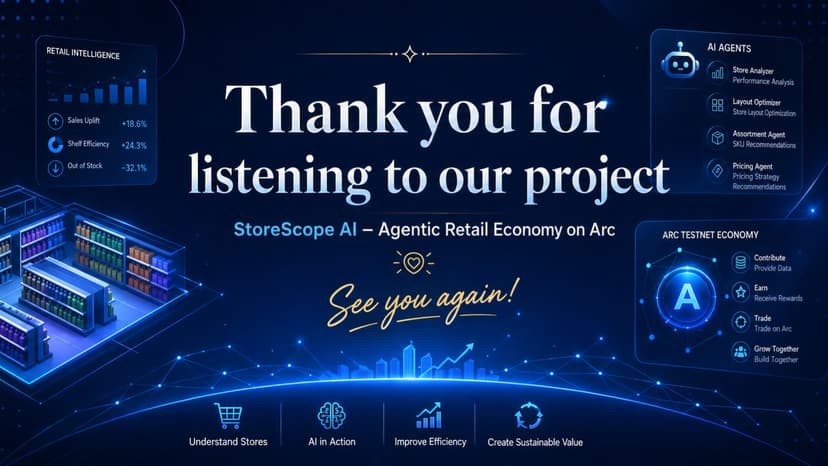
StoreScope AI is an AI-powered FMCG retail intelligence platform built for the Agentic Economy on Arc. The project helps retail teams, distributors, category managers, and FMCG professionals analyze store images, understand product visibility, detect stock risks, compare competitor presence, and generate actionable reports. Beyond image analysis, StoreScope AI also provides a store layout simulation space where users can create their own store models, place shelves, coolers, checkout counters, promotion islands, and product zones. These layouts help managers understand which display positions are most effective and how store structure can impact sales performance. The platform also introduces a community marketplace and FMCG forum where users can share layouts, reports, and practical retail experience. User-created layouts can become digital assets that may be shared or traded within the community. On Arc Testnet, StoreScope AI uses USDC nanopayments to support small AI tasks, premium reports, layout templates, and agent-powered services. The goal is to create more than an application: a professional FMCG ecosystem where AI agents, retail knowledge, and digital payments work together.
26 Apr 2026
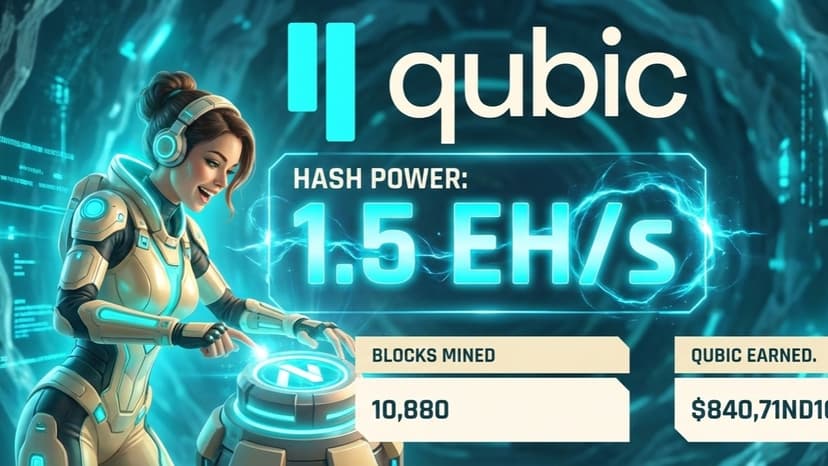
Qubic TAP TAP Miner with Nostromo Launchpad
QUBIC TAP TAP MINER IS A FIRST QUBIC BLOCKCHAIN MINING GAME WHICH ALLOWS YOU TO MINE 1000 QUBIC COIN PER TAP AND LET YOU STAKE SWAP OR WITHDRAW ON YOUR OWN REQUIREMENT AND DEMAND YOU CAN EASILY SWAP IT TO ANY OTHER TOKEN VIA DEFI TRADING USING META MASK OR SEND IT TO YOUR PEER FROM COMMUNITY PAY BACK P2P TRADE AND SEND SYSTEM USING Nostromo LAUNCHPAD PROTOCOL How Nostromo Works Users earn QUBIC through tap-to-earn gaming, staking on launchpad, and referrals, then maximize returns using DeFi features like token swaps, liquidity pools, yield farming, and lending protocols. STEP 1 Tap & Earn Tap to mine QUBIC tokens instantly STEP 2 Stake Lock tokens to earn high APY rewards STEP 3 Refer Invite friends and earn bonus rewards STEP 4 DeFi Trading Swap, farm, and lend for maximum yield STEP 5 Spend Redeem gift cards with your earnings STEP 6 Grow Wealth Compound returns and scale profits Pro Tip: Stake your earned QUBIC in the Nostromo Launchpad for passive income, then use DeFi to multiply your returns through yield farming and liquidity provision!
7 Dec 2025
Shadow Mentor
The Shadow Mentor is an AI-driven solution built on IBM Watsonx that tackles the significant HR problem of "Post-Onboarding Ghosting". This refers to the critical gap that emerges after the first week of employment, where new hires feel lost and productivity drops because managers cease constant hand-holding. The agent serves as an Invisible Onboarding Companion, ensuring continuous and personalized functional and cultural integration for the new hire.The system operates based on a constant Perceive , Decide , Act loop. It Perceives by using Watsonx Skills (Calendar, Slack, HRIS read access) to scan the employee's activity and identify "Integration Gaps" (e.g., no manager 1:1, or failure to access a core code repository). It then Decides the necessary intervention by consulting its knowledge base, which includes features like matching the user with their certification path/roadmap and confirming their role (Junior/Senior). Finally, it Acts discreetly, either by ghost-booking a 15-minute check-in on the manager's calendar with talking points or by sending a personalized Slack DM to the new hire with direct links for tasks like setting up a 401k.Crucially, the Shadow Mentor offers Intelligent Provisioning by assigning a pre-configured, role-specific initial project. This is central to Performance Tracking, which includes scoring and Tests with 3 retakes before certificate enrollment. Additional features include a smart calendar with a predictive clock and a switch for Active/Manual scheduling. By connecting enterprise systems intelligently, the Shadow Mentor transforms the risk of abandonment into a powerful opportunity for seamless, productive, and supported employee integration from day one.
23 Nov 2025
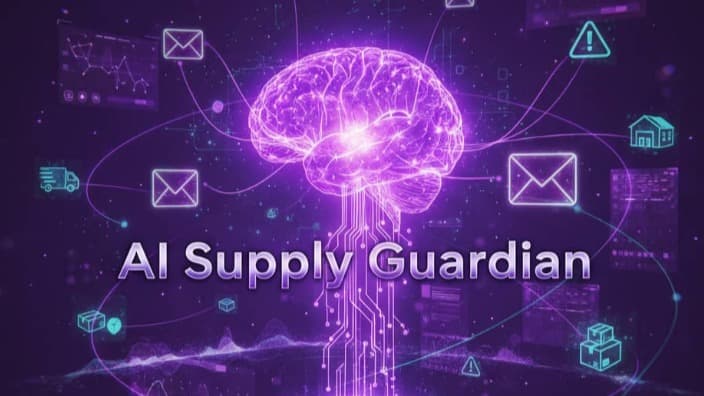
AI Supply Guardian-Smart Risk Alerts for SMEs
AI Supply Guardian is a lightweight, AI-powered assistant designed to help small and medium businesses stay ahead of supply chain risks. Many SMEs struggle with delayed shipments, sudden price changes, and the constant need to manually monitor supplier emails or updates. Our tool solves this by analyzing supplier messages, order details, and user-provided inputs to detect potential delays or cost shifts in real time. The system provides clear risk levels, actionable recommendations, and a clean dashboard where businesses can track every supplier at a glance. With quick alerts and simple workflows, AI Supply Guardian empowers teams to take faster, smarter decisions, without needing complex ERP systems or technical expertise. It’s practical, easy to adopt, and built to make supply management more predictable and stress-free.
19 Nov 2025


