🤝 Top Collaborators



🤓 Latest Submissions
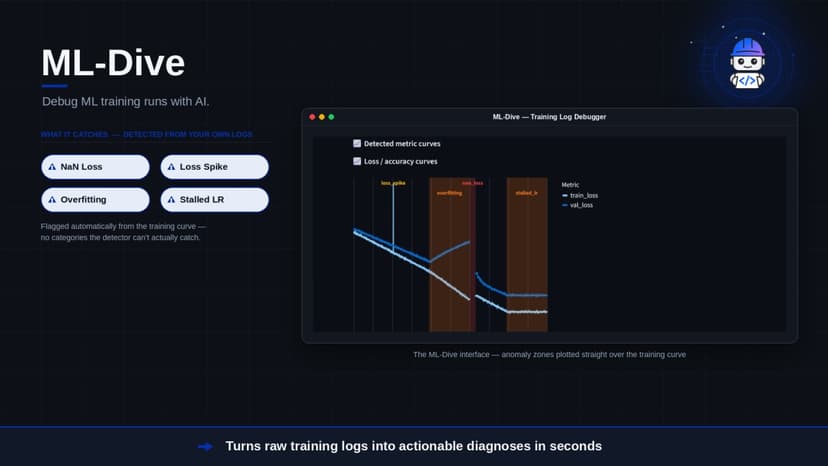
ML-Dive - ML Codebase & Log Debugger
Machine learning engineers often face two time-consuming problems when joining or debugging an ML project: understanding an unfamiliar codebase and finding the cause of a failed training run. ML-Dive is an AI assistant built specifically for these workflows. It uses IBM Bob 2.0 as the analysis engine and presents the results through a Streamlit application designed for ML engineers. The first workflow is Codebase Onboarding. A user provides a computer-vision repository, such as a Detectron2-style project. Bob analyzes the repository structure, important files, configuration, entry points, data locations, and training/inference workflow, then produces an onboarding report that gives the engineer a practical map of the project instead of requiring them to manually explore hundreds of files. The second workflow is Training Log Triage. A user provides a training log and its run configuration. Bob analyzes the run and produces a human-readable diagnosis together with structured anomaly data. ML-Dive surfaces issues such as loss spikes, overfitting, NaN/Inf loss, and stalled learning rates. Each detected anomaly can be presented with its severity, iteration range, and numerical evidence. The target users are machine learning engineers, computer-vision researchers, ML students, and developers joining existing ML projects or debugging model-training runs. ML-Dive combines both workflows into one interface instead of treating repository understanding and training debugging as separate tools. Bob performs the reasoning and analysis, while ML-Dive converts that output into an ML-focused interface with readable reports, loss charts, anomaly bands, learning-rate visualization, zoomed-in problem areas, and diagnosis cards. A key part of the design is the separation between analysis and presentation. The Streamlit application does not perform the anomaly detection itself. It renders structured outputs produced by the analysis workflow, making the interface easy to test and allowing the same rendering pipeline to work with both verified reference data and IBM Bob output. The project was built in Python using Streamlit, pandas, NumPy, and Altair. The repository also includes validation tests, structured anomaly schemas, prompts, demo data, and IBM Bob integration. ML-Dive turns a process that can require hours of manual repository exploration and log inspection into a guided workflow: provide the project and training data, let Bob analyze it, and get an actionable view of what the ML engineer needs to understand next.
27 Sep 2026
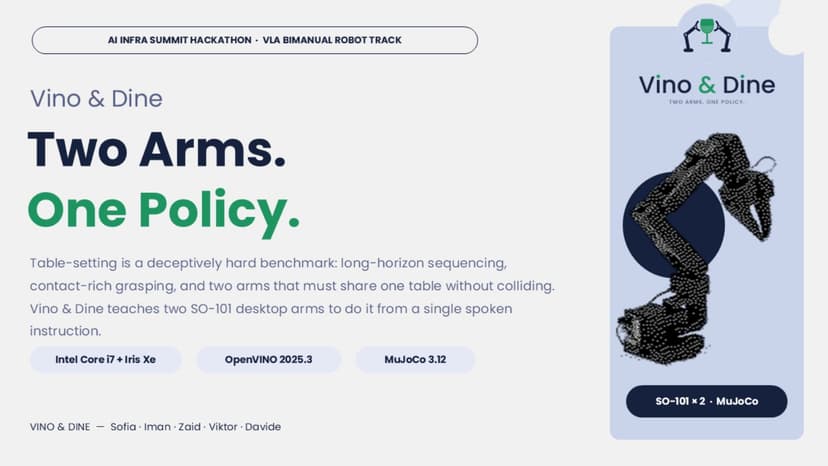
Vino & Dine: Voice-Guided Bimanual SmolVLA
Vino & Dine is a voice-guided bimanual robotics project in which two simulated SO-101 arms complete a multi-step table-setting task in MuJoCo. The goal is to connect a spoken request to a vision-language-action policy that can be evaluated safely before hardware deployment. The system uses an overhead camera, two wrist cameras, domain randomization, deterministic evaluation, and custom grasp-assist logic. Demonstrations generated by an IK-based expert are stored in LeRobot format and used to fine-tune SmolVLA with the SmolVLM2-500M-Video-Instruct backbone. The policy outputs 50-step action chunks for the 12-dimensional bimanual joint state. Speechmatics provides cloud-based real-time speech recognition. A spoken command is transcribed and matched to trigger keywords, which then launch the real SmolVLA rollout using the trained drawer-and-plate instruction. Verified results include 10/10 successful drawer open/close episodes and 7/10 successful plate pick-and-place episodes. Fixing an image-preprocessing mismatch improved evaluation from 2/10 to 7/10 without retraining the checkpoint. For optimized inference, we built a SmolVLA-to-OpenVINO bridge that directly exports the fixed-shape velocity step to OpenVINO IR while retaining PyTorch preprocessing and Python-based Euler updates. CPU parity testing validated the implementation, and our benchmark showed about a 20× speedup for the denoising-step workload versus PyTorch CPU execution. The runtime supports OpenVINO CPU, GPU, and NPU targets. The cup extension is still in progress, currently succeeding on 4/10 evaluation seeds, so it is not treated as a headline result. Future work will improve cup reliability and extend the voice-triggered workflow to the full drawer, plate, and cup sequence.
16 Sep 2026
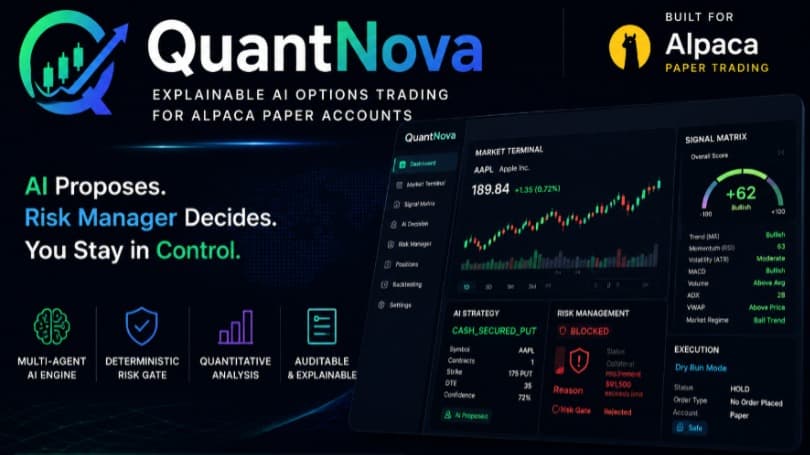
QuantNova
QuantNova is an explainable options-trading research terminal built for Alpaca paper accounts. It combines quantitative market analysis, market-regime detection, specialized AI agents, structured trade decisions, real option-contract resolution, and deterministic risk controls into one end-to-end workflow. QuantNova uses Alpaca market data and calculates technical indicators including moving averages, RSI, ATR, MACD, Bollinger Bands, ADX, momentum, realized volatility, volume ratio, VWAP, support, and resistance. These signals are combined into an eight-factor market score and used to classify market conditions. The multi-agent decision engine includes a Market Analyst, Opportunity Scanner, Options Strategist, and Devil's Advocate. The AI proposes a trade, while the deterministic risk manager decides whether execution is allowed. The system validates account conditions, portfolio exposure, position size, collateral requirements, strategy support, confidence, contract validity, and maximum loss. Invalid decisions fail closed to HOLD. QuantNova supports dry-run cycles, backtesting, and Alpaca paper execution while keeping trading auditable and risk-aware.
4 Sep 2026


