
🤝 Top Collaborators


🤓 Latest Submissions
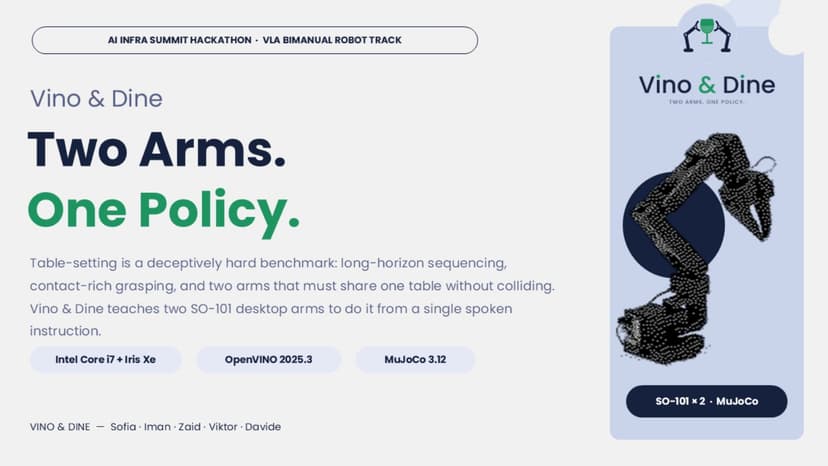
Vino & Dine: Voice-Guided Bimanual SmolVLA
Vino & Dine is a voice-guided bimanual robotics project in which two simulated SO-101 arms complete a multi-step table-setting task in MuJoCo. The goal is to connect a spoken request to a vision-language-action policy that can be evaluated safely before hardware deployment. The system uses an overhead camera, two wrist cameras, domain randomization, deterministic evaluation, and custom grasp-assist logic. Demonstrations generated by an IK-based expert are stored in LeRobot format and used to fine-tune SmolVLA with the SmolVLM2-500M-Video-Instruct backbone. The policy outputs 50-step action chunks for the 12-dimensional bimanual joint state. Speechmatics provides cloud-based real-time speech recognition. A spoken command is transcribed and matched to trigger keywords, which then launch the real SmolVLA rollout using the trained drawer-and-plate instruction. Verified results include 10/10 successful drawer open/close episodes and 7/10 successful plate pick-and-place episodes. Fixing an image-preprocessing mismatch improved evaluation from 2/10 to 7/10 without retraining the checkpoint. For optimized inference, we built a SmolVLA-to-OpenVINO bridge that directly exports the fixed-shape velocity step to OpenVINO IR while retaining PyTorch preprocessing and Python-based Euler updates. CPU parity testing validated the implementation, and our benchmark showed about a 20× speedup for the denoising-step workload versus PyTorch CPU execution. The runtime supports OpenVINO CPU, GPU, and NPU targets. The cup extension is still in progress, currently succeeding on 4/10 evaluation seeds, so it is not treated as a headline result. Future work will improve cup reliability and extend the voice-triggered workflow to the full drawer, plate, and cup sequence.
16 Sep 2026
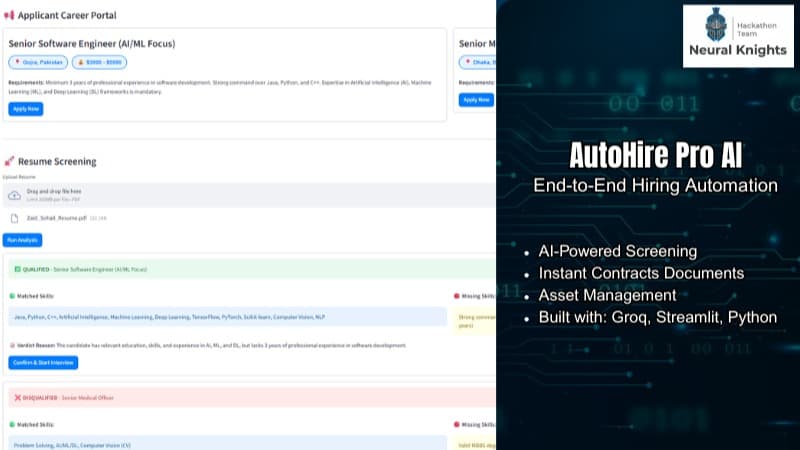
AutoHire Pro AI - End-to-End Hiring Automation
AutoHire Pro AI: Comprehensive Recruitment & Management Flow The project, developed by team Neural Knights, begins with the Job Management Phase, where managers can directly post new job openings through a specialized recruiter dashboard. This initial step allows the system to set specific technical criteria and parameters for the AI to follow during the subsequent screening and evaluation stages. By centralizing job postings, the platform ensures that all recruitment data is synchronized from the very start of the hiring lifecycle. Once the hiring process moves forward, the system introduces an Intelligent Screening Ecosystem. It automates resume parsing and calculates a unique honesty score by cross-referencing candidate claims with their performance in real-time technical interviews. This ensures that only genuine talent is shortlisted through a dynamic questioning process that generates role-specific assessments for every applicant. After a candidate is successfully evaluated, the system transitions into the Administrative and Onboarding Phase. A critical feature here is the Asset Request System, which allows new hires or their managers to request necessary hardware (like laptops or monitors) and software licenses (such as IDEs or cloud access) directly through the portal. This administrative sync ensures that the internal workflow is automated and that the employee has all the required resources ready for their first day. Finally, the project leverages high-fidelity Document Automation to finalize the process. Using a dictionary-based placeholder mapping system in Python, the portal instantly generates fully formatted, error-free Offer Letters and Employment Contracts in .docx format with a single click. This unified portal, built with a Streamlit frontend and Python backend, represents a professional standard of software engineering that addresses every stage of modern recruitment.
7 Feb 2026


