
🤝 Top Collaborators



🤓 Latest Submissions
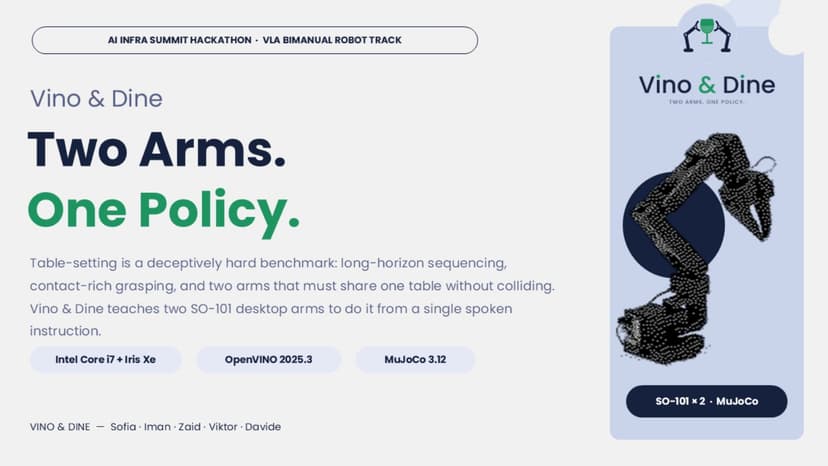
Vino & Dine: Voice-Guided Bimanual SmolVLA
Vino & Dine is a voice-guided bimanual robotics project in which two simulated SO-101 arms complete a multi-step table-setting task in MuJoCo. The goal is to connect a spoken request to a vision-language-action policy that can be evaluated safely before hardware deployment. The system uses an overhead camera, two wrist cameras, domain randomization, deterministic evaluation, and custom grasp-assist logic. Demonstrations generated by an IK-based expert are stored in LeRobot format and used to fine-tune SmolVLA with the SmolVLM2-500M-Video-Instruct backbone. The policy outputs 50-step action chunks for the 12-dimensional bimanual joint state. Speechmatics provides cloud-based real-time speech recognition. A spoken command is transcribed and matched to trigger keywords, which then launch the real SmolVLA rollout using the trained drawer-and-plate instruction. Verified results include 10/10 successful drawer open/close episodes and 7/10 successful plate pick-and-place episodes. Fixing an image-preprocessing mismatch improved evaluation from 2/10 to 7/10 without retraining the checkpoint. For optimized inference, we built a SmolVLA-to-OpenVINO bridge that directly exports the fixed-shape velocity step to OpenVINO IR while retaining PyTorch preprocessing and Python-based Euler updates. CPU parity testing validated the implementation, and our benchmark showed about a 20× speedup for the denoising-step workload versus PyTorch CPU execution. The runtime supports OpenVINO CPU, GPU, and NPU targets. The cup extension is still in progress, currently succeeding on 4/10 evaluation seeds, so it is not treated as a headline result. Future work will improve cup reliability and extend the voice-triggered workflow to the full drawer, plate, and cup sequence.
16 Sep 2026

Beleth - Autonomous Options Risk DEMON
Beleth is an autonomous options-trading agent built for the Alpaca AI Trading Agents Hackathon. It runs a short vertical credit spread strategy — always defined-risk, single multi-leg orders, never naked legs — selling premium only when implied volatility is genuinely rich relative to realized risk (volatility risk premium, VRP). What makes Beleth different is what it refuses. Most trading bots only show you the wins. Beleth's public dashboard shows every cycle it runs, in real time, including the trades it chose NOT to take and exactly why — VRP too thin, an inverted term structure, a macro event on the calendar, an existing order still resting, VIX regime too extreme. On day one alone, 147 rejections were logged with full reasoning against a single trade taken. Under the hood, Beleth enforces eleven independent risk rules: minimum VRP threshold, term-structure and macro-event gates, defined-risk-only enforcement, profit-take/stop-loss exits (50% profit / 2x loss), position sizing capped at 1-2% of equity, a daily 3% drawdown circuit breaker, a linear size taper driven by 1-year VIX percentile (calibrated against 35 years of CBOE VIX history), anti-stacking protection against duplicate resting orders, and an aggregate portfolio-risk cap across all open exposure. Every check is logged and auditable. The stack: Python agent in Docker, LLM reasoning via LiteLLM (model-agnostic), Alpaca paper trading API, Supabase Postgres as the single source of truth, and a Next.js dashboard on Vercel reading live from it. A deploy guard even blocks redeploys while markets are open.
4 Sep 2026

Sybil Agent - AI native work agent
A freelancer or a four-person agency runs 6 to 11 clients in parallel with no project manager and no one whose job is to keep the board updated. Every one of those clients produces the same three things: something that must happen on a date, something that must happen when a condition is met, and something nobody remembers at all. Existing tools handle the first case perfectly and have no representation for the second. So it gets forced into the first - a fake deadline invented so we don't forget - or it stays in someone's head. Both fail, and the cost of failing is a lost client. Redo the pricing WHEN the competitor moves. Follow up WHEN the client hasn't replied. Send the file WHEN the previous round is approved. The Greeks had two words for time. Chronos is clock time - dates, deadlines, calendars. Kairos is the right moment. Notion, Asana, Trello, Linear and Todoist are all built on Chronos. Sybil is built on Kairos. Nothing enters Sybil as a task. Everything enters as a Signal - a spoken sentence, a chat or Telegram message, a calendar event, a change on a live web page. An Interpreter extracts intent and entities. A Resolver then decides whether that signal is a new task or an update to an existing one. That component is what separates a product from a demo: without it, "move Rossi's quote to Monday" creates a duplicate instead of moving the real task. A task can carry a wake condition in plain language instead of a deadline. The agent turns that sentence into a sentinel watching a live page. When the world changes, the task returns to the top of the daily briefing carrying the proof - a diff and a link to the evidence. Three partners cover three stages, not one model doing everything. Bright Data is the eyes: monitoring, change detection, evidence capture - content is hashed before any model call, so an unchanged page costs zero tokens. Speechmatics is the ears and the voice. AI/ML API is the brain, with OpenRouter as automatic failover.
10 Aug 2026


