
🤝 Top Collaborators


🤓 Latest Submissions

Contradictor: Evidence Before Acceptance
AI-assisted development can produce convincing completion claims before a team has reproducible evidence. Contradictor addresses the testing and repair handoff: developers need to know what failed, which build was tested, what changed, and whether the same challenge passes after repair. Fulcrum Force built a local developer workflow around IBM Bob IDE. An operator freezes a requirement and admits an independently authored challenge. A FastAPI backend executes the challenge; Contradictor binds the results to candidate and challenge identities, preserves stdout/stderr and structured evidence, and exports a review package. A confirmed finding becomes a bounded Bob repair packet. The same frozen challenge then runs again, and an independent reviewer makes the technical determination. Our self-case study challenged Contradictor itself. A plan could inherit authorization from its prototype. The frozen F9 challenge exposed that behavior: 29 of 30 tests passed and F9 failed. Bob added an own-property guard without weakening the challenge or existing authorization checks. The unchanged challenge then passed 30/30, including the legitimate own-property positive control. One of those 30 cases is an explicitly deferred observational check, not a resolved defect. Independent BUILD reproduction exercised both candidates through the live backend and confirmed the failure-to-pass transition. The accepted integrated candidate also passed typecheck, 146 Node regression tests, and eight backend tests. Evidence stays attributable to its actual executor; Bob's shell was unavailable, so Bob did not execute these checks. The prototype demonstrates a repeatable way to inspect failure, route repair, compare reruns, and distinguish test success from acceptance. We do not claim a measured productivity percentage. It is a trusted-local prototype, not a hostile-code sandbox or production authorization system. Acceptance covers the frozen HC-B01/F9 scope only; HC-B02 through HC-B05 and the zero-width-space policy are deferred.
27 Sep 2026

KnowFlow AI — AI-Powered Document Q&A
KnowFlow AI is an AI workplace assistant that transforms static, dense documents into interactive knowledge sources using Retrieval-Augmented Generation (RAG). People often lose hours manually searching through PDFs, manuals, and reports, and standard AI chatbots risk hallucinating facts when they lack real document grounding. KnowFlow AI solves this by letting users upload PDF or text documents, which are automatically parsed, chunked, embedded, and indexed for fast semantic search. Users can then ask natural-language questions and receive concise, accurate answers with citations pointing directly to the source document and excerpt, so every answer is verifiable. The app features secure authentication with per-user data isolation, a document management dashboard with processing status tracking, persistent chat history, and a clean, responsive UI. Under the hood, the frontend is built with React, TypeScript, and Vite, styled with Tailwind CSS and shadcn/ui. The backend runs entirely on Supabase — using Postgres with pgvector for vector storage and semantic search, Supabase Storage for document files, Supabase Auth for secure login, and Supabase Edge Functions for server-side processing. Embeddings and chat completions are powered by the AIML API (OpenAI-compatible), using text-embedding-3-small and GPT-4o-mini. The result is a fast, secure, and genuinely useful tool for anyone who needs instant, trustworthy answers from their own documents.
10 Aug 2026
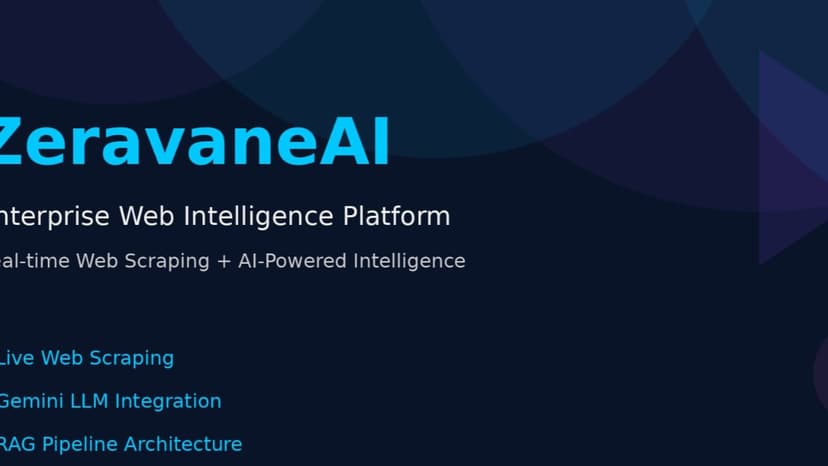
ZeravaneAI — Enterprise Web Intelligence Platform
ZeravaneAI is an enterprise-grade AI platform that combines web scraping, RAG (Retrieval-Augmented Generation), and advanced LLM capabilities to provide intelligent analysis of live web data. Key Features: • Real-time web scraping with BeautifulSoup for dynamic data extraction • Gemini 1.5 Flash LLM integration for intelligent response generation • Full RAG pipeline for context-aware, accurate answers • Multi-turn conversation with history tracking • Streamlit Cloud deployment for enterprise reliability • Handles complex queries about live web content Technical Stack: Gemini 1.5 Flash, BeautifulSoup, Streamlit, FastAPI, Python 3.x, ChromaDB Use Cases: - Market intelligence and competitor monitoring - News aggregation and trend analysis - Business research and data extraction - Enterprise web data analysis Live Demo: https://zeravaneai160506.streamlit.app/ MIT Licensed, open-source, ready for integration.
31 May 2026

Guardian Agent
Edge-first architecture with NVIDIA Jetson achieves sub-50ms latency even in low-bandwidth rural regions. Offline-first design caches decisions locally and syncs when connectivity resumes. Guardian Agent scales horizontally—adding cities adds capacity, not complexity. The roadmap includes Phase 1 (5 current nodes), Phase 2 (15 cities by Q4 2026), and Phase 3 (54 nations by 2027). The Streamlit dashboard uses Plotly for guardrail breakdown donut charts and regional traffic volatility bar charts. Professional compliance reporting generates PDF binaries for daily SOC summaries, threat incident reports, and audits—compliant with NDPR, DPA, and POPIA. Guardian Agent combines Google Gemini with Veea security guardrails to protect Africa's critical infrastructure.
19 May 2026


