

Hamza Ali@hamza____ali
8
Events attended
3
Submissions made
Pakistan
1 year of experience
About me
I am data scientist having hands on expertise with data engineering, ML, LLM integration, prompt engineering agentic environments, backend development, data scraping, automation bots, API integrations, Passionate about making connections and exploring more opportunities.
🤝 Top Collaborators


🤓 Latest Submissions
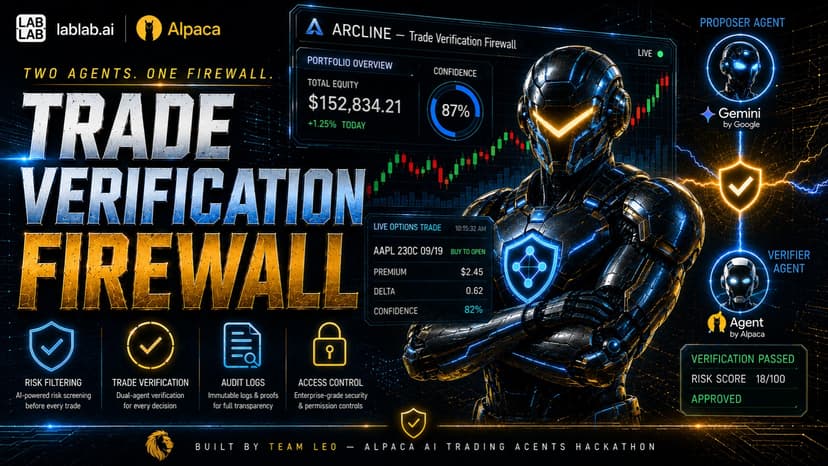
Trade Verification Firewall
Trade Verification Firewall is an AI-native options trading agent built for the Alpaca AI Trading Agents Hackathon that solves a core problem with autonomous trading bots: blind trust in a single AI's judgment. Instead of letting one model generate and execute trades, we split the decision into two independent AI checkpoints. The Alpaca API streams live price and options data into a Gemini-powered Signal Agent, which analyzes the market and proposes a trade. That signal doesn't go straight to execution — it passes to a second, independent Gemini Verifier Agent whose only job is to critically review the first agent's reasoning and either approve or reject it. Only signals that clear both checkpoints are sent back to Alpaca to place a paper trade. Every step of this process — the original signal, the verifier's reasoning, the final decision, and the trade outcome — is logged to Supabase and Google Sheets in real time, creating a complete, timestamped audit trail. This makes the system's decision-making fully transparent and reviewable, rather than a black box. n8n orchestrates the entire pipeline, connecting Alpaca's API, the two Gemini agents, and the logging layer into a single automated workflow that's easy to test, debug, and extend. The result is a trading agent architecture built around a simple principle: no trade fires on a single AI opinion.
4 Sep 2026

KnowFlow AI — AI-Powered Document Q&A
KnowFlow AI is an AI workplace assistant that transforms static, dense documents into interactive knowledge sources using Retrieval-Augmented Generation (RAG). People often lose hours manually searching through PDFs, manuals, and reports, and standard AI chatbots risk hallucinating facts when they lack real document grounding. KnowFlow AI solves this by letting users upload PDF or text documents, which are automatically parsed, chunked, embedded, and indexed for fast semantic search. Users can then ask natural-language questions and receive concise, accurate answers with citations pointing directly to the source document and excerpt, so every answer is verifiable. The app features secure authentication with per-user data isolation, a document management dashboard with processing status tracking, persistent chat history, and a clean, responsive UI. Under the hood, the frontend is built with React, TypeScript, and Vite, styled with Tailwind CSS and shadcn/ui. The backend runs entirely on Supabase — using Postgres with pgvector for vector storage and semantic search, Supabase Storage for document files, Supabase Auth for secure login, and Supabase Edge Functions for server-side processing. Embeddings and chat completions are powered by the AIML API (OpenAI-compatible), using text-embedding-3-small and GPT-4o-mini. The result is a fast, secure, and genuinely useful tool for anyone who needs instant, trustworthy answers from their own documents.
10 Aug 2026
Glycoswarm AI
72% of diabetics are only diagnosed after a complication has already appeared, and damage to the kidneys, nerves, eyes, or heart can develop silently for 4-7 years before that. Today's screening checks one specialist, one chart, one metric at a time. GlycoSwarm AI fixes that with a 4-agent specialist pipeline: dedicated Renal, Neuropathy, Retinal, and Cardiovascular agents each reason over a different slice of a patient's real lab panel, then a Synthesis Agent weighs all four findings against each other and outputs one ranked referral recommendation, all generated live, not pre-computed or hardcoded. Every specialist writes and executes its own Python risk-scoring code against the patient's actual labs in real time, visible in a live reasoning terminal. The system runs on genuine on-GPU inference: Gemma 4 26B served via Ollama on an AMD Instinct MI300X (AMD Developer Cloud), with Fireworks GLM 5.2 as a real, user-triggered fallback. If neither provider is reachable, it honestly reports "unavailable" rather than faking a clean result. We validated the full pipeline across 104 real, de-identified CDC NHANES patients, with 90 flagged in at least one organ system. The dashboard (Next.js, FastAPI, LangGraph) renders an anatomical risk map, live agent terminal, and an exportable clinical brief. It's a prototype, not a certified clinical device, but the architecture generalizes beyond diabetes to chronic kidney disease, metabolic syndrome, and post-transplant care, as a SaaS subscription or EHR-integrated license, against a $1T+ global health spend.
13 Jul 2026


