
🤝 Top Collaborators


🤓 Latest Submissions
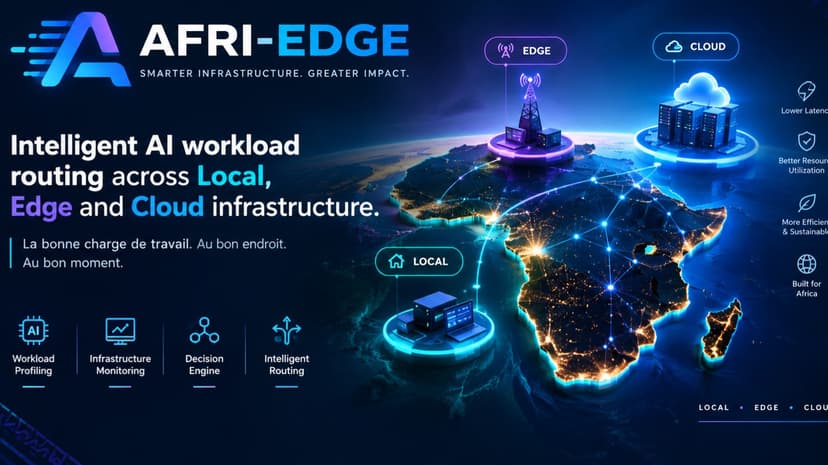
AFRI-EDGE
AFRI-EDGE is an intelligent infrastructure routing platform designed to optimize where AI and compute workloads run across Local, Edge, and Cloud environments. Instead of sending every workload to the cloud, AFRI-EDGE continuously evaluates available infrastructure conditions and workload requirements, then uses a Decision Engine to select the most appropriate execution target. The platform combines workload profiling, infrastructure monitoring, constraint-based candidate evaluation, and intelligent routing into a unified system. For each workload, the Decision Engine evaluates the available targets, ranks eligible candidates, and produces a transparent routing decision with a score and reasons behind the selection. AFRI-EDGE is designed with a practical African infrastructure context in mind, where connectivity, bandwidth, compute availability, latency, and resource constraints can vary significantly. By making infrastructure placement more adaptive, the project aims to provide a foundation for more efficient and resilient AI infrastructure. The current MVP includes an end-to-end routing flow, infrastructure state collection for LOCAL, EDGE, and CLOUD, workload profiling, candidate evaluation, and a dashboard for visualizing routing decisions and candidate rankings. Core principle: don't assume the cloud is always the right destination — evaluate the workload and the infrastructure, then route accordingly.
16 Sep 2026
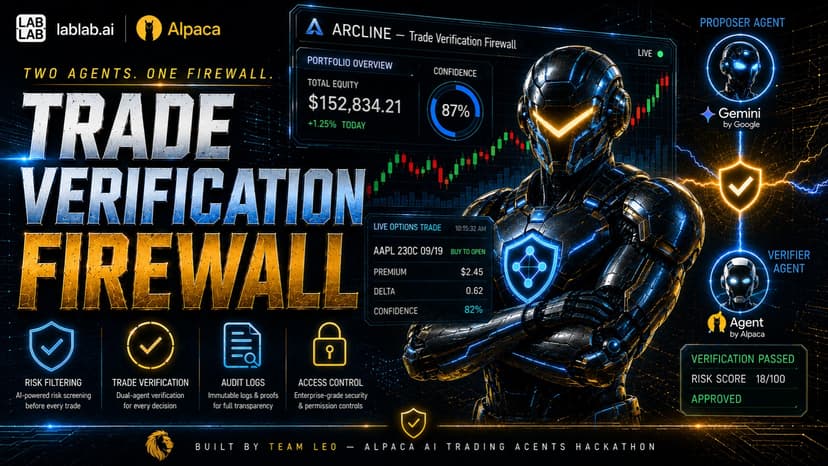
Trade Verification Firewall
Trade Verification Firewall is an AI-native options trading agent built for the Alpaca AI Trading Agents Hackathon that solves a core problem with autonomous trading bots: blind trust in a single AI's judgment. Instead of letting one model generate and execute trades, we split the decision into two independent AI checkpoints. The Alpaca API streams live price and options data into a Gemini-powered Signal Agent, which analyzes the market and proposes a trade. That signal doesn't go straight to execution — it passes to a second, independent Gemini Verifier Agent whose only job is to critically review the first agent's reasoning and either approve or reject it. Only signals that clear both checkpoints are sent back to Alpaca to place a paper trade. Every step of this process — the original signal, the verifier's reasoning, the final decision, and the trade outcome — is logged to Supabase and Google Sheets in real time, creating a complete, timestamped audit trail. This makes the system's decision-making fully transparent and reviewable, rather than a black box. n8n orchestrates the entire pipeline, connecting Alpaca's API, the two Gemini agents, and the logging layer into a single automated workflow that's easy to test, debug, and extend. The result is a trading agent architecture built around a simple principle: no trade fires on a single AI opinion.
4 Sep 2026

No-ShowGuard
Every missed appointment is money walking out the door — and most clinics don't see it coming until the chair is empty. No-Show, No Problem predicts which appointments are at risk, explains why in plain language, and automatically triggers the right recovery action, a deposit request or reminder, before the patient misses their slot. Built around a real clinic persona, Dr. Amina's Dental Clinic, the system follows a simple loop: Predict, Explain, Act. Every appointment is auto-scored Low, Medium, or High using real visit history, booking channel, and lead time. Staff get a plain-language reason for every score, not a black box. One click sends a real, trackable deposit request or reminder email — live, not simulated. An analytics dashboard cross-checks the risk engine against real appointment outcomes, so the scores are measured from day one, not assumed. Built end-to-end and deployed live using Supabase, Resend, and React + Vite.
10 Aug 2026


