

Tsadok ADIDO@tsadok17
6
Events attended
4
Submissions made
Benin
2+ years of experience
About me
Developer and AI builder specializing in agent architecture and automation — React, TypeScript, Supabase, Claude API and n8n for orchestration. Shipped four hackathon projects to submission: DiagnoCommerce, an AI diagnostic tool for merchants; a two-agent trade-verification system catching low-confidence trading decisions (Alpaca Hackathon); and an infrastructure-aware AI runtime routing workloads across Local/Edge/Cloud (AI Infra Summit) and TrustForge. Anthropic AI Fluency certified. Founder of Tsk's Tech Services, Bénin.
🤝 Top Collaborators


🤓 Latest Submissions
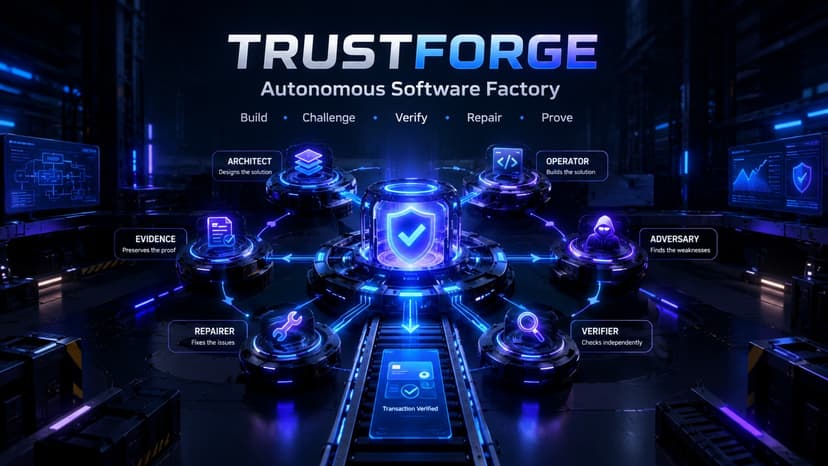
TrustForge — Evidence-Gated AI Software Factory
TrustForge is an autonomous software factory designed around one principle: code that works is not necessarily code that can be trusted. Instead of relying on a single AI coding agent to build software and declare it finished, TrustForge creates a complete engineering loop: Architect → Operator → Adversary → Verifier → Repairer → Verifier → Evidence Each seat has a bounded responsibility. The factory transforms requirements into explicit properties, generates adversarial scenarios, implements the required behavior, independently verifies the running system, repairs concrete failures and re-verifies the repaired revision before producing an evidence package. For the Pocketful track, TrustForge produced a self-contained Stage 1 wallet and payments service covering authentication, payments, requests, bill splitting, idempotent writes, atomic multi-item operations, exact integer money arithmetic, activity visibility and state export/import. The verification philosophy is simple: Requirement → Property → Scenario → Implementation → Execution → Observation → Verdict → Repair → Re-verification TrustForge does not treat “tests passed” as proof of universal correctness. Its evidence model explicitly distinguishes VERIFIED, FAILED, INCONCLUSIVE and BLOCKED states and preserves limitations and failure history. The recovered project records 147/147 shipped checks passing in the official isolated Pocketful Stage 1 harness, alongside independent HTTP verification and reproducible container instructions. The factory itself is designed to be reusable beyond Pocketful. Its mandates are domain-agnostic and can be applied to software, APIs, business automations, AI agents and AI-generated applications. TrustForge's goal is not simply to make AI build faster. It is to make AI-built software harder to trust blindly.
6 Oct 2026
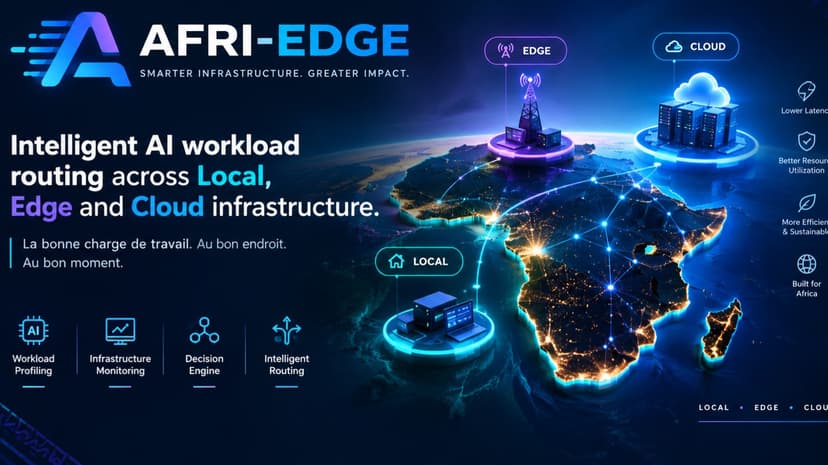
AFRI-EDGE
AFRI-EDGE is an intelligent infrastructure routing platform designed to optimize where AI and compute workloads run across Local, Edge, and Cloud environments. Instead of sending every workload to the cloud, AFRI-EDGE continuously evaluates available infrastructure conditions and workload requirements, then uses a Decision Engine to select the most appropriate execution target. The platform combines workload profiling, infrastructure monitoring, constraint-based candidate evaluation, and intelligent routing into a unified system. For each workload, the Decision Engine evaluates the available targets, ranks eligible candidates, and produces a transparent routing decision with a score and reasons behind the selection. AFRI-EDGE is designed with a practical African infrastructure context in mind, where connectivity, bandwidth, compute availability, latency, and resource constraints can vary significantly. By making infrastructure placement more adaptive, the project aims to provide a foundation for more efficient and resilient AI infrastructure. The current MVP includes an end-to-end routing flow, infrastructure state collection for LOCAL, EDGE, and CLOUD, workload profiling, candidate evaluation, and a dashboard for visualizing routing decisions and candidate rankings. Core principle: don't assume the cloud is always the right destination — evaluate the workload and the infrastructure, then route accordingly.
16 Sep 2026
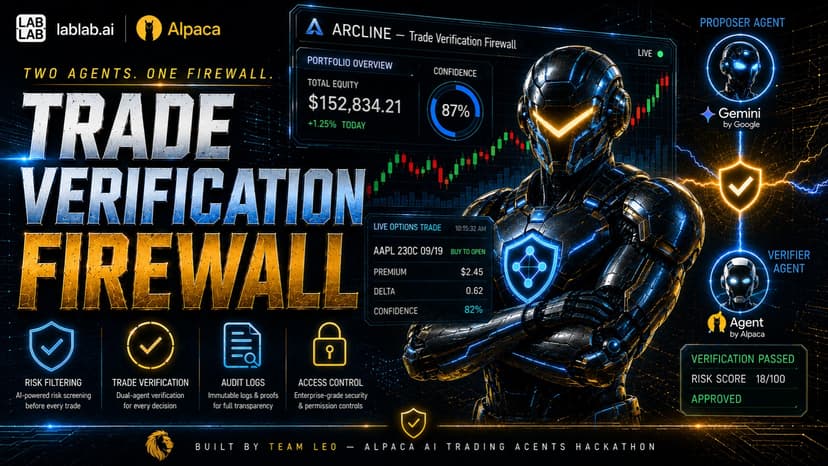
Trade Verification Firewall
Trade Verification Firewall is an AI-native options trading agent built for the Alpaca AI Trading Agents Hackathon that solves a core problem with autonomous trading bots: blind trust in a single AI's judgment. Instead of letting one model generate and execute trades, we split the decision into two independent AI checkpoints. The Alpaca API streams live price and options data into a Gemini-powered Signal Agent, which analyzes the market and proposes a trade. That signal doesn't go straight to execution — it passes to a second, independent Gemini Verifier Agent whose only job is to critically review the first agent's reasoning and either approve or reject it. Only signals that clear both checkpoints are sent back to Alpaca to place a paper trade. Every step of this process — the original signal, the verifier's reasoning, the final decision, and the trade outcome — is logged to Supabase and Google Sheets in real time, creating a complete, timestamped audit trail. This makes the system's decision-making fully transparent and reviewable, rather than a black box. n8n orchestrates the entire pipeline, connecting Alpaca's API, the two Gemini agents, and the logging layer into a single automated workflow that's easy to test, debug, and extend. The result is a trading agent architecture built around a simple principle: no trade fires on a single AI opinion.
4 Sep 2026
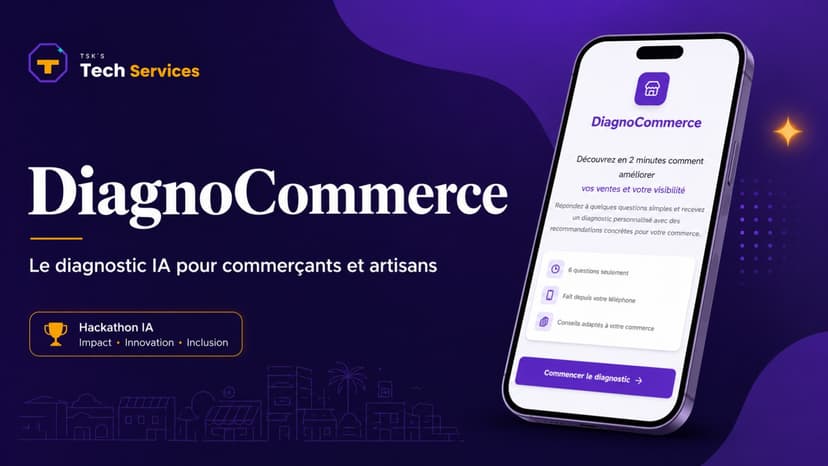
DiagnoCommerce : AI Sales Diagnostic for Merchants
DiagnoCommerce helps small merchants and artisans in Bénin who have real business potential but no clear starting point to grow — no time, no marketing expertise, no budget for consulting. Through 6 simple questions, answered in under 2 minutes on any phone, the app generates a personalized diagnostic: a score, key strengths, and concrete, actionable recommendations — all dynamically generated by Claude via the AI/ML API, tailored to each merchant's specific situation. Built entirely with native.builder (React, TypeScript, Tailwind CSS v4, Supabase for database and Edge Functions), DiagnoCommerce is the first accessible step of Tsk Tremplin, a free digital mentorship program I run for merchants and artisans in Bénin — turning a real, ongoing need into a working AI-native product.
10 Aug 2026


