

Arshad Abbas@Arshad_Abbas
4
Events attended
2
Submissions made
Pakistan
1 year of experience
About me
Plant Breeding & Genetics researcher (MSc Hons.) applying AI to agriculture, currently seeking a fully funded PhD in AI for agriculture focused on AI-driven plant breeding and climate-resilient crops. I combine crop genetics with machine learning, deep learning, and remote sensing to study crop stress, climate risk, and agrochemical contamination, with the goal of building AI-driven decision tools that help breeders and farmers adapt to a changing climate. My current projects include PlantCRISPR, an offline CRISPR guide-RNA design tool for crops including polyploids; Sentinel-2 crop stress monitoring for wheat (in progress); and a machine learning model that predicts pesticide contamination in groundwater under future climate scenarios. My research interests include genomic selection, plant disease detection, yield prediction, and agentic AI for crop monitoring and breeding decisions. In the #IBM Bob 2.0 Hackathon, I built the agent core of SpecCheck, a set of five custom AI modes that check whether code matches its requirements. I'm open to PhD opportunities, research collaborations, and hackathon teams working on AI for agriculture, plant science, or climate.
🤝 Top Collaborators


🤓 Latest Submissions
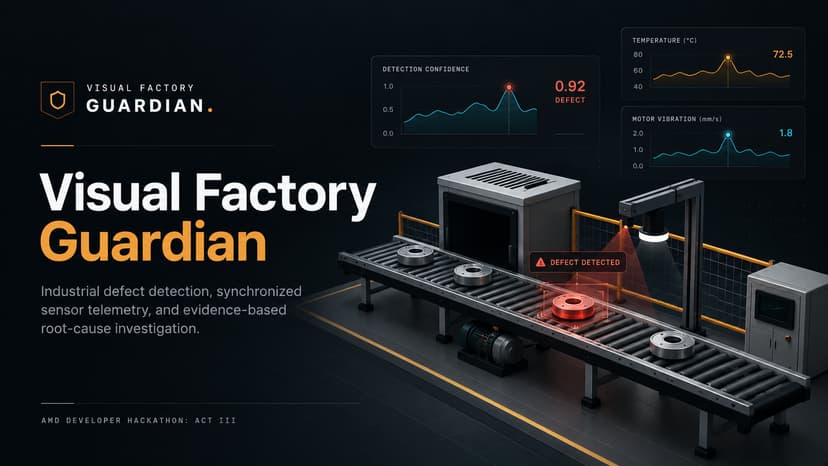
Visual Factory Guardian
## Visual Factory Guardian Visual Factory Guardian (VFG) is an industrial quality-monitoring and fault-investigation prototype designed to help manufacturing operators understand not only what defect occurred, but also which process conditions may have contributed to it. Conventional visual inspection can flag a defective product without showing the machine conditions surrounding the event. VFG connects image-based anomaly detection, timestamped sensor telemetry, statistical root-cause analysis, and technical-manual retrieval into an evidence-driven investigation workflow. The prototype includes: - **Computer vision:** An OpenCV-based inspection pipeline with a lightweight PatchCore-style anomaly detector and an optional Anomalib/PatchCore backend for compatible AMD ROCm environments. - **Machine telemetry:** A deterministic simulation of temperature, vibration, and motor current, with fault injection and synchronized inspection timestamps. - **Root-cause investigation:** CUSUM change-point analysis, baseline deviations, z-scores, temporal precedence, and ranked candidate causes. - **Technical documentation:** Retrieval of relevant passages from a sample tile-production maintenance manual to support operator review. - **Interactive visualization:** A React and Three.js factory experience with inspection events, sensor trends, evidence review, and a dedicated live-backend interface. VFG distinguishes simulated inputs from real model outputs and treats root-cause results as **evidence-supported hypotheses rather than proof of causation**. Recommended actions remain subject to human review; the prototype does not control industrial machinery. The project demonstrates an extensible approach to industrial quality investigation that combines machine vision, telemetry, explainable analytics, and an accessible operator interface. The repository includes the application, test suites, API contracts, scenario configuration, and instructions for running the prototype.
18 Oct 2026

SpecCheck — Requirement Traceability
Software teams often have requirements written in a PRD and working code in a repository, but it can be difficult to quickly determine whether each requirement is actually supported by implementation evidence and tests. This creates a gap between what a project says it should do and what can be demonstrated from the codebase. SpecCheck addresses this problem by providing a requirement-to-test traceability workflow demonstrated against ResumePilot AI. It starts with the project requirements, extracts and structures them, searches the codebase for implementation evidence, verifies the evidence using strict criteria, generates tests, and produces a final traceability report. The workflow uses five IBM Bob custom modes: Spec Reader, Evidence Finder, Strict Verifier, Test Writer, and Trace Reporter. Each mode has a focused responsibility in the verification pipeline. The resulting reports connect individual requirements with evidence, verification decisions, tests, and traceability information. The primary users are software developers, engineering teams, reviewers, and technical project teams who need a reproducible way to inspect whether implemented software satisfies written requirements. A user can provide a project with its requirements and then follow the generated reports to understand what is supported, what requires further verification, and where weaknesses exist. What makes SpecCheck distinctive is its focus on traceability rather than simply generating code or tests. It creates an evidence chain from requirement to implementation evidence, verification, and test coverage. This helps separate claims supported by the codebase from claims that require additional investigation. In the current project, the workflow expanded the original requirements into 18 traceable requirements and produced offline tests for the SpecCheck workflow. The repository records 62 tests, with 50 passing and 12 expected failures documenting identified defects. The project also documents issues such as clean-checkout harness failures, ground-truth file rewriting, verification weaknesses, and inconsistencies between documented and executed evaluation cases. SpecCheck does not modify the ResumePilot AI application code. Instead, it provides a structured verification and traceability layer around the existing project.
27 Sep 2026


