

🤝 Top Collaborators


🤓 Latest Submissions
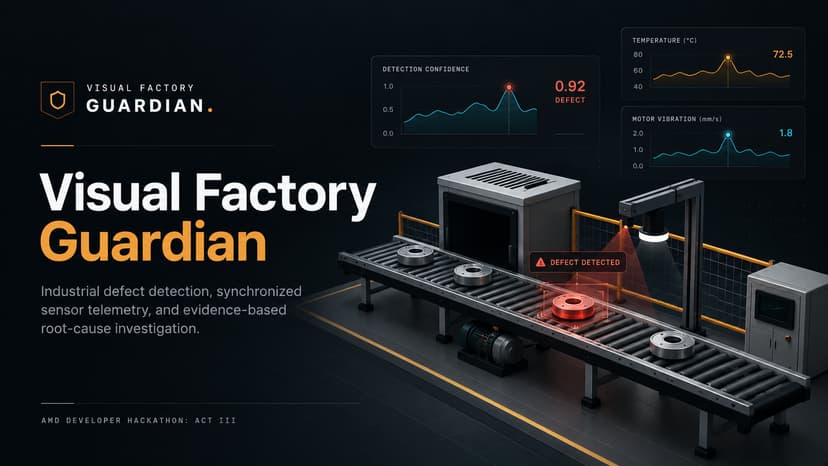
Visual Factory Guardian
## Visual Factory Guardian Visual Factory Guardian (VFG) is an industrial quality-monitoring and fault-investigation prototype designed to help manufacturing operators understand not only what defect occurred, but also which process conditions may have contributed to it. Conventional visual inspection can flag a defective product without showing the machine conditions surrounding the event. VFG connects image-based anomaly detection, timestamped sensor telemetry, statistical root-cause analysis, and technical-manual retrieval into an evidence-driven investigation workflow. The prototype includes: - **Computer vision:** An OpenCV-based inspection pipeline with a lightweight PatchCore-style anomaly detector and an optional Anomalib/PatchCore backend for compatible AMD ROCm environments. - **Machine telemetry:** A deterministic simulation of temperature, vibration, and motor current, with fault injection and synchronized inspection timestamps. - **Root-cause investigation:** CUSUM change-point analysis, baseline deviations, z-scores, temporal precedence, and ranked candidate causes. - **Technical documentation:** Retrieval of relevant passages from a sample tile-production maintenance manual to support operator review. - **Interactive visualization:** A React and Three.js factory experience with inspection events, sensor trends, evidence review, and a dedicated live-backend interface. VFG distinguishes simulated inputs from real model outputs and treats root-cause results as **evidence-supported hypotheses rather than proof of causation**. Recommended actions remain subject to human review; the prototype does not control industrial machinery. The project demonstrates an extensible approach to industrial quality investigation that combines machine vision, telemetry, explainable analytics, and an accessible operator interface. The repository includes the application, test suites, API contracts, scenario configuration, and instructions for running the prototype.
18 Oct 2026

IWIR(Intelligent-Web-Information-Retrieval)
Intelligent Web Information Retrieval Agent AKA IWIR is a high-precision, autonomous web intelligence and retrieval system engineered for Match 4 of the AMD AI League (Lablab AI Academy Challenge). Designed to operate under strict enterprise evaluation contracts, the system autonomously understands natural-language inquiries, navigates web ecosystems, and extracts exact, verifiable answers with zero hallucinations. The architecture is built around a rigorous 5-stage deterministic agent pipeline: 1. Understand: Performs semantic intent classification, entity boundary recognition, and multi-angle query reformulation. 2. Search: Executes keyless, resilient multi-provider search with automatic fallback mechanisms. 3. Fetch & Navigate: Asynchronously crawls target pages via aiohttp with redirect resolution, polite rate-limiting, and deep link-hopping. 4. Extract: Parses complex representations including JSON-LD schema graphs, HTML tables, and semantic content blocks. 5. Verify (Mandatory Contract): Validates candidate answers against source page token boundaries using strict regex validation before emission. If factual grounding cannot be proven, the agent produces an explicit refusal with zero citations, ensuring 100% precision. Optimized for AMD Developer Cloud instances (such as MI300X accelerators) and local developer environments, the solution is packaged in reproducible, production-grade Docker containers based on official AMD ROCm PyTorch distributions without any proprietary CUDA dependencies. It adheres strictly to headless grader contracts, sub-30-second query execution budgets, and full offline fallback validation.
1 Dec 2026


