

Muhammad Arslan Bodla@Arslan
10
Events attended
2
Submissions made
Pakistan
2+ years of experience
About me
I am Muhammad Arslan Bodla From Pakistan. I am MSCS In education. Currently I am working as Computer Programmer In GCU Lahore.
I built with
Cohere🤝 Top Collaborators



🤓 Latest Submissions
MedDev Guardian
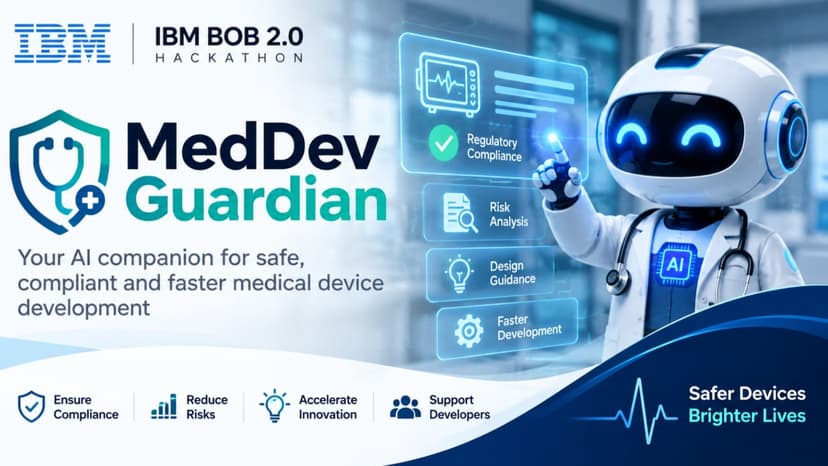
Healthcare software development requires careful planning, testing, security reviews, documentation, and release preparation. However, developers working on healthcare-related projects may lack a simple, structured workflow that brings these activities together. Missing requirements, incomplete testing, and overlooked risks can make development and release preparation harder to manage. MedDev Guardian is a prototype built for the IBM Bob 2.0 Hackathon. It provides a guided, seven-stage workflow for healthcare software development: Understand, Plan, Implement, Test, Security Review, Documentation, and Release Readiness. Developers can organize feature requests, generate structured implementation plans, track task completion, review testing requirements, manage security checklists, and assess release readiness from one dashboard. The Evidence & Metrics panel summarizes the current workflow state, helping users see completed tasks, outstanding checks, and remaining work. The prototype is designed for healthcare software developers, student developers, and teams building health-related applications. Its key idea is to make important development steps visible and organized through a single, easy-to-use interface rather than scattered notes and checklists. MedDev Guardian is a self-contained demonstration with a deterministic plan generator and interactive workflow checklists. It does not process patient data, run clinical workflows, or replace professional security testing. Checklist results depend on user input, and the prototype has not been clinically validated or submitted for regulatory approval. The goal is to demonstrate how structured workflow guidance can help development teams organize their work and prepare healthcare software projects for review and release.
27 Sep 2026
Ask Quran
Our goal is to develop a system that can take documents in any language and allow users from different parts of the world with different languages to interact with those documents. This can help spread knowledge without any language barrier. We are first testing it out with Quranic text, which is in Arabic, and building a chatGPT-style bot for question answering. In future, we would like to expand it to additional documents in any language. We first perform embedding of the text using Cohere's multilingual embed model and save those embeddings in a vector database, Pinecone DB in our case. We then take user queries and also embed them and perform a similarity-based search to provide the most relevant results based on the query. The app is currently deployed and publicly available. Streamlit app link: https://taqihaider7-tafsir-quran-sementic-search-llm-app-fwh2if.streamlit.app/
3 Feb 2023


