
🤝 Top Collaborators




🤓 Latest Submissions
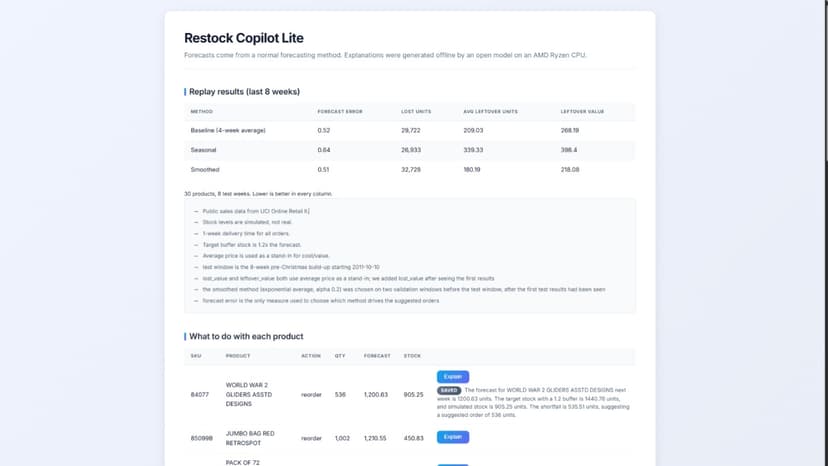
Restock Copilot Lite
Restock Copilot Lite is an inventory forecasting tool designed to tell small shops what to reorder and why, without relying on external cloud APIs or expensive GPU clusters. The system tests three forecasting methods (4-week baseline, seasonal, and smoothed trend) on 105 weeks of UK retail data to predict demand for 30 products over an 8-week pre-Christmas simulation. The simulation selected the smoothed method based on a strict pre-agreed rule of lowest forecast error (0.5077), though unmet demand results were mixed. To meet the AMD hardware requirement securely, we eliminated live API dependencies. Plain-language explanations for all restocking actions were generated offline using the open-source Qwen/Qwen2.5-1.5B-Instruct model running via PyTorch purely on the CPU of an AMD Ryzen 7 7735HS laptop. The FastAPI backend serves these static, pre-computed outputs, falling back to a factual template if a check fails. The language model does not forecast, and the stock mentioned in explanations is strictly simulated.
18 Oct 2026
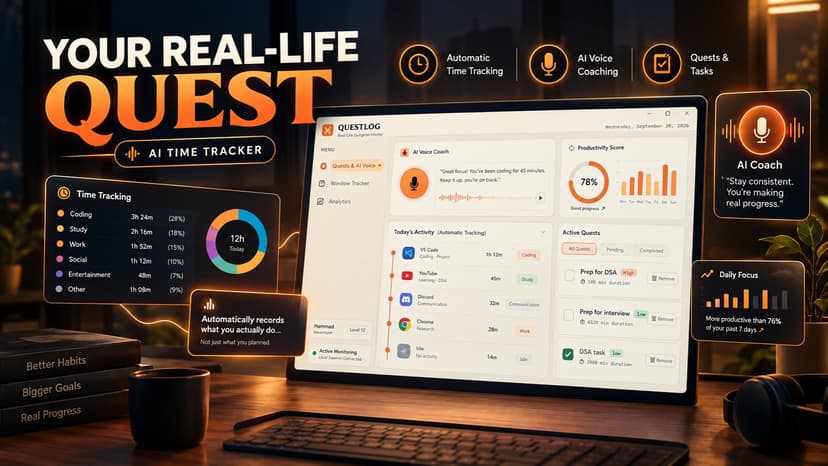
Questlog: Real-Life Dungeon Master
Questlog turns real life into a measurable, coachable system. Most task managers record what you plan to do, and most time trackers record what you actually did. Questlog does both, then closes the gap with an AI accountability companion you can talk to. The Windows desktop app (WPF, .NET 8) and a Chrome extension track your activity, classify it as productive or distracting, and feed a deterministic, explainable scoring engine. The score starts at 50 and every change has a stated reason, so it never becomes a black box or a judgment of you as a person. The voice experience is the heart of the project. You speak to the Dungeon Master through a mic orb, and audio streams at 16 kHz over AssemblyAI's Streaming v3 WebSocket using short-lived tokens minted by our FastAPI backend, so the real API key never reaches the client. When you finish speaking, a Groq-hosted Llama 3.3 70B agent uses tool calling to create, update, complete or delete quests and to generate a daily schedule. The reply is spoken back through Windows text-to-speech. Say "Schedule 2 hours of DSA and 1 hour of project work" and your quests and schedule fill in automatically. Next up: voice barge-in, XP and level-ups, background window tracking, and an end-of-day Campaign Debrief.
30 Sep 2026

RepoScope — AI-Powered Repository Intelligence
Modern software repositories can contain hundreds or thousands of files, functions, classes, and interconnected modules. When developers join an existing project or investigate unfamiliar code, finding the right information often requires manually searching across files and tracing imports and dependencies. Traditional keyword-based search can locate matching text, but it does not inherently explain how code components are connected or which related files are important to the question. This makes repository onboarding, dependency investigation, debugging, and understanding unfamiliar systems time-consuming. Developers also need confidence in AI-generated explanations. An answer without clear evidence or source locations can be difficult to verify, especially when reasoning about a large codebase. The challenge is therefore to provide a practical way to understand a repository through both its textual content and its underlying code relationships, while keeping AI responses grounded in identifiable repository evidence. Solution Statement RepoScope addresses this problem by building a structured intelligence layer over a software repository. The system first ingests repository files and extracts structural information such as classes, functions, methods, modules, signatures, and line ranges. It then identifies relationships between files, including IMPORTS and EXPORTS, and indexes repository content into searchable chunks. When a developer asks a question, RepoScope combines lexical retrieval with relationship-aware expansion to identify relevant files, components, and connected code. A context builder assembles the retrieved evidence, including source locations and relationship information, and passes the grounded context to IBM watsonx.ai and Granite to generate an answer. The resulting response is accompanied by source files, line ranges, and relationship evidence, allowing developers to trace the explanation back to the repository. A dependency graph further provides a visual representation of how relevant code components are connected. This approach combines repository structure, relationships, retrieval, and generative AI into a single workflow for exploring and understanding unfamiliar codebases.
27 Sep 2026

TradeAudit AI — AI Trade Audit Agent
When algorithmic trading happens, most people have no idea why their trades executed. You place an order and it fills — but the "why" remains a mystery. That's what we solved. TradeAudit AI is an autonomous agent that connects directly to Alpaca Paper Trading, detects every fill in real-time, and immediately explains it in plain English using Groq AI. No jargon. No confusion. Here's what it does: A trade happens on Alpaca → Our agent detects it via WebSocket → AI generates a human-friendly explanation → Risk score is calculated → Everything is saved to an audit database → Users can ask questions about their trades anytime. Example: User's trade: BUY 10 AAPL @ $200 = $2,000 Agent explains: "Apple was purchased to increase Technology sector exposure. The trade represents 8% of portfolio value, making it LOW risk." Users can also chat with the AI. Ask "Show me today's risky trades" or "Why did we buy Tesla?" and get instant answers from the audit history. We built three interfaces: - Web dashboard (React) with live portfolio, charts, and audit log - AI chatbot panel with natural conversation - Mobile app (Flutter) so traders can monitor on the go All powered by a single backend that orchestrates Alpaca API, Groq AI, SQLite database, and real-time WebSocket streaming. Why it matters: Transparency builds trust. In trading, that's everything.
4 Sep 2026


