

🤓 Latest Submissions
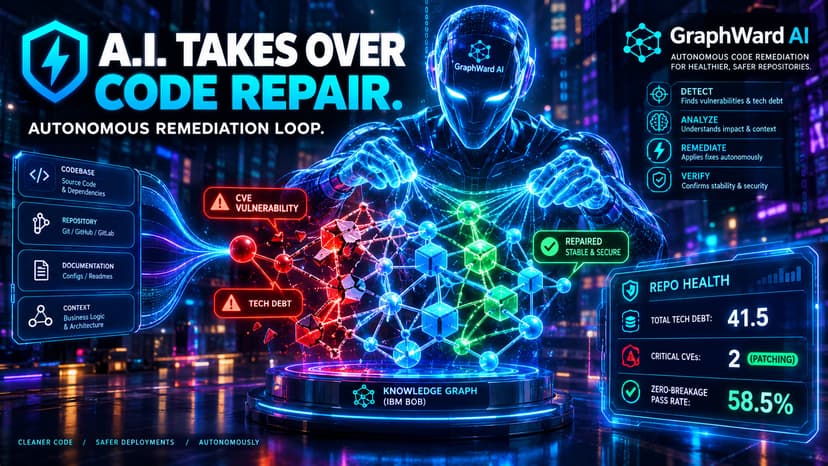
GraphWard AI
Modern software engineering teams face an overwhelming technical debt crisis and security backlog. Legacy codebases, complex module dependencies, and constant CVE security advisories force developers to spend thousands of hours manually tracing call graphs and attempting refactorings. Traditional code completion and autocomplete LLM tools offer inline snippets, but they lack deep architectural visibility. When applied to large codebases, raw LLM patches frequently break existing downstream functionality, causing regression cascades and requiring tedious manual debugging. GraphWard AI solves this problem by delivering an autonomous, closed-loop code remediation and security refactoring platform. Rather than treating code merely as linear text, GraphWard AI parses Abstract Syntax Trees (AST) and maps the complete repository into an Open Knowledge Graph. This topological representation allows the system to analyze function dependencies, evaluate security vulnerabilities, and generate precise refactoring patches across multiple files without breaking connected modules. Target users include DevOps engineers, software architects, security auditors, and maintainers of enterprise repositories. Users interact with GraphWard AI through a real-time web control room and CLI integration. On the web dashboard, users set target repository scopes, track key telemetry—including Total Tech Debt, Active CVE Backlogs, and the Zero-Breakage Pass Rate—and visualize inter-module call graphs. When a remediation run is triggered, the system initiates a closed-loop execution flow: it locates vulnerabilities, authors target patches, applies them cleanly, and executes automated regression suites (such as pytest). If regression failures are detected during execution, GraphWard halts deployment, serializes an AST analysis log, and flags the issue for supervised human review. What makes GraphWard AI unique is its deterministic combination of AST topological graph mapping with agentic verification loops. It bridges the gap between generative patch authoring and rigorous software verification, ensuring that automated refactoring remains safe, audit-ready, and zero-breakage.
27 Sep 2026
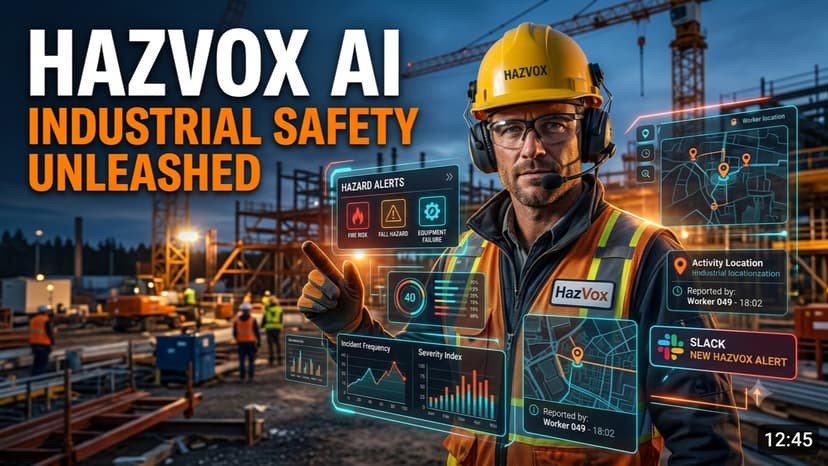
HazVox AI — Hands-Free Voice Safety Agent
HazVox AI is an autonomous, hands-free voice compliance and dispatch agent built for high-risk, loud industrial environments like construction sites, factories, and fleet operations. Workers frequently face high friction when filing safety reports due to restricted visual attention, heavy background noise, and manual OSHA paperwork, leading to delayed hazard mitigation and costly non-compliance penalties. HazVox AI solves this by deploying a hardware-to-dashboard pipeline powered by AssemblyAI's Voice Agent API and Universal-3 Pro model. Workers simply speak into a WebRTC microphone stream. AssemblyAI manages voice activity detection, natural turn-taking, and extreme noise rejection over industrial background sound. Through native JSON-Schema tool calling (`report_safety_hazard`), HazVox extracts structured arguments—such as hazard severity level, equipment ID, and precise location—and posts them directly through a Next.js API route into a Supabase PostgreSQL backend. Supabase Realtime Subscriptions immediately broadcast the updated safety event to an industrial dark-mode command center dashboard, giving operations managers instant situational awareness without worker friction. By eliminating manual logging, HazVox AI reduces workers' compensation insurance premiums by 5–15%, prevents heavy regulatory fines, and recovers billable labor hours. Future roadmap features include Gemini-powered automated triage and Slack dispatch workflows.
30 Sep 2026


