
Augustya Singh@Caesar
2
Events attended
1
Submissions made
India
1 year of experience
About me
Systems-focused engineer and CSE undergrad studying and learning more about low-level architecture, Rust, C++, and event-driven market infrastructure. Builder of Siege Engine, which was a high-throughput, event-driven trading bot, also keen interests spanning macroeconomic analysis and systems internals. Competing in the Lablab.ai Alpaca Hackathon to build ultra-fast, robust agent execution pipelines that bridge LLM decision-making with high-performance market trading logic. Alongside systems engineering, I actively conduct macroeconomic research and market microstructure analysis to understand how liquidity cycles, rate environments, and order book dynamics drive algorithmic behavior.
🤝 Top Collaborators



🤓 Latest Submissions
HedgeMePlease
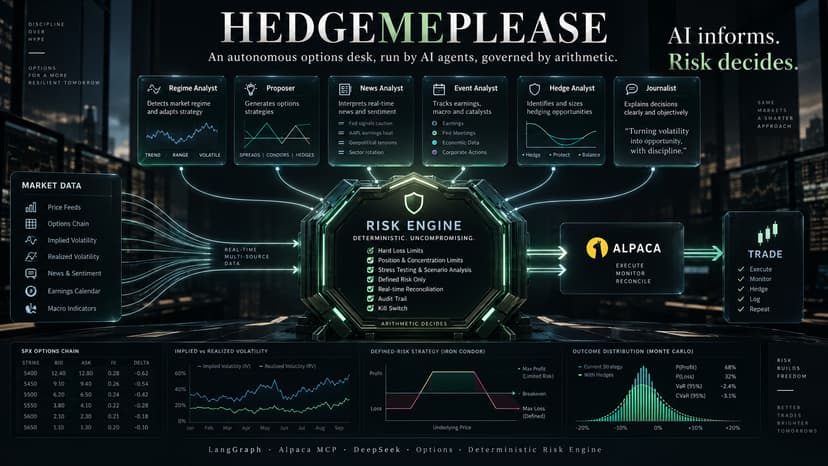
HedgeMePlease is a trading agent that ran a $100,000 Alpaca paper account on its own for the four contest days. No human placed or approved a single trade. It finished at $100,200.69, and the way it got there matters more than the number: the most capital it ever had at risk at one time was $1,916, under 2% of the account. On that deployed capital the return was 10.6% in four days. The worst the account ever dipped inside a day was 0.19%, against a 5% team limit. Seven trades, six winners, and the one loser was insurance we bought on purpose. It made money three ways. Strategy A sold iron condors on ETFs like SPY, but only when four separate checks confirmed options were overpriced versus our own volatility forecast (all 4 trades won, +$174). Strategy B sold the earnings volatility crush on DELL and AVGO in the final minutes before each report (+$118, both won; DELL moved its full expected range overnight and the trade still profited). Strategy C bought a cheap SPY put as crash protection so the other two could stay invested through a tense news week (-$88, the cost of the insurance). Under the hood, a LangGraph state machine wakes every five minutes and pulls live data through Alpaca's official MCP server, the only path to the broker in the codebase. Six DeepSeek agents read the market regime, pick trades, veto on news, time the hedge, and write a diary of every cycle. They can only reduce risk, never increase it: every limit is hard-coded, ending in a kill switch at -3.5% that never came close to firing. Every decision, including refused trades, is logged with the agent's reasoning next to the resulting P&L. Five real bugs were found and fixed live mid-contest without missing a single planned trade, the books are reconciled against the broker every five minutes, and 102 offline tests cover the whole pipeline. http://13.90.28.24:8080/?k=hedgeme26
4 Sep 2026


