
🤓 Latest Submissions
Physics Lab
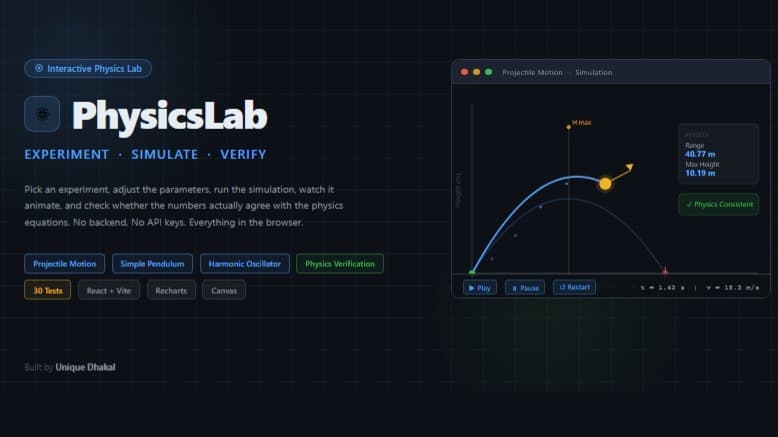
Physics is one of those subjects where the equations look clean on paper but the intuition behind them takes a long time to build. Most people learn projectile motion by memorizing the range formula and moving on. They never actually see what happens when you change the launch angle from 30 to 60 degrees, or what energy conservation looks like as a graph, or whether the numbers a simulation produces actually agree with what the formula predicts. That gap between knowing the equation and understanding what it means is the problem PhysicsLab is built to close. PhysicsLab is a browser-based physics simulation and verification tool. There are three experiments: projectile motion, simple pendulum, and a harmonic oscillator. For each one, you set the physical parameters using sliders or number inputs, hit Run Simulation, and watch the system animate on a canvas in real time. There are four charts per experiment showing trajectory, position over time, velocity over time, and energy over time. Every value displayed has the correct unit. Every chart is built from real calculated data points. What makes it different from a regular physics visualizer is the verification engine. After every simulation, it runs a set of real physics checks and shows you whether the output is physically consistent. For projectile motion it checks that horizontal acceleration stays near zero, that vertical acceleration matches the gravity value that was set, that the range and maximum height agree with the analytical formulas, and that total mechanical energy is conserved. Every check shows the measured value from the simulation, the expected value from the formula, and the percentage error between them. The result is PASS, WARNING, or FAIL depending on how close the simulation is to what the physics actually predicts. Change any parameter and every chart, every result, and every verification check updates to reflect it. The target users are students, self-learners, and anyone who learns better by interacting with something than by reading about it. The interface is designed to feel like a real scientific tool. Everything is labeled. Nothing requires an account or a backend. The whole application runs in the browser with no server and no API keys. The application is built with React and Vite, uses Recharts for the interactive charts, and HTML Canvas for the animations. There are 30 automated unit tests covering all three physics engines. It is deployed on Vercel and the full source is on GitHub. The core idea is that understanding physics should not stop at the equation. It should go all the way through to running the numbers, watching the motion, and then actually checking whether the result makes physical sense. PhysicsLab does all three steps in one place, in the browser, without needing anything else.
27 Sep 2026

