
🤝 Top Collaborators




🤓 Latest Submissions
PulseCommerce AI
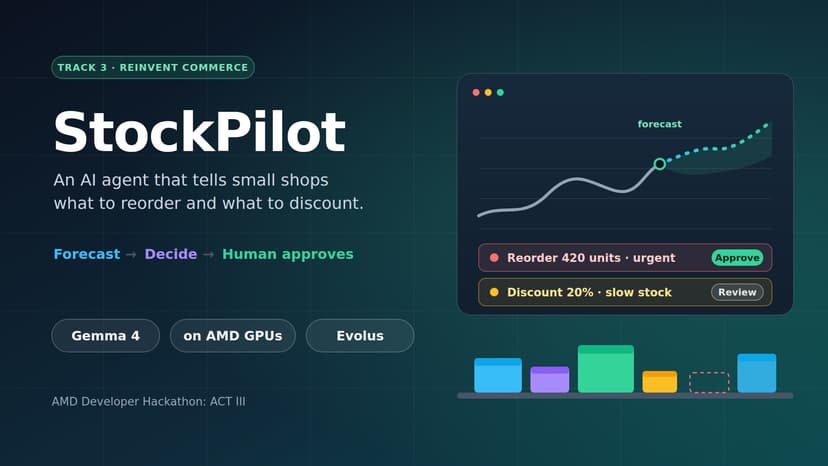
Small retailers lose money in two ways: products run out and sales are lost, or too much stock sits unsold and cash is locked up. Most owners decide by gut feeling. PulseCommerce AI is an agent that tells a merchant what to reorder and what to discount, explains why, and waits for a person to approve before anything happens. How it works: a gradient boosting model forecasts weekly demand per product from sales history, seasonality, price and promotions. We do not use a language model for forecasting, so every number can be measured. Simple rules turn the forecast, stock level and supplier lead time into proposed actions: reorder with quantity and urgency, or discount with a percentage. Gemma 4, served on AMD GPUs through vLLM, explains each action in plain language and drafts the supplier email. Evolus runs the process through its API, with a knowledge library for supplier rules, MCP to update the inventory system, and mandatory manager approval. In a rolling backtest on weeks the model had not seen, it beat both a seasonal-naive baseline and a 4-week moving average (12.4% error versus 13.5% for the best baseline). This test used synthetic data, so it demonstrates the method, not final accuracy. Next steps: real retail data and a live inventory system. Built with Gemma 4, AMD GPUs, vLLM, ROCm, Evolus, Python, scikit-learn and Docker.
18 Oct 2026
Incident Commander: AI Incident Response
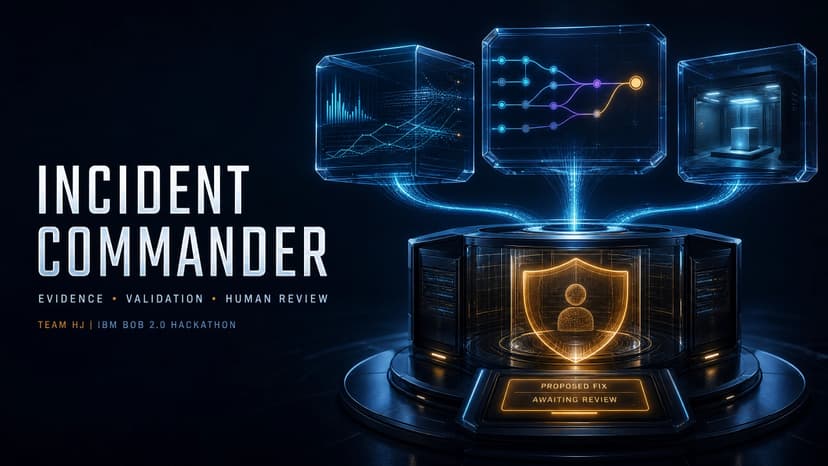
Incident Commander tackles the slow, fragmented first-response work after a production bug: engineers must connect a failing test or stack trace to the responsible code change, verify a proposed repair, and document what happened while under pressure. The project is designed for on-call engineers and small development teams, and targets the hackathon's debugging and application-maintenance challenges. In the demo, an engineer enters a service, severity, failing test, and raw error log in one dashboard. Incident Commander presents a three-role investigation: Log Analyst identifies the failing function and symptom; Code Historian links the evidence to a suspect Git commit; Fix Writer proposes a focused patch. The combined report surfaces the source file, test, commit, and plain-language explanation, so the engineer can review the reasoning instead of treating the answer as a black box. In this submitted MVP, these agent findings are loaded from structured project files; the deployed backend does not invoke live Bob or watsonx agents at runtime. The FastAPI backend adds context from the sample runbook and README, runs the original sample tests to confirm the seeded bug, then applies the proposed change only to a temporary copy and runs the tests again. It records the actual test result and cleans up the copy, leaving the original sample app untouched. In the submitted recording, the proposed-fix check fails; the dashboard correctly marks the fix unverified and requires human review. The project does not auto-deploy. The workflow then drafts an incident postmortem containing a timeline, impact, root cause, and prevention steps. Its creative value is the complete, explainable loop from incident evidence to change history, a reviewable patch, an independent test outcome, and reusable documentation—not just a code suggestion. By bringing those steps into one guided workspace, it aims to reduce context switching, help engineers reach a trustworthy first read faster, and keep final operational decisions with the human on-call engineer.
27 Sep 2026


