

🤝 Top Collaborators




🤓 Latest Submissions
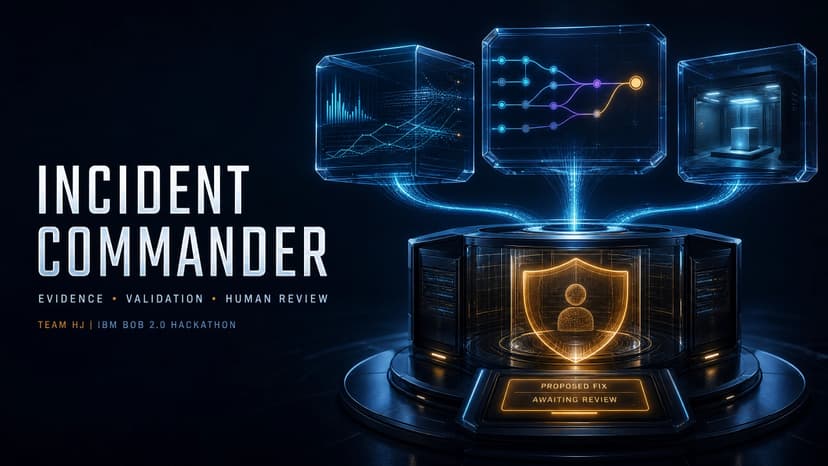
Incident Commander: AI Incident Response
Incident Commander tackles the slow, fragmented first-response work after a production bug: engineers must connect a failing test or stack trace to the responsible code change, verify a proposed repair, and document what happened while under pressure. The project is designed for on-call engineers and small development teams, and targets the hackathon's debugging and application-maintenance challenges. In the demo, an engineer enters a service, severity, failing test, and raw error log in one dashboard. Incident Commander presents a three-role investigation: Log Analyst identifies the failing function and symptom; Code Historian links the evidence to a suspect Git commit; Fix Writer proposes a focused patch. The combined report surfaces the source file, test, commit, and plain-language explanation, so the engineer can review the reasoning instead of treating the answer as a black box. In this submitted MVP, these agent findings are loaded from structured project files; the deployed backend does not invoke live Bob or watsonx agents at runtime. The FastAPI backend adds context from the sample runbook and README, runs the original sample tests to confirm the seeded bug, then applies the proposed change only to a temporary copy and runs the tests again. It records the actual test result and cleans up the copy, leaving the original sample app untouched. In the submitted recording, the proposed-fix check fails; the dashboard correctly marks the fix unverified and requires human review. The project does not auto-deploy. The workflow then drafts an incident postmortem containing a timeline, impact, root cause, and prevention steps. Its creative value is the complete, explainable loop from incident evidence to change history, a reviewable patch, an independent test outcome, and reusable documentation—not just a code suggestion. By bringing those steps into one guided workspace, it aims to reduce context switching, help engineers reach a trustworthy first read faster, and keep final operational decisions with the human on-call engineer.
27 Sep 2026
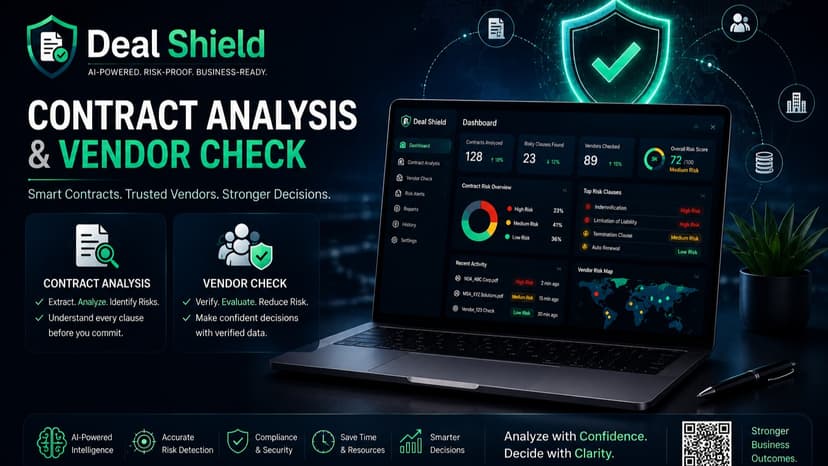
Deal Shield — Contract & Vendor Risk Agent
Deal Shield is an AI-powered Contract & Vendor Risk Agent built for small businesses, startups, founders, procurement teams, and operations managers who need faster and clearer business risk assessment. Users can upload a business contract in PDF format and receive an AI-assisted analysis of important clauses, including payment terms, termination, confidentiality, intellectual property, liability, indemnity, renewal, data privacy, governing law, and dispute resolution. Each finding includes a risk classification, plain-English explanation, supporting context, and practical negotiation recommendation. The application also provides vendor intelligence by assessing available vendor information and credibility signals, including reputation, reviews, business details, and news-related indicators where available. Contract risk and vendor risk are combined into an explainable Deal Safety Score to support more informed business decisions. The workflow is simple: Upload Contract → Extract Text → Analyze Clauses → Assess Vendor Risk → Calculate Deal Safety Score → View Recommendations. Deal Shield is built primarily with native.builder using React, TypeScript, Supabase, Supabase Edge Functions, and AI-powered analysis workflows. AI output supports business risk review and is not a substitute for advice from a qualified legal professional.
10 Aug 2026

ZameenEye-AI
ZameenEye-AI is a wildfire detection pipeline that bridges computer vision with real-world geospatial infrastructure. At its core is a custom-trained YOLOv8 object detection model, trained end-to-end on AMD Radeon hardware via ROCm across 50 epochs, learning to identify wildfire and smoke hotspots from satellite and aerial imagery, reaching an mAP50 of 0.94 on the validation set. The inference pipeline runs natively on AMD GPU compute, with the device explicitly targeted via PyTorch's ROCm-backed CUDA interface (device='cuda:0'), confirmed through torch.cuda.get_device_name(). A single image passes through the model in roughly 4 milliseconds, fast enough for near real-time monitoring workflows. Detection doesn't stop at a bounding box. Each hotspot's pixel coordinates are passed through a georeferencing transform — linear interpolation across a defined area-of-interest's bounding coordinates — converting pixel-space detections into real-world latitude and longitude. The output is a structured, PostGIS-compatible payload (SRID=4326, WKT POINT geometry) with hazard type and confidence score, ready for ingestion into a spatial database for mapping, alerting, or historical tracking. The stack: YOLOv8 (Ultralytics) for detection, PyTorch with ROCm for AMD GPU acceleration, OpenCV for image I/O, and a Python inference layer producing PostGIS-ready JSON. The long-term architecture is designed to plug into a live satellite tile feed and a multi-tenant backend, turning raw imagery into actionable, geolocated wildfire alerts for wildfire-prone regions, including areas across Pakistan where early-detection infrastructure is limited.
13 Jul 2026


