
🤝 Top Collaborators



🤓 Latest Submissions
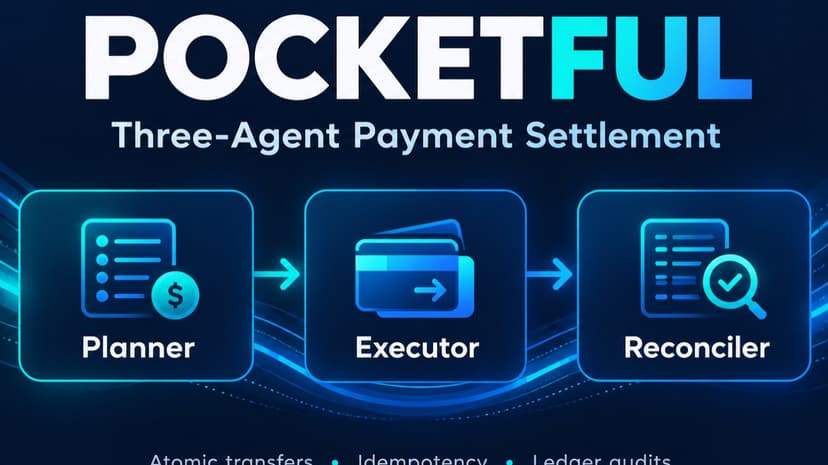
Pocketful: Three-Agent Payment Settlement
Pocketful is an autonomous payment settlement prototype built for the Dark Factory hackathon’s pocketful track. Three AI agents coordinate in a BAND room: the Planner validates requests, the Executor performs approved transfers, and the Reconciler independently audits the resulting ledger state. Only the Executor receives the transfer tool; the other agents have read-only settlement tools. The agents call a Python FastAPI service backed by a C ledger. Balances use integer cents, and a mutex protects ledger operations. Each transfer applies its debit, credit, and transaction record atomically. Replaying an identical transaction identifier moves no additional money, while reusing an identifier with different transfer details is rejected. Invalid amounts, sub-cent precision, unknown accounts, self-transfers, and insufficient funds are also rejected. The current repository passes 76 automated tests covering the C core and HTTP API. A documented BAND session demonstrates an approved transfer, execution, and audit without further human input. C-level concurrency testing provides additional evidence of transaction safety. The prototype is intentionally transparent about its limits: balances and transaction history are held in memory, HTTP handlers currently serialize requests, and controlled lost-response recovery and transient retries remain unverified. It demonstrates coordinated agents operating over a tested settlement service using simulated funds.
6 Oct 2026
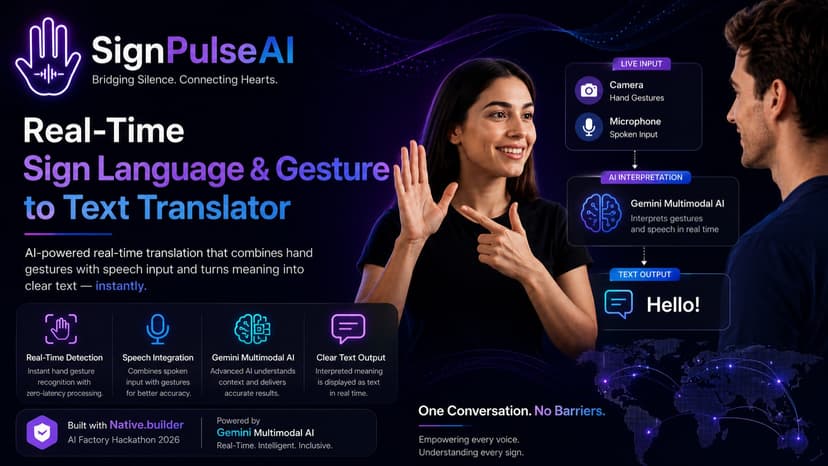
SignPulseAI: Real-Time Gesture-to-Text Translator
SignPulseAI is a real-time multimodal AI application designed to help bridge communication gaps for people who may have difficulty hearing. The application combines hand gestures or sign-language input captured through a camera with spoken input captured through a microphone. The system uses MediaPipe Hand Landmarker for real-time hand landmark detection and processes the visual input together with speech information through a low-latency AI pipeline. Gemini Multimodal AI is used to interpret the combined visual and language context and determine the intended meaning. The interpreted result is presented as readable text in real time through a live user interface. Users can see the camera feed, gesture detection, and generated text while interacting with the application. The core workflow is: Camera + Microphone → Hand Gesture & Speech Input → Computer Vision → Gemini Multimodal AI → Interpretation → Real-Time Text Output. SignPulseAI focuses on accessibility, real-time interaction, and multimodal communication. Instead of relying only on visual gesture recognition, the system combines gesture and spoken context to improve interpretation and provide meaningful text output. The project was developed by Team Algorithmic Vanguard for the AI Factory Hackathon 2026 using native.builder as the primary application-building platform, with Gemini Multimodal AI, MediaPipe, Speechmatics, Supabase, React, and Vite as supporting technologies.
10 Aug 2026
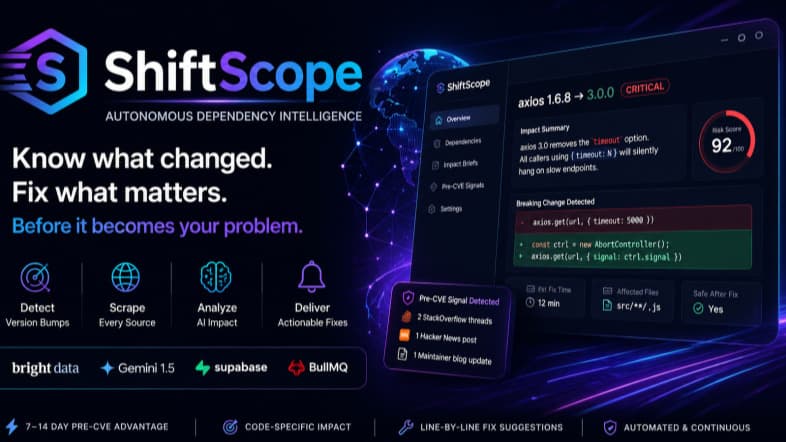
ShiftScope: AI-Powered Dependency Intelligence
ShiftScope is an autonomous dependency intelligence agent that tells you exactly what a package update means for your code — not just that it happened. While tools like Dependabot and Renovate detect version bumps and open PRs, ShiftScope goes further: it scrapes the full human-written context around every release — changelogs, GitHub issues, security blogs, Reddit threads, StackOverflow workarounds — then runs a 5-step AI analysis chain to produce a ranked, code-specific impact brief with line-by-line fix suggestions. It also monitors the pre-CVE window: the 7–14 day gap between public security disclosure and official CVE assignment, during which every standard scanner reports zero vulnerabilities. How it works: A 15-minute cron cycle detects version changes across all major ecosystems (npm, PyPI, Cargo, Go, RubyGems, Maven). For each change, it scrapes 6 source types via Bright Data, stores raw intelligence in Supabase, runs it through Gemini 1.5 Pro, and delivers a severity-ranked brief to Slack, email, webhook, or dashboard — with before/after code diffs and an estimated fix time.
31 May 2026

Medication Reminder
This project is designed as a personal healthcare companion that improves how people manage their medications and access quick health guidance. Many patients, especially the elderly or those with chronic illnesses, often struggle with remembering when and how to take their medicines. At the same time, they may have common health-related questions but no immediate access to professional help. This app addresses both problems in a single solution. On one side, the Medicine Reminder System allows users to enter details about their prescriptions, including medicine name, dosage, date, and specific times of day. These reminders are stored safely on the device and trigger popup notifications at the right time. To make the experience more user-friendly, the system integrates with the Eleven Labs Text-to-Speech API to generate clear voice alerts, so users are verbally reminded: “It is 9 AM, time to take 1 tablet of Paracetamol.” On the other side, the app includes an AI Chatbot powered by Coral Protocol. This assistant can handle common health-related queries such as: “What should I do if I miss a dose?” “Can I take two medicines together?” The chatbot streams answers in real-time, providing concise and easy-to-understand guidance. It offers a smooth conversational interface where users can either type their own questions or select from predefined suggestions. Together, these two systems — Reminders + AI Chatbot — create a reliable and interactive digital health assistant. By combining automation, voice technology, and artificial intelligence, the app not only ensures that patients never miss their medicines but also empowers them with quick medical guidance whenever needed. Ultimately, this project demonstrates how technology and AI can be merged with healthcare to improve everyday life, reduce mistakes in medication routines, and give people more confidence in managing their health independently.
21 Sep 2025

3D Virtual Assistant AI for Astronauts
An advanced AI-powered 3D virtual assistant designed to assist astronauts during space missions with real-time voice interaction, facial animations, and intelligent responses.3D Realistic Human Assistant: Built using Three.js and Blender models for lifelike animations and interactions. Real-time Speech Recognition: Converts astronaut commands into text using advanced AI models like OpenAI Whisper. LLM-Powered Conversation: Provides intelligent and context-aware responses using OpenAI, LLaMA, and Custom GPT. Text-to-Speech (TTS) Synthesis: Generates lifelike voice responses using Google TTS, Amazon Polly, and OpenAI TTS. Lip Sync & Facial Animations: Enhances realism using Viseme-based animation techniques. Multi-Platform Support: Compatible with web (React), desktop (Unity), and mobile (React Native) platforms.Mission Integration: Offers real-time mission status updates and alerts, making it a valuable tool for space missions. The project targets space agencies, aerospace companies, AI technology firms, and research institutions, providing enhanced astronaut support, improving mission efficiency and safety, and creating new opportunities for innovation in AI and space technologies.
9 Feb 2025


