
Daniel Landi@drlandi
3
Events attended
2
Submissions made
Brazil
1 year of experience
About me
AI and infrastructure engineer from São Paulo, Brazil. After 25+ years running mission-critical telecom systems across seven countries, I'm building AI applications and local-LLM tooling: a C inference runtime on llama.cpp for 8 GB CPU-only machines, typed-decision LLM demos, and serverless AWS pipelines. I'm also a teacher at a São Paulo state public school and a student at 42 São Paulo. For the IBM Bob 2.0 Hackathon I built a self-correcting AI teaching activity generator that adapts to any classroom's resource level. Portfolio: drlandi.dev
🤝 Top Collaborators

🤓 Latest Submissions
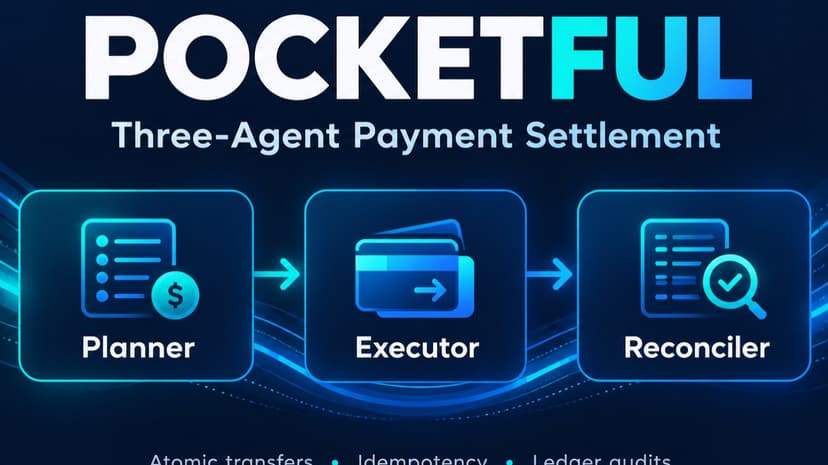
Pocketful: Three-Agent Payment Settlement
Pocketful is an autonomous payment settlement prototype built for the Dark Factory hackathon’s pocketful track. Three AI agents coordinate in a BAND room: the Planner validates requests, the Executor performs approved transfers, and the Reconciler independently audits the resulting ledger state. Only the Executor receives the transfer tool; the other agents have read-only settlement tools. The agents call a Python FastAPI service backed by a C ledger. Balances use integer cents, and a mutex protects ledger operations. Each transfer applies its debit, credit, and transaction record atomically. Replaying an identical transaction identifier moves no additional money, while reusing an identifier with different transfer details is rejected. Invalid amounts, sub-cent precision, unknown accounts, self-transfers, and insufficient funds are also rejected. The current repository passes 76 automated tests covering the C core and HTTP API. A documented BAND session demonstrates an approved transfer, execution, and audit without further human input. C-level concurrency testing provides additional evidence of transaction safety. The prototype is intentionally transparent about its limits: balances and transaction history are held in memory, HTTP handlers currently serialize requests, and controlled lost-response recovery and transient retries remain unverified. It demonstrates coordinated agents operating over a tested settlement service using simulated funds.
6 Oct 2026
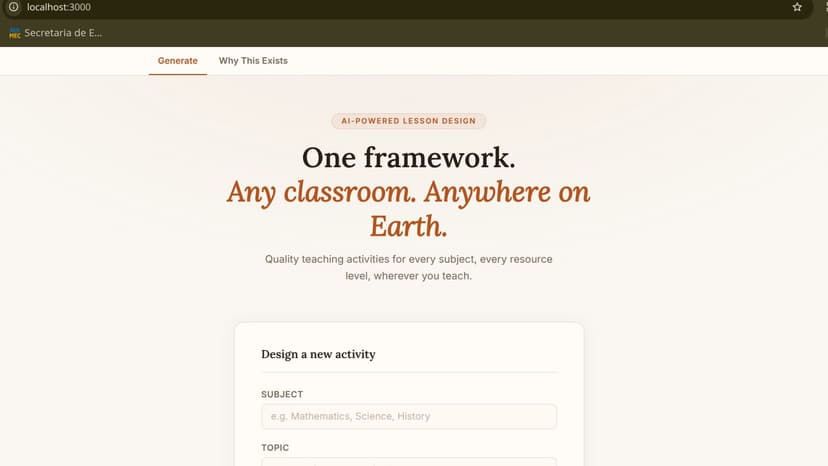
Self-Correcting AI Teaching Activity Generator
THE PROBLEM Teachers everywhere — from well-resourced schools to under-resourced classrooms — spend enormous unpaid time designing engaging, age-appropriate lesson activities. AI tools can generate lesson content quickly, but a single-pass AI output can quietly contain real defects: unsourced statistics, rubrics too vague to grade consistently, sensitive topics flattened into simplistic binaries, or timelines that don't fit the class period. A teacher using an AI generator has no way to know which of these problems, if any, made it into their activity. THE SOLUTION This project is a Node.js/Express web app where a teacher enters a subject, topic, optional cross-curricular link, and classroom context (grade level, available resources, class size). The app calls IBM Bob 2.0 as the generation engine to produce a complete, ready-to-teach activity: a narrative hook, timeline, materials list, step-by-step instructions, reflection questions, an assessment rubric, and customization zones — rendered as a clean, printable page with an optional Mermaid flowchart view. What makes this different from a single-shot AI generator is a second, automated self-critique pass. After Bob generates an activity, the app calls Bob a second time to review its own output against six concrete quality checks we identified through a manual audit of an initial batch of test activities: unsourced or overconfident data claims, false binaries that flatten real-world nuance (especially in historical or social topics), unrealistic scope for the stated class time, rubrics that lack concrete observable examples, missing opt-out options for students uncomfortable with public speaking, and internal contradictions between different sections of the same activity. If a real issue is found, the activity is revised at the exact location of the defect — not just patched with a generic disclaimer. If the critique step fails for any reason, the app safely falls back to the original, successfully-generated activity, so a technical hiccup in the quality-check layer never blocks a teacher from getting their lesson. The app also adapts its material recommendations to the classroom's actual resources: a well-resourced school might get a recommendation for lab equipment or a robotics kit, while a low-resource classroom gets the same concept taught with straws and tape, cut paper, mud, or found containers — the same pedagogy, adapted to what's actually available. TARGET USERS Teachers in any subject and any resource context — from fully-equipped STEM labs to classrooms with no budget for materials — who want a ready-to-teach activity they can trust was checked for common AI-generation pitfalls before it reaches their students. WHY THIS IS EFFECTIVE We didn't just build this and assume it worked — we tested it. We manually audited 10 initial test activities against six pedagogical quality dimensions, found a real bug in our own quality-validator script (it was counting punctuation marks instead of actual questions), fixed it, then built the self-critique mechanism and ran it through five additional adversarial test scenarios spanning physics, sensitive history, a contested policy debate, a mock trial, and a science lab — refining the mechanism each time a real gap was found, including catching and permanently blocking a case where the AI fabricated a fake academic citation to satisfy a "cite your source" instruction. Only after that iterative testing did we wire the mechanism into the live app, then verified it end-to-end through the actual running application.
27 Sep 2026


