
🤝 Top Collaborators


🤓 Latest Submissions
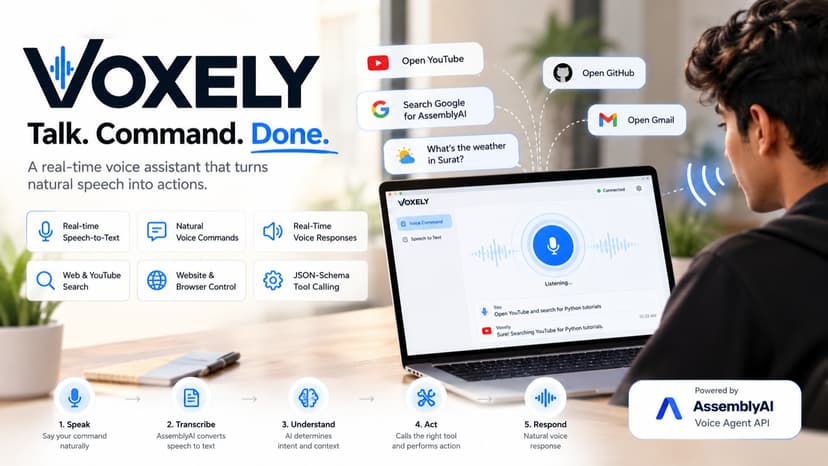
Voxely – Voice-Controlled Assistant
Voxely is a real-time voice-controlled assistant designed to make everyday computer and web interactions faster and more natural. Instead of typing commands or navigating through multiple interfaces, users can simply speak to Voxely and let it understand and perform the requested action. The project uses AssemblyAI Voice Agent technology for real-time speech-to-text, voice activity detection, natural turn-taking, voice responses, and intelligent tool calling. Voxely supports two core experiences: Voice Command and Speech-to-Text. In Voice Command mode, users can say commands such as “Open YouTube,” “Search YouTube for Python tutorials,” “Search Google for AssemblyAI,” “Open GitHub,” or “What is the weather in Surat?” The assistant identifies the user's intent and calls the appropriate tool. The Speech-to-Text mode provides live transcription while the user speaks, with options to pause, resume, stop, clear, copy, and download the generated text. The system maintains short conversational context, allowing natural follow-up commands such as “Open the first result” or “Go back.” Voxely focuses on a simple, practical, and human-centered voice experience where speech becomes text, intent becomes an action, and the result is delivered immediately through a natural voice response.
30 Sep 2026
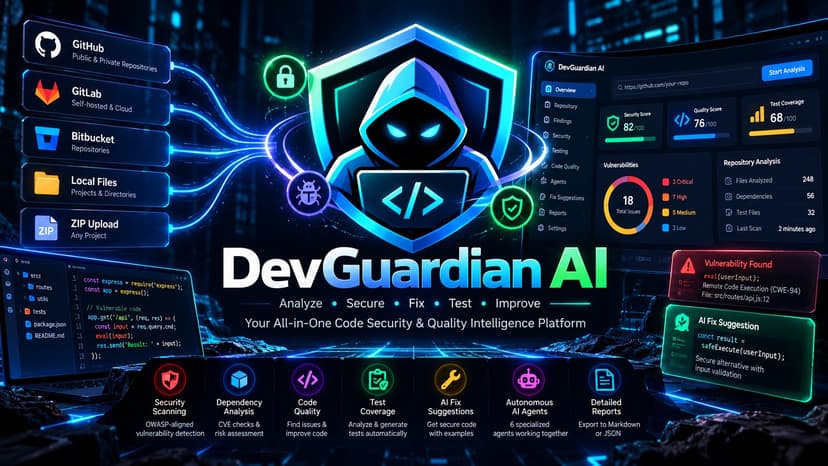
DevGuardian — Autonomous Code Security
Problem Modern software teams spend significant time manually reviewing code, identifying security vulnerabilities, checking dependencies, finding testing gaps, debugging failures, and validating fixes. These activities are often performed across multiple tools and require developers to repeatedly inspect files, understand dependencies, write tests, run validation, and review the resulting changes. This increases development time, manual effort, errors, and rework. Solution DevGuardian AI is an autonomous software-engineering platform designed to improve this workflow. It uses IBM Bob as the core development and agentic intelligence component to analyze a real software repository and coordinate multiple specialized engineering tasks. A developer provides a repository to DevGuardian. The system first builds an understanding of the project structure, technology stack, dependencies, important components, and existing tests. Specialized agents then analyze the repository for security vulnerabilities, dependency risks, code-quality issues, testing gaps, and potential defects. Findings are categorized by severity and include the affected file, location, explanation, evidence, and recommended remediation. DevGuardian can then generate proposed fixes and regression tests. The modified code is tested and analyzed again to verify whether the identified problems have been resolved and whether the changes introduce regressions. Core workflow Repository → Code Analysis → Security Analysis → Test Analysis → Risk Prioritization → Fix Generation → Regression Tests → Validation → Re-scan → Engineering Report The platform contains specialized roles including a Code Analyst, Security Agent, Test Agent, Debug Agent, Review Agent, and Documentation Agent. These agents focus on separate tasks to reduce duplicated analysis and make the workflow easier to understand. Target Users DevGuardian is designed for software developers, development teams, security engineers, QA engineers, and teams maintaining existing applications. What makes it different Instead of only reporting vulnerabilities or generating code, DevGuardian demonstrates a complete engineering loop: understand the repository, identify problems, propose remediation, generate tests, execute validation, re-check the repository, and report measurable improvements. The dashboard presents findings, severity, test results, coverage information, agent activity, changed files, validation status, and before/after metrics in one place. IBM Bob IBM Bob is a core component of the solution. Bob IDE is used to understand the repository, develop the platform, perform agentic engineering tasks, analyze code, generate and modify implementation, create tests, debug failures, review changes, and iterate on the solution. Bob's agent/subagent capabilities are used to divide complex engineering work into focused tasks. The prototype demonstrates how an AI-assisted developer workflow can reduce repetitive manual analysis and validation while keeping developers in control of important code changes. This aligns closely with the official requirements around developer workflow improvement, Agent mode/subagents, full workflow demonstration, and measurable impact
27 Sep 2026


