

mohit mohit@MADHAV-AI-LAB
2
Events attended
2
Submissions made
India
1 year of experience
About me
I AM A PART-TIME CODER MEANS A VIBE CODER . I EXICTED TO LEARN SOMETHING NEW & COMPLICATED THINGS. RECENTLY I AM WORKING ON AUTONOMOUS AI PERSONAL AGENT WHICH HAVE MULTI BRAINS AND PERSONALITY. & MY INETEREST IS IN QUANTUM COMPUTING ALSO
🤓 Latest Submissions
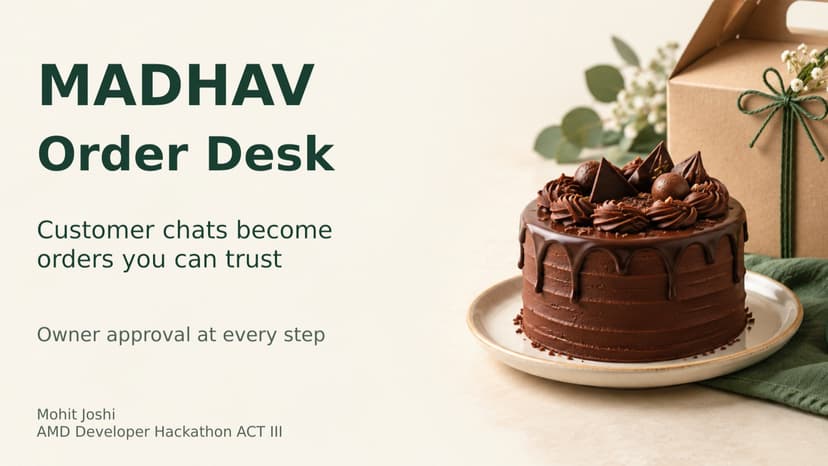
MADHAV Order Desk
Small businesses that sell through chat have to turn informal messages into reliable orders. A home baker must identify the requested item, confirm the pickup date, check capacity and calculate the advance while answering repeated questions. MADHAV Order Desk brings that workflow into one place. DeepSeek-V4-Flash through AMD TokenFactory extracts product, quantity and date from English or Hinglish conversations. Code validates the structured response, uses catalog prices and checks capacity for the requested pickup date. If a cake is sold out, the reply suggests available alternatives and asks the customer to choose. Missing details and unsupported requests require clarification or owner review. The owner approves each reservation and reply. Reservation changes update the existing order instead of creating duplicates. The order book separates order value from manually recorded payments and the outstanding balance. Customer claims never automatically mark an order paid. Our working prototype includes fictional customer chats, editable proposals, a catalog, capacity checks, payment recording and CSV export. Six synthetic deployed AMD extraction checks passed after prompt refinement. Local regression tests cover stock, duplicate prevention, edits, alternatives and payment bounds. These are development checks, not an official benchmark. The initial target is home bakeries, with a monthly subscription as a business hypothesis. Next we plan merchant pilots to measure time per confirmed order and missed requests. The current demo simulates WhatsApp-style chat, uses browser-local storage and does not send real messages or collect payments. Production steps include the official WhatsApp API, shared storage and payment webhooks. Built by Mohit joshi with OpenAI Codex assistance.
18 Oct 2026
MADHAV Lens — AMD GPU OCR
MADHAV Lens is an OCR application developed for Mini Challenge 2 of the AMD AI Academy Challenge. It uses Qwen2.5-VL-3B-Instruct with PyTorch and AMD ROCm to read vehicle registration plates and road signs. The application supports PNG, JPEG, and TIFF inputs and writes extracted text in the required JSON format. A persistent GPU worker loads the model once, while a lightweight command-line client handles individual image requests. For license plates, the prompt requests the registration number without surrounding state banners or slogans. For road signs, it requests the printed text in reading order. Testing on an AMD Radeon Pro W7900D correctly transcribed all 10 public PDF samples and all 54 cases in a supplementary sample-based test suite. These results are development checks, not hidden-set evaluation scores. Additional real-world testing revealed some missed text and character errors. The Docker image has been built using the mandated ROCm base, and its library imports and size have been checked. Final GPU-container execution and uncached startup validation remain pending.
1 Dec 2026


