
🤝 Top Collaborators




🤓 Latest Submissions
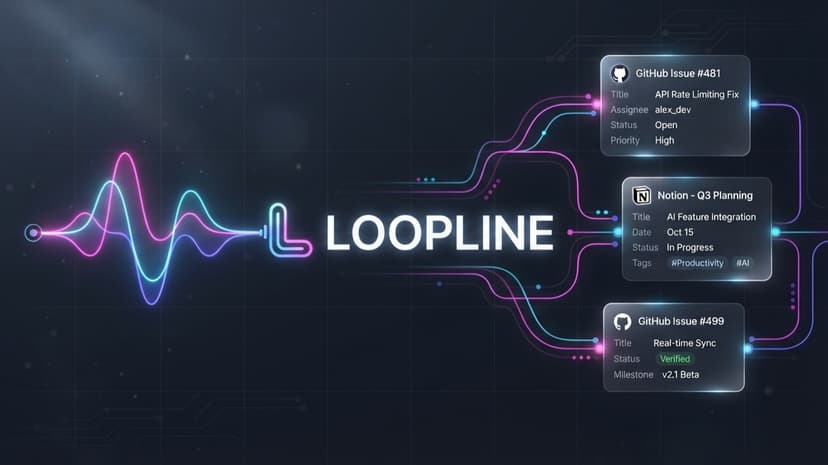
Loopline — Ambient Voice Triage & Auto-Filing
Loopline is an ambient voice-triage agent: open a tab, talk freely about several unrelated things in one breath — a bug, a reminder, a stray idea — and it splits what you said into discrete items, decides where each one belongs, and actually files it. A real GitHub issue. A real Notion page. Not a transcript you still have to process later. Most voice tools solve capture or summarization. Neither decides where something goes, and neither takes action. Loopline is built as a routing decision-maker with real write access: a segmentation pass splits a messy ramble into separate thoughts, a classification pass assigns each one a type and a destination with a confidence score, and — only for anything that clears the confidence threshold — execution agents file it for real through GitHub's and Notion's official MCP servers. Processing runs entirely as a batch pass right after the capture ends, not live mid-conversation, so nothing about the GitHub or Notion integrations can ever break the capture itself. The capture agent runs on AssemblyAI's Voice Agent API, tuned to listen ambiently with wide turn-detection thresholds rather than converse; segmentation and classification run on AssemblyAI's LLM Gateway. Governance is built in, not bolted on: anything that sounds like a password or secret is never filed anywhere, and every session ends with a digest — a full recap of what was heard and where it went, so nothing happens silently. Loopline was built and tested live while developing a separate real project, VibeSecure — narrating bugs and enhancement ideas out loud while testing the app, then watching them land as real GitHub issues and Notion notes with one click. It's not a voice receptionist demo. It's the missing layer between a fleeting thought and it actually being tracked.
30 Sep 2026
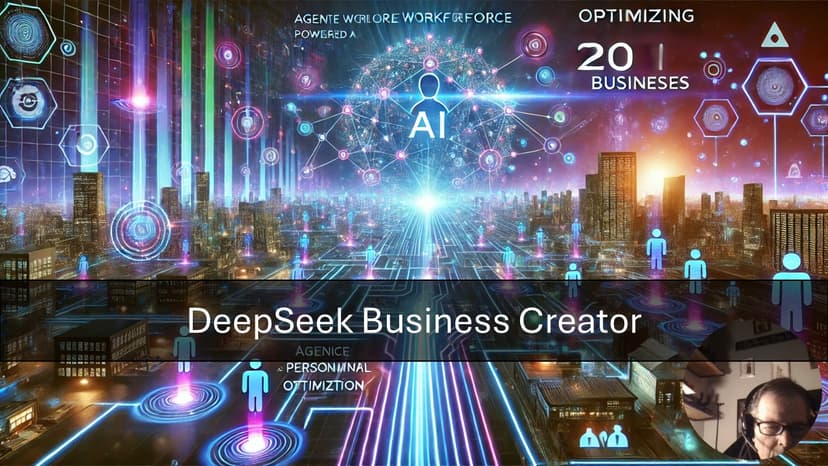
DeepSeek Business Creator
The DeepSeek Business Creator demonstrates how to leverage DeepSeek's latent reasoning space to emulate three-agent interaction for multi-business creation on the web. This system integrates a simple Markov chain optimization process with browser automation, allowing businesses to emerge dynamically in an optimized sequence. The approach enables AI-driven enterprises to launch and scale efficiently, simulating real-world economic expansion with minimal human intervention. From an initial dataset of 200 business ideas, 20 were selected based on predefined success factors. Each of these businesses was assigned three AI agents, each specializing in different aspects of business creation: market research, operational strategy, and adaptive growth. The sequence of business creation was optimized using a Markov chain model, ensuring that dependencies between business types and market readiness were accounted for. This optimization increased the likelihood of success by structuring the order in which AI-driven businesses launched and scaled. AI agents interacted within DeepSeek’s latent space to generate business plans dynamically. These plans emerged from the interplay of three AI agents, refining concepts based on strategic reasoning. Once validated, browser automation was used to execute the launch of these businesses, coordinating their deployment across different online markets. As AI-driven businesses launched, they began to emerge in various markets worldwide. The system's ability to simulate economic scaling in a decentralized manner demonstrated the potential of AI agents to drive real-world business success autonomously. As businesses evolved, AI agents adapted and absorbed the most successful strategies. The agent absorption rule ensured that underperforming agents were phased out, while the most effective decision-making patterns were integrated into the next generation of business iterations.
16 Feb 2025


