

🤓 Latest Submissions
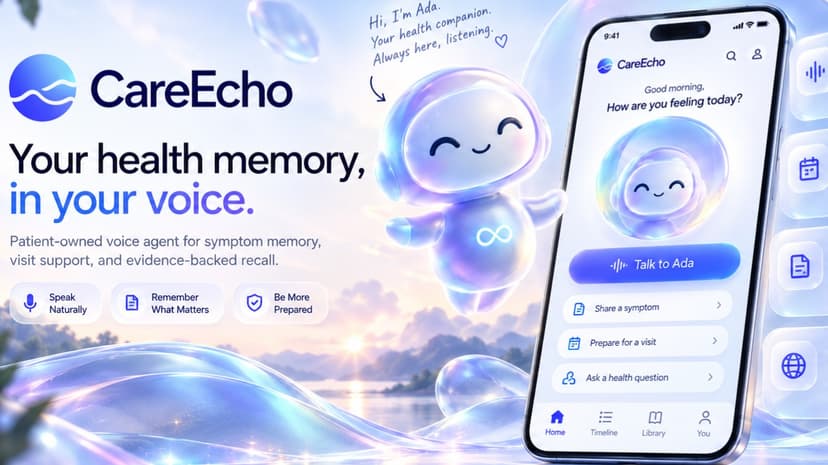
CareEcho — Patient-Owned Voice Health Memory
CareEcho is a patient-owned voice health memory that stays with someone before, during, and after a medical visit. Between appointments, users speak naturally to CareEcho about symptoms, changes, concerns, and questions. Those reports become a dated, structured health timeline with the original voice evidence preserved. During a consultation, CareEcho can retrieve that history in real time. If a clinician asks when a symptom started, the patient can ask CareEcho and receive an answer grounded in their own saved records. When a clinician gives a new medication or care instruction, CareEcho does not silently overwrite memory. Its Confirm-to-Commit flow creates a proposed instruction, compares it with previous confirmed instructions, highlights any conflict, and asks for explicit confirmation before saving the change. After the visit, users can ask questions such as, “What changed with my medication today?” CareEcho answers only from stored evidence and links the response back to the relevant transcript segment. If the information is not in the record, it says so instead of guessing. AssemblyAI powers the real-time voice layer, including speech recognition and the agent conversation flow, while structured tool calls connect voice to health-memory actions such as logging symptoms, searching history, proposing clinician instructions, confirming changes, and retrieving evidence. CareEcho is designed to be multilingual-first and accessible for older adults, blind and low-vision users, and people who find traditional health apps difficult to navigate. It does not diagnose conditions or replace medical professionals. Its core rule is simple: no source, no claim; no confirmation, no clinical-memory change.
30 Sep 2026
OptionGnome
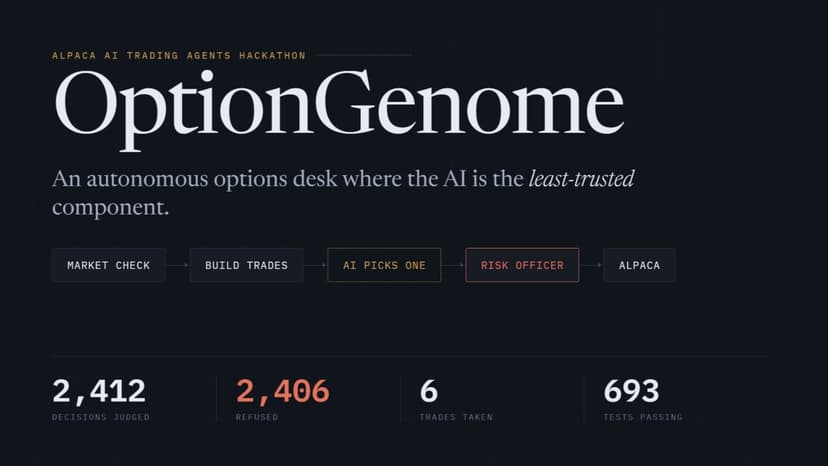
Most trading agents ask an LLM what to trade and then do it. The model always answers. It never says "nothing looks good right now, don't trade," and in trading, not trading is most of the job. OptionGenome flips that. The model is the least-trusted component in the system. HOW IT WORKS MarketDNA classifies the market from arithmetic only (EMA, ADX, realized vs implied volatility, IV rank, an events calendar) and outputs a permission set: which structures are legal and how many lots. Never an order. It withholds permission when implied vol is not above realized, the one case where selling premium has no edge. Roll Desk screens the live SPY option chain and builds fully specified defined-risk candidates: put credit spreads and iron condors, 5 and 10 wide, ranked on credit net of bid-ask cost per dollar of risk. Qwen-2.5-72B (Featherless) picks one and writes one sentence why. That is its entire authority. It cannot change a strike, expiry, size or price. It never sees equity, buying power, the risk budget or the rules. Its reply is parsed as hostile input. The Risk Officer runs 15 deterministic checks and is the only thing that can commit capital. It recalculates width, credit, max loss and DTE from live quotes instead of trusting the ticket. Any exception is a DENY. Open positions are re-checked every pass: take profit at 50%, stop at 2x, flatten at 1 DTE. All reads go through Alpaca's MCP server, all writes through the Alpaca CLI, and a test fails the build if anything crosses that line. WHAT RUNNING IT LIVE CAUGHT Bugs a green test suite missed: a read tool matched to an order-placing tool. Credits sent with the wrong sign. 49ms of clock skew denying every trade. Each is now a regression test. Every decision lands in an append-only journal. The dashboard shows the last one end to end: what the model chose, and what the Risk Officer did about it. 2,057 decisions. It refused 2,051. Down $96 on $100k paper, every dollar accounted for. Paper trading only.
4 Sep 2026
xRegime Oracle
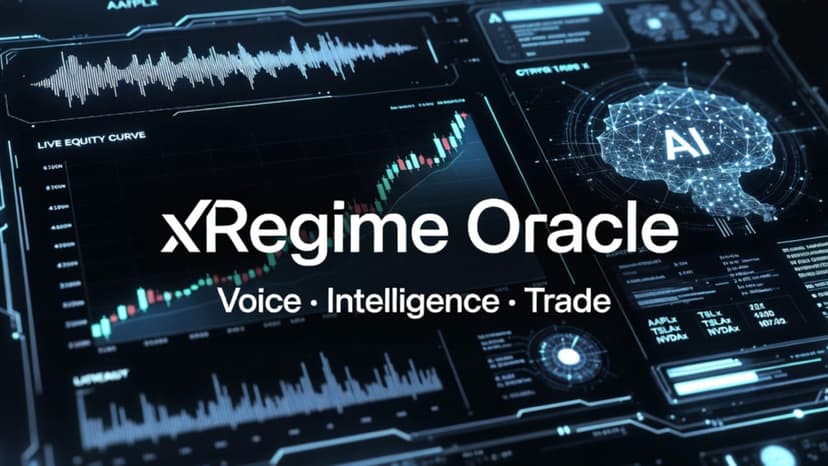
xRegime Oracle is a self-improving autonomous trading agent that turns voice input or earnings calls into executed xStock trades with full transparency and reliability. Core Workflow Voice Layer: Accepts live voice commands or uploaded audio files (Speechmatics real-time/batch transcription + speaker diarization). Intelligence Layer: A 3-model open-source finance ensemble on Featherless (specialized LLMs running in parallel) analyzes transcripts, market signals, and regime shifts, then casts a majority vote on trading decisions. Regime Engine: Calculates a live Regime Score based on recent performance. The agent self-evolves nightly — reviewing its own paper trades and autonomously updating risk rules, stop-loss levels, and momentum thresholds. Execution: All decisions are backtested and executed safely via the official Kraken CLI in paper trading mode. Dashboard: Beautiful, interactive Streamlit web app with colored Regime Score cards, live equity curve chart, chat interface (text + voice), trade history, and full audit trail. Production Deployment Runs 24/7 on a Vultr VPS with auto-restart. Fully open-source, async-first, and built as a market-ready enterprise solution.
19 May 2026
KarmaForge Swarm - Self-Evolving AI Agent
KarmaForge Swarm is a sovereign 5-agent LangGraph swarm powered by local Ollama that autonomously trades in the hackathon sandbox using Kraken CLI and simulated Aerodrome yield. Core innovation: It treats its live ERC-8004 reputation score as "karma" and uses it to dynamically evolve its own rules every 4 hours. Every decision and evolution is EIP-712 signed and emitted on-chain as a validation artifact. The five agents work together in a closed feedback loop: • Signal Scanner pulls real-time market data from Kraken CLI • Risk Guardian dynamically scales risk limits based on current karma • Strategy Engine executes RSI + momentum trades (60% Kraken CEX + 40% simulated Aerodrome yield) • Validator cryptographically signs every action • Reflector runs every 4 hours, critiques performance, proposes small numeric improvements, and emits signed Strategy Checkpoints Fully autonomous, zero paid APIs, persistent SQLite memory, and public MCP endpoint via ngrok. It demonstrates the true promise of verifiable self-improving AI agents for trustless finance.
12 Apr 2026


