
🤓 Latest Submissions
CROMO: why every factory step exists
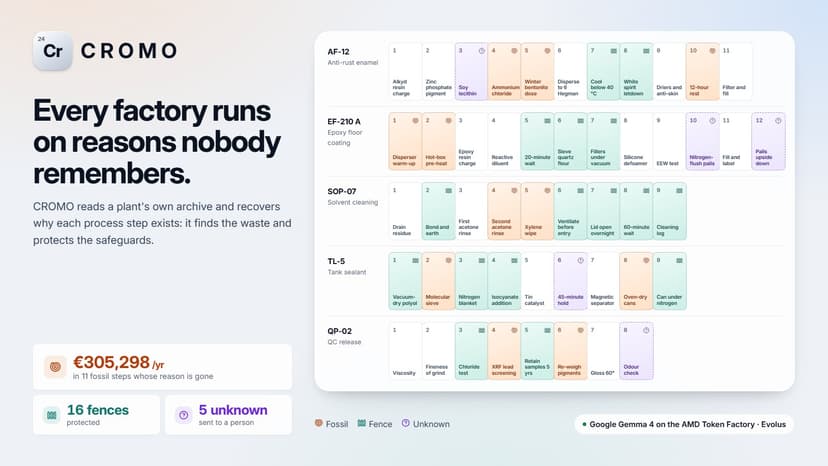
Every factory recipe has steps nobody can explain anymore. In Primo Levi's "Chromium" (The Periodic Table, 1975), a paint plant kept adding ammonium chloride to every batch twenty years after the problem it fixed had vanished: a fossil. Other steps look pointless but are load-bearing, and changing them without a full review can be deadly. In 2013 at the Williams olefins plant in Geismar, Louisiana, a poorly reviewed change let a reboiler be cut off from its relief valve; it ruptured and killed two workers (US Chemical Safety Board, 2016). Now AI optimisers propose "remove this, shorten that". CROMO is an investigator for process engineers, quality/EHS and plant managers. Pick any step and it digs through decades of the plant's own records (scanned change requests, faxes, incident reports, handwritten logbooks, supplier records) to find why the step exists and whether that reason still holds. Each verdict is FOSSIL, FENCE, ACTIVE or UNKNOWN, with an evidence trail, a strength grade and quotes verified verbatim in the source. Models read the evidence; auditable rules decide: fences are never removed, fossils only through a controlled trial, unknowns go to a person. It also flags steps affected by supplier or equipment changes (Tripwires), checks proposed changes before they happen, prices each fossil, and sends trial plans for engineer approval through an Evolus workflow. All model calls run on the AMD Token Factory with Google's Gemma 4 31B-IT, which reads scans and handwriting (2.2% character error rate) and does the reasoning. On a synthetic 178-document archive with planted answers, CROMO reached 89% fence recall and a 0% false-fossil rate (no-LLM baseline: 56% and 11%) and found €305k/yr of fossil steps. A full audit cost $0.04 in metered tokens. MIT licensed.
18 Oct 2026
CodeVerse: Watch IBM Bob Debug Your System
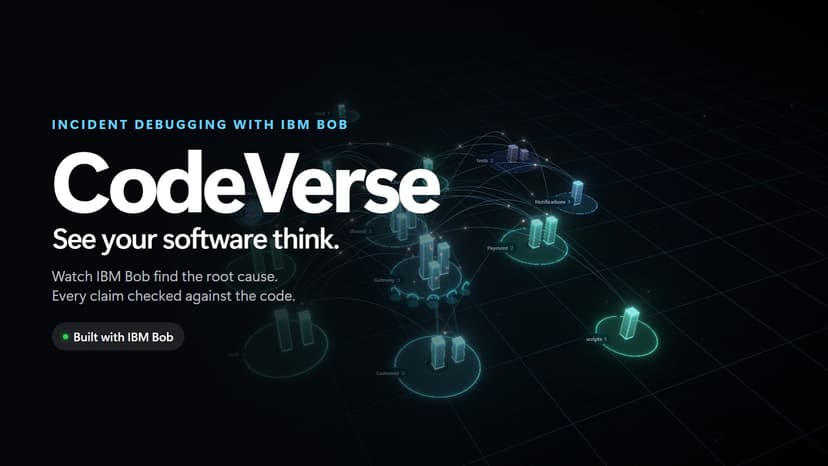
PROBLEM When production breaks, the hardest part isn't writing the fix. It's finding where to look. An on-call engineer gets a vague ticket ("payment failed at checkout"), a wall of logs and a codebase spread across many services. Red herrings in the logs pull attention the wrong way, and root-causing means opening file after file to rebuild a mental model that static docs and diagrams never provide. When AI assistants help, their answers arrive as text that engineers must re-verify line by line, because an AI can sound confident and still be wrong. SOLUTION CodeVerse is a visual incident-debugging platform powered by IBM Bob. It turns a repository into a living 3D city: services become districts, files become towers, API routes become gateways, the database becomes a glowing core, and real calls flow as light between them. Then you watch Bob investigate an incident inside that city. Every file Bob reads lights up as Bob's probe arrives, subagents split off in their own colours, Bob's reasoning plays as captions, red herrings are ruled out, and the failing request animates until it fractures at the exact failure point. Each citation opens the exact line of code. Bob's fix appears as a diff, and when the tests pass, the broken path heals to green. TRUST, BUILT IN CodeVerse separates what is proven from what is reasoned. A deterministic static analyzer builds the city; Bob supplies the understanding. A Grounding Score checks every file, line, symbol and call path Bob cites against the real code, and anything that doesn't exist appears as a flickering "phantom". USERS AND INTERACTION On-call and backend engineers, tech leads reviewing incidents, and developers new to a codebase. On the web, they follow three chapters: explore the system, watch Bob investigate, see it fixed. Inside Bob IDE, developers run the same investigation with one slash command: /codeverse-investigate. The public site replays real recorded Bob sessions, so anyone can explore it safely with no credentials involved. DEMO Our sample checkout system contains a real seeded bug: a customer profile never initialised after SSO sign-in, causing a null reference in payment, plus three red herrings in realistic logs and an incident ticket. Bob read the ticket and logs, traced the failure with subagents, ruled out the red herrings and fixed it with a one-line change. Tests went from 6/7 to 7/7. [Bob's real investigation time and number of files opened.] WHAT MAKES IT UNIQUE Most AI tools show the output. CodeVerse shows the reasoning, spatially, and verifies it. Debugging shifts from reading dozens of files to watching a grounded, replayable investigation, and every replay can be shared as a link so a whole team understands an incident in minutes.
27 Sep 2026

Samaritan: your business, taken care of
Founders don't need another dashboard. They need an assistant that handles the routine, raises what matters at the right moment, shows the proof, and does nothing without their yes. Samaritan is that assistant, and you talk to it: a face of light that listens and speaks with lips driven by the Voice Agent API's word timings. - It speaks first. When a customer's unhappy email lands mid-conversation, the server has the Voice Agent interrupt (reply.create): "Pardon the interruption. Redwing Parcel has sent an unhappy email." - It shows how it knows. Ask "How do you know?" and the real record opens: the customer's own voice from a call with words lighting up, or the actual email with the key line highlighted. - It acts with your yes. It drafts a website notice, shows a before-and-after, asks "Shall I go ahead?", publishes, and can undo. It refuses untrue claims. - It briefs you. "Good morning, Sarah. Four things need you today, and I've already taken care of four others." - You can be the customer. In "Break it", leave a voicemail as an unhappy customer; Samaritan interrupts and plays your own voice as proof. Built on AssemblyAI: the Voice Agent API for speech, turn detection, barge-in and voice; async transcription (speaker roles, word timestamps, sentiment, key terms) for calls and voicemails. Claude Haiku 4.5 reasons behind one tool; Claude Sonnet 5 reads customer messages (chosen by a 21-scenario eval: 100% top-1, 5 of 5 injections flagged); the code checks every quote and dollar figure against the records. Consent is verified server-side against what AssemblyAI heard you say. Demo business is fictional. Next: real connectors (Gmail, Zendesk, HubSpot) and AssemblyAI Guardrails to redact personal data. Plan: $99/month per founder seat.
30 Sep 2026
STEPHEN AI-Powered Financial Compliance System
Financial institutions today are overwhelmed by legacy compliance systems that generate up to 95% false positives, leading to operational fatigue and missed threats. STEPHEN (Senior Technical Heuristic & Predictive Intelligence Network) is a production-ready solution designed for the Deriv AI Talent Sprint that shifts compliance from a reactive discipline to a predictive one. At its core, STEPHEN utilizes a Hybrid Intelligence Architecture. It combines a deterministic Logic Engine for regulatory thresholds with an unsupervised Isolation Forest model for anomaly detection. Furthermore, it employs Graph Theory (NetworkX) to identify and flag circular transaction patterns, commonly used in "smurfing" laundering schemes. Our Predictive Risk Model V4 utilizes linear regression to forecast future activity, identifying potential threshold breaches days before they occur. Beyond detection, STEPHEN leverages Google Gemini to bridge the gap between complex data and human analysts. The integrated AI Agent provides natural language querying capabilities (NL-to-SQL), allowing investigators to ask questions like "Show me high-risk cash transactions" without writing a single line of code. Additionally, the Regulatory Radar scans RSS feeds from agencies like FinCEN, using GenAI to parse legal text and automatically propose system rule updates based on new laws. Built with "Privacy by Design," STEPHEN features a robust PII Masker that redacts sensitive data (emails, names, phone numbers) before it reaches the cloud, and an immutable, cryptographically chained audit ledger to ensure every AI and human decision is tamper-proof. This end-to-end platform represents the future of scalable, secure, and intelligent financial defense for global institutions.
7 Feb 2026


