
🤝 Top Collaborators
🤓 Latest Submissions

AccessCast: one video, made for every viewer
Most online video has no audio description, and many viewers can't use it as it is. AccessCast takes one video and makes a version for each viewer: description in the pauses for blind viewers (the video holds a frame when a pause is too short), captions with sounds for deaf viewers, easy-read captions, and subtitles and voice-over in Hindi, Italian, Spanish, French and Portuguese. Every version comes from one analysis of the video. Gemma 4 31B on AMD Token Factory looks at the frames and writes, translates and repairs. Code checks every line against the audio timeline, a word budget and rules against invented names and unsupported claims; failed lines go back to Gemma. A person approves every description line before the public hears it. On the site, one video is reviewed by a person; the other two are labelled drafts. On 10 W3C videos never used for tuning, Gemma alone kept every "not", "never" and "no" in 105 of 114 easy-read captions; what AccessCast published kept 114 of 114 and sent 7 to a person. On our attack clips, Gemma dropped a time limit in 20 of 20 tries; the number check caught every one, and 0 attack outputs reached a viewer. On the live site, anyone can run the attack, type a caption or describe a picture, and watch Gemma on AMD write while our checks test each line. Token Factory answered 3,825 Gemma requests for us (3.6 million tokens). Gemma work for five versions of one finished minute costs about $0.0053 (an estimate), so the real cost is a person's review time. The European Accessibility Act has applied since 28 June 2025, and the US ADA Title II deadline is 26 April 2027. Our first target customer: a US public university's accessibility office with years of undescribed video. What didn't work: our pre-registered pause test could not separate the arms (only 6 usable pauses in 9.3 minutes); we report it. Live: https://accesscast.vercel.app · Code: https://github.com/Prashant-thakur77/AccessCast
18 Oct 2026

Redline: tests-first dark factory (pocketful)
Redline is a software factory of five BAND seats. One human message goes into the room; after that, nobody types. @Planner (Claude Opus) turns each pocketful stage into numbered requirements, putting the conservation rules first: the total of all balances never changes, no balance goes negative, and a request moves money at most once. @Redline (Claude Sonnet) writes tests for every requirement before any implementation exists, and never reads the code. @Builder (Claude Sonnet) implements one item at a time. @Adversary (Claude Sonnet) attacks each item with races, replays, rounding and stale state, and every break it finds becomes a permanent test. @Verifier (Claude Sonnet) cannot edit anything; it re-runs the gates itself and answers GO, NEEDS_WORK or BLOCK. The gates are scripts, not opinions: a clean offline build at judging limits, the spec tests, the public checks, a storm of 1,000+ concurrent operations with replays checked against the conservation invariant, earlier stages' tests plus an upgrade from populated state, a mutation gate that proves the tests catch bugs, a UI gate at three widths with an accessibility scan, and a budget governor that sends stuck work back to the planner. A scope check reads git history and blocks any commit outside its author's boundary. Results from the judged run: stages 1 and 2 of 4 pass the kickoff harness in isolated mode; 497 spec tests pass at stage 2's close; mutation score 100% at stage 1 and 70% at stage 2; 54 rejections recorded (9 adversary breaches, all fixed); about $680 list-price equivalent; 17 h 25 min wall time. The rejection ledger in FACTORY.md lists every BLOCK and NEEDS_WORK, what it caught, and the diff it forced, each linked to its room message. The same mandates, unchanged, built the toy track (100% of the toy's stage-1 suite, `proof/toy/`).
6 Oct 2026

Beacon Night Shift on-call agent you can interrupt
It is 3 AM, payments are failing, and you are alone with a phone in your hand. Every voice-agent demo is a receptionist. This one holds write access to production, so the question is not whether it can talk but what it is allowed to do on your word. A CloudWatch alarm fires. Beacon reads the logs, diffs security groups against a golden snapshot, finds the CloudTrail change that caused it, dry-runs the one allowlisted fix under a locked-down role, and phones you. You say "fix it" and it reads back the blast radius. You say "approve fix one" and a Step Functions loop applies it, refusing to say recovered until CloudWatch agrees. Say "grant contract for seven days" and the next time that fault fires, nobody is woken at all. Built for the backend engineer on a team of one to five running AWS for users in another time zone: no second shift, nobody to escalate to. Remove AssemblyAI and you do not lose the voice interface, you lose the audit, and the audit is why it can hold a credential. The Voice Agent API carries the whole conversation on one socket: nine JSON-Schema tools called mid-sentence, turn detection tuned per channel, keyterms rebuilt per incident, en/hi code-switching, session resume after a drop. A phone call is G.711 mu-law forwarded untouched; the API takes it natively. Consent is checked against the transcript, never the model's argument. "Yes, do it" is refused; the exact phrase is not. Every approval is later re-transcribed from the session's own recording, per channel, and scored by its weakest word, because the agent reads the phrase back too and its own voice is not consent. Everything else either asks without acting (PagerDuty) or acts without asking (an SSM runbook restores a rule somebody deleted on purpose). Beacon does both, and the asking is what makes the acting defensible. Live on a real AWS account: 420 tests, five scripted phone calls through the real API, and a latency benchmark generated from them.
30 Sep 2026
BlastRadius
The problem Code review happens on the diff, but the damage a pull request does usually sits in code the diff doesn't show. A reviewer sees nineteen tidy files and misses the twentieth caller that still passes its arguments in the old order. Both arguments are strings, so TypeScript compiles, CI stays green, and real users get locked out. Our solution BlastRadius turns every pull request into a map of what it can break, and hands that map to IBM Bob, which does the review. A deterministic engine parses both sides of the branch with tree-sitter into a code graph in under a second, with no LLM or network. It: - walks reverse call and render edges from each changed unit to every dependent, and names the affected subsystems; - compares signatures before and after, and checks each caller the PR didn't update against the old and new parameter order, catching argument-swap bugs type checkers miss; - finds untested units and the ADR sections in scope; - produces a 0–100 risk score where every point has a written reason. A BlastRadius MCP server gives Bob this evidence as eight tools. Our custom BlastRadius Reviewer mode and reusable skill tell Bob to stop for a human at high risk, judge each ADR rule with a file and line, send one parallel subagent per risky subsystem to write and run a vitest regression test against a real in-memory database, and apply fixes only after approval. When watsonx.ai is configured, IBM Granite writes the plain-English summary from the evidence alone. Target users Reviewers and tech leads who merge pull requests daily, where one missed caller can become a security incident. How they use it - In Bob IDE: switch to BlastRadius Reviewer and say "review branch X". - CLI: blastradius review --head X --fail-on 70 prints the scored reasons and exits 2. - GitHub Actions: the CLI gates the merge and Bob Shell writes the review as a PR comment. What makes it creative and unique Other PR-risk tools score the diff and ask a model for an opinion. BlastRadius gives Bob evidence, not a prompt: every claim carries a file and line. Bob acts as a reviewer that proves what it says, with tests it wrote and ran and rules it checked against the team's own decisions. Why it works, and efficiently On three seeded PRs: - A copy change scores 6 and is approved in one pass. - Three lines in the session check score 70, reaching 34 units across 13 subsystems. - The hero PR scores 95. BlastRadius points to the missed caller at comments/[commentId]/route.ts:18. Bob's subagent test fails with "expected 403 to be 200", as does a second test proving the new archive route skips the activity log required by ADR-002. After the approved fixes, 5 of 5 tests pass. Across the three PRs, the diffs showed 21 files; the blast radius covered 56. Both hidden bugs were caught before merge, for 3.24 Bobcoins.
27 Sep 2026

Thali — two arms that set your table by voice
Millions of people can talk but can't set a table or pour a glass of water without help: stroke survivors, people with tremors, older adults living alone. Thali gives that back. Say what you want and two SO-101 arms open the drawer, lay out the cutlery and the plate, and one arm holds the mug steady while the other pours. Say "stop" and it stops mid-motion. Only the person who said "Thali, listen" is obeyed. Everything except speech recognition runs on the Intel laptop already in the house. The closed loop: Speechmatics realtime speech (partials, end-of-turn at 0.6 s, speaker diarization for operator focus, custom vocabulary, Hindi) feeds a local Qwen2-VL-2B INT4 planner on OpenVINO that turns the overhead camera frame and a scene description into a JSON plan. A deterministic safety verifier checks every step before anything moves (reachability, grasp preconditions, drawer before cutlery, never pour unless the other arm holds the mug) and logs every decision to a sha256-chained audit trail; 20 of 20 injected unsafe plans were blocked. Per-arm queues dispatch skills (ACT/SmolVLA policies, retry, then a scripted IK expert), a camera check and the simulator confirm each one, and the robot replies by TTS. Barge-in on partial transcripts pauses the arm within one 20 ms control step. Measured on an Intel Core i7-13650HX with its UHD iGPU (no NPU): the full 7-skill task with a -table handoff and hold-while-pour succeeds on 5 of 10 held-out seeds; 6-axis robustness heatmap; the VLM planner runs at 44.6 tokens/s on the CPU with 100% of executed plans verifier-approved; ACT policies exported to OpenVINO IR and quantized to INT8 with NNCF cut a policy call from 49 ms to 17 ms with identical behaviour; all four voice samples (clear, tired, Hindi, noisy room) recover the correct skills, the background speaker is ignored, and speech end to arms moving takes 10.4 s. 1050-episode LeRobot dataset on Hugging Face.
16 Sep 2026
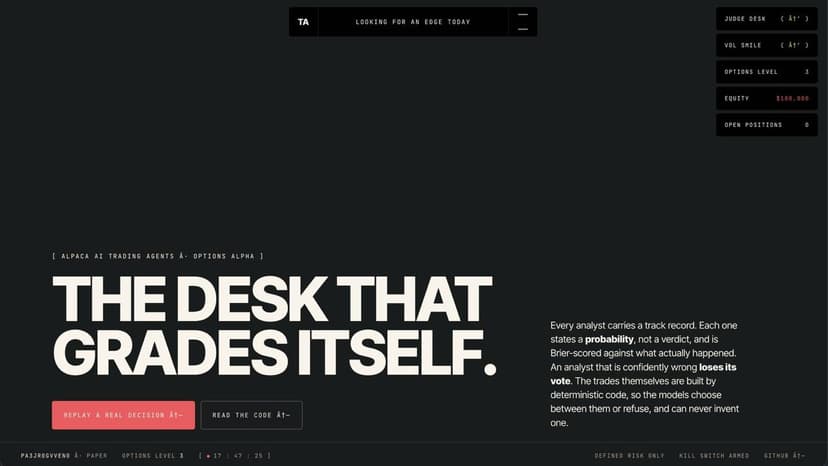
Trading Alpaca: an options desk that grades itself
Most trading agents ask a language model what to buy and act on the answer. This desk inverts that: deterministic Python enumerates every legal, defined-risk options structure the live SPY chain supports (about 1,500 fully priced candidates per cycle), and the analyst committee may only pick one by id or ABSTAIN. There is no code path by which a model can invent a strike, change a quantity, or move a limit price. Every pick then passes two independent vetoes with decorrelated failure modes: a pure-code thesis check (do the position Greeks match the structure's own directional claim?) and a blind LLM review starved of the committee's reasoning. RiskGuard then enforces risk.yaml as the single source of truth ($1,000 max loss per position, 3 positions, one new trade per underlying per day, delta/vega caps, DTE 7-45, liquidity gates, a 2% daily-loss halt) and fails closed on any error. A pre-mortem compiles each trade's failure modes into deterministic exit triggers, and the exit monitor manages the book before it adds to it. Each analyst emits a probability, not a verdict. Every decision is appended to a hash-chained journal; closes resolve those predictions and Brier scores recompute analyst weights every cycle, so a confidently wrong analyst loses its vote. A credential-free judge page replays four real decisions, two of them refusals. Live, on a new $100k paper account inside the official window: 3 fills (each at better than its limit), 1 automated close on its own breakeven trigger, 0 corrupted positions, closing equity $99,827.64 (-0.17%). Four bugs were found by running while the 933-test suite was green, each root-caused from the journal and fixed mid-session. We claim architecture and refusal discipline, not edge; the README says what cannot be proved. Orders route through the official Alpaca CLI; market data through the official Alpaca MCP server (read-only toolsets); alpaca-py for analysis.
4 Sep 2026


