

Hector Lopez@Rafagye
11
Events attended
8
Submissions made
Ecuador
5+ years of experience
About me
uilder of AI-powered autonomous systems that connect intelligence with real-world execution. Founder of InnerSpark, currently building InnerOS, a local-first, model-agnostic agentic platform that coordinates specialized AI agents, persistent memory, infrastructure, bounded tools, human approvals, verification, and recovery across software and physical environments. My work spans multi-agent orchestration, edge AI, Physical AI, computer vision, smart buildings, local inference, automation, and human-in-the-loop systems. I focus on production-minded architectures that can sense what is happening, reason over context, take controlled action, verify the outcome, and preserve evidence. Recent work includes InnerOS Physical Guardian, which adds governed AI to existing cameras, sensors, access systems, and building infrastructure instead of requiring customers to replace what they already have. I’m especially interested in building AI systems that move beyond answering questions and become reliable operational infrastructure for the real world.

🤓 Latest Submissions
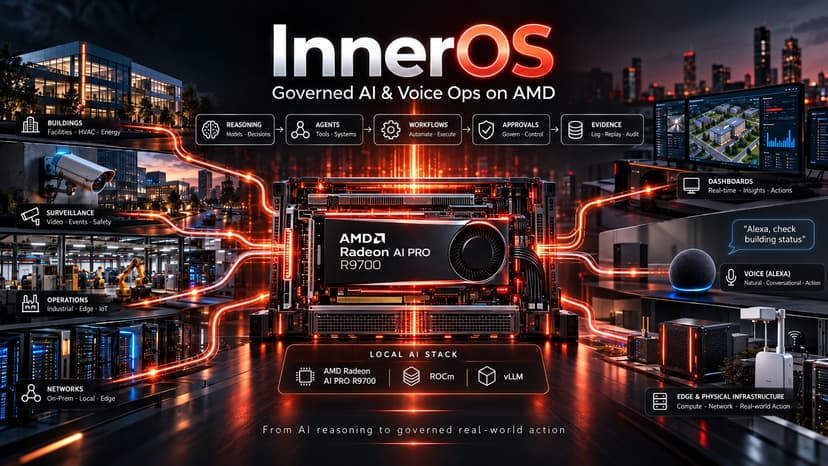
InnerOS: Governed AI & Voice Ops on AMD
InnerOS is a governed AI operations fabric that moves AI beyond chat and into real business execution. For AMD Developer Hackathon ACT III, we built and verified a new end-to-end partner lane on top of the existing InnerOS control plane. A real Bellini smart-building incident is analyzed by Gemma-4-31B-IT through AMD Developer Cloud and ROCm. Gemma produces a structured IncidentPlan with diagnosis, severity, recommended actions, and execution boundaries. InnerOS then passes that governed result to Evolus, where Workflow and Knowledge Library components turn the decision into an operational work-order representation. InnerOS preserves policy, approvals, execution state, cryptographic evidence, and replay. We are explicit about what was reused versus built for ACT III. InnerOS governance, local AMD ROCm/vLLM/Qwen execution, MCP/A2A coordination, and evidence/replay concepts existed before the event. ACT III added the live AMD Developer Cloud + Gemma integration, structured IncidentPlan contract, live Evolus integration, Bellini→Gemma→Evolus→Evidence pipeline, Judge Console, and public submission package. InnerOS also reuses technology developed in our parallel Alexa hackathon. The working Inner Oz skill already queries live InnerOS/Home Assistant energy data and has demonstrated a governed UniFi restart with owner approval and post-action verification. A newer voice-programming flow can create a GitHub repository and governed InnerOS Ops Task for an AI agent; task creation is verified, while agent completion is tracked separately. The architecture is unified: AMD provides the compute foundation, Gemma provides reasoning, Evolus provides business workflow execution, Alexa provides natural voice access, and InnerOS provides governance, orchestration, evidence, and proof. Reason. Act. Prove.
18 Oct 2026
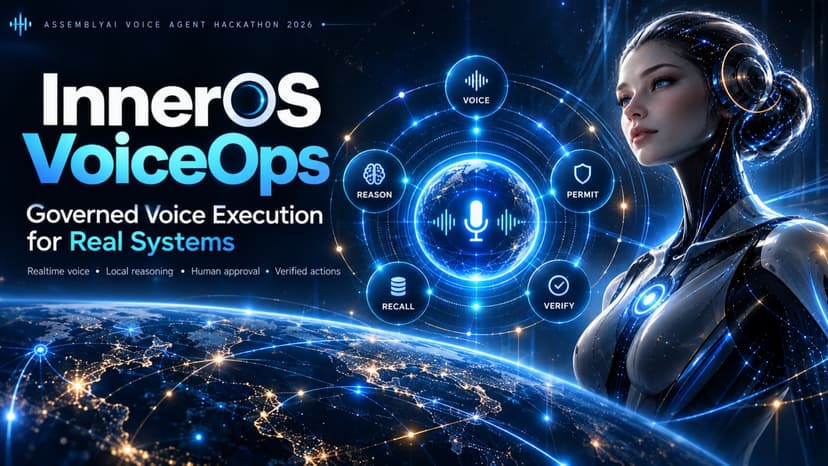
InnerOS VoiceOps
InnerOS VoiceOps is a governed voice agent that turns natural conversation into safe, verifiable actions on real-world systems. AssemblyAI provides the realtime voice layer, allowing users to speak naturally with VoiceOps through a live WebSocket session. InnerOS then connects that conversation to operational context, local AI reasoning, memory, Home Assistant, MCP tools, and connected infrastructure. The core workflow is intentionally different from a typical voice assistant: Voice → Recall → Reason → Permit → Act → Verify → Remember. VoiceOps can read live system state immediately, but any action that changes the physical environment is held behind explicit human approval. Once approved, InnerOS issues a single-use execution permit, performs the requested action, verifies the resulting state, and stores evidence of what happened. Our current demo connects to real Home Assistant and MCP infrastructure and demonstrates governed control of lighting, supported camera operations, and allowlisted network devices. Local Qwen reasoning keeps the decision path local-first, while AssemblyAI handles the realtime conversational voice experience. The interface also exposes live execution provenance so judges can see the active AssemblyAI connection, session state, audio frames, events, local reasoning path, fallback status, approvals, actions, and verification results in real time. The goal of InnerOS VoiceOps is simple: move voice AI beyond answering questions and toward trustworthy interaction with the physical world, while keeping humans in control.
30 Sep 2026
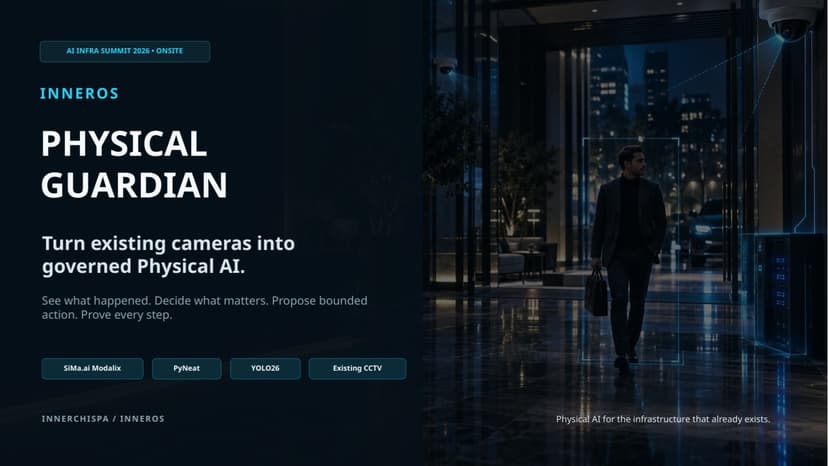
InnerOS Physical Guardian
InnerOS Physical Guardian is a Physical AI control layer designed to make existing buildings intelligent without forcing owners to replace their cameras, DVRs, access systems, or other infrastructure. The system ingests real camera images from existing Dahua installations and a local laptop camera, sends the exact captured frame to a SiMa.ai Modalix MLSoC running PyNeat and a YOLO26 object-detection model, and returns real detections with labels, confidence scores, bounding boxes, and frame-level provenance. But detection is only the first step. Physical Guardian evaluates what SiMa saw against configurable Guardian policies. A detected person can trigger a restricted-zone, after-hours, or repeated-presence policy, while unrelated objects remain visible without generating unnecessary alarms. When a policy is triggered, Guardian proposes a bounded response such as notifying an operator or activating an attention signal. Human approval is required before governed physical actions can execute. Every stage is traceable: camera source, frame ID, SHA-256 hash, inference result, policy decision, approval state, action, verification, and evidence receipt. Our goal is not to build another smart camera. It is to create a portable Physical AI layer that upgrades existing security infrastructure with edge intelligence, human governance, and forensic accountability. For the hackathon, we integrated SiMa.ai Modalix EV74 inference with real camera sources in Ecuador and demonstrated a path from camera perception to governed action and evidence.
16 Sep 2026

InnerOS on AMD: Governed Agentic Intelligence
InnerOS on AMD is a local-first, governed agentic AI platform built around AMD Radeon AI PRO hardware and ROCm. Rather than treating each AMD AI League challenge as an isolated demo, we use every Match as an independent acceptance test for a capability that can later graduate into the broader InnerOS architecture. Match 2 validates vision and OCR through ChispaVision / InfraLens. Its public container was physically verified on an AMD Radeon AI PRO R9700 (gfx1201), including anonymous pull and re-execution of the published artifact. Match 3 validates grounded multimodal RAG across PDFs, DOCX, XLSX, CSV, logs, source code and images. It achieved 10/10 on the official public sample, 2/2 visual questions, network-disabled execution, and anonymous public-image verification on the R9700. The shared foundation is AMD ROCm, reproducible Docker artifacts, local models, evidence, provenance and governed execution. Future League Matches extend the same architecture into web retrieval, code repair and additional autonomous capabilities. The public umbrella repository separates verified challenge artifacts from roadmap claims and links each independently reproducible implementation.
1 Dec 2026
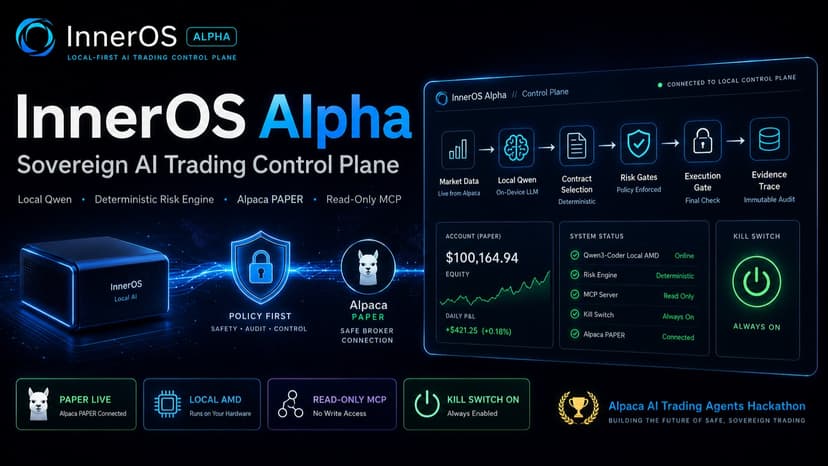
InnerOS Alpha: Sovereign AI Trading
InnerOS Alpha is a sovereign, local-first AI options trading control plane built for the Alpaca ecosystem. Instead of giving an LLM unrestricted broker access, the system separates reasoning from authority. Live Alpaca market and account context feeds a Qwen3-Coder model running on owned AMD hardware. The model produces a structured trade intent, but deterministic code selects an eligible options contract, calculates bounded max loss, checks portfolio and risk gates, and decides whether execution is allowed. The official Alpaca MCP server is configured as a read-only sidecar for account, assets, stock data, options data, and news; trading is deliberately excluded from the MCP toolset. Only the deterministic Execution Agent can reach the Alpaca Trading API, and the server kill switch starts ON. The public Judge WOW Mode demonstrates this boundary live: LIVE NOW runs the current market -> local Qwen -> contract -> risk -> execution-gate pipeline with execute=false, while VERIFIED PAPER PROOF replays sanitized evidence from a controlled PAPER end-to-end run. That verified run reached Alpaca with a real order ID, one correlation ID across the pipeline, Risk PASS, persisted evidence, and the kill switch re-armed afterward. The competition account was validated ACTIVE from the $100,000 PAPER baseline. No live money is used. InnerOS Alpha is built around one principle: the AI may propose, but policy owns the final authority.
4 Sep 2026
Ralphi-IA Hybrid Ops Copilot - AMD
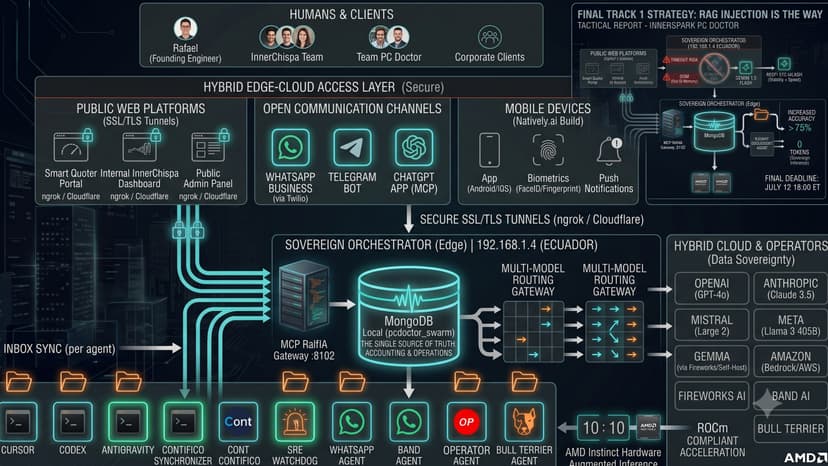
RalfIIA Hybrid Ops Copilot is a production-ready orchestration ecosystem built for IT service providers (PC Doctor / InnerSpark) to automate technical quoting, cross-channel operations, and system diagnostics. It operates as an Agent-to-Agent (A2A) mesh orchestrating a CrewAI Smart Quoter, a LangGraph SRE Watchdog, and a Contífico ERP API Synchronizer, driven by a multi-model routing gateway. 🌐 Cross-Channel Integration & Security Unlike isolated prototypes, RalfIIA connects business frontends to private infrastructure: Production Channels: Operations via WhatsApp Business (Twilio), Telegram Bots, and Web Admin Panels. Mobile App: iOS/Android builds via Natively.ai with secure biometric authentication (FaceID) for critical tasks. Secure Ingress: Public ingress is tunneled safely via SSL/TLS (Cloudflare/ngrok) into our local sovereign node, securing data privacy. ⚡ Hybrid Routing (Track 1 Architecture) To maximize token cost-efficiency, the intelligent router dynamically balances workloads: Edge Core Inference ($0 Tokens): Low-complexity tasks run locally using Ollama on AMD Ryzen physical hardware at zero remote token cost. Cloud Scale Inference: High-complexity reasoning scales to Fireworks AI models on enterprise AMD Instinct MI300X cloud GPUs. Single Truth: Telemetry metrics (latency, token costs) save instantly to local MongoDB (pcdoctor_swarm) for SRE cost auditing. 🛡️ Hardware-Aware Gemma ROCm Auditor A specialized Gemma Auditor Agent acts as an isolated supervisor. Whenever an automation script is generated, Gemma intercepts it to perform a hardware-aware second-turn code audit, flagging VRAM overflows and verifying CUDA-to-HIP kernel translation to optimize performance for AMD ROCm GPU environments before physical clúster deployment.
13 Jul 2026
InnerOS: Sovereign Multi-Agent IT Field Swarm
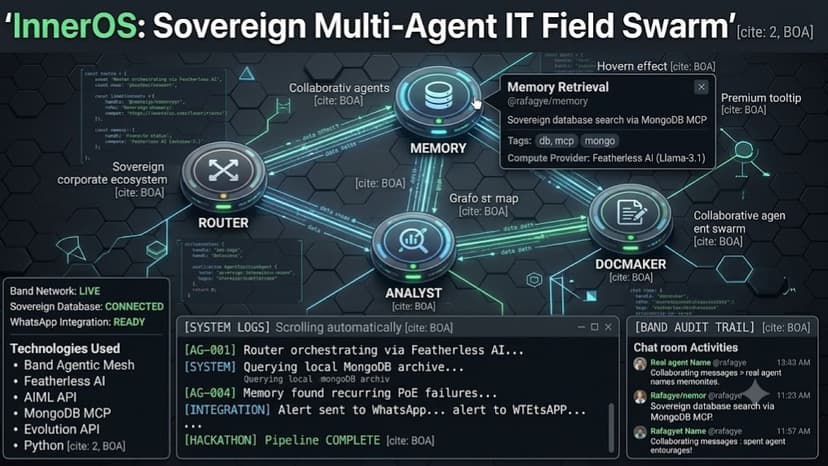
InnerOS is a sovereign enterprise multi-agent swarm designed to automate critical IT field operations and diagnostic reporting, maximizing local data privacy. Operating within the Band network layer as its collaborative communication bus, the system registers 4 specialized external agents: Router, Memory Retrieval, Analyst, and Document Maker. When an operational query is received, the Router intercepts the request and handles internal orchestration via open-source LLMs hosted serverless on Featherless AI. The Memory Retrieval agent then queries a local MongoDB MCP enterprise database to unearth historical context and technical logs without leaking raw corporate information to the internet. Next, the Technical Analyst ingests this retrieved context, using advanced reasoning models via AIML API (DeepSeek-R1) to run root-cause diagnostics and evaluate infrastructure failures. Finally, the Document Maker synthesizes the analytical insights into an enterprise-grade, production-ready Executive Summary and SOP in English, automatically triggering a live webhook notification that dispatches the finalized report directly to the administrator's WhatsApp via Evolution API. By combining decentralized network coordination with a hybrid local-inference pipeline, InnerOS proves that enterprise automation can be fast, cost-effective, compliant, and strictly sovereign. Online Link: https://sworn-profusely-alongside.ngrok-free.dev/
19 Jun 2026
VigilOS: Autonomous AI Edge Security Ecosystem
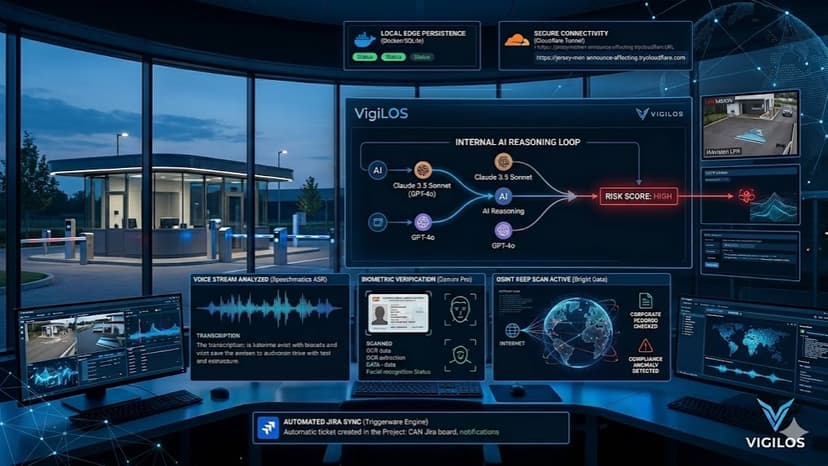
VigilOS is an enterprise-grade AI edge security ecosystem designed to transform physical access control and perimetric surveillance into a decentralized, data-driven intelligence operation. Core Pipeline & Multi-Agent Orchestration: When an event occurs, VigilOS intercepts physical feeds via a Hikvision Hardware Bridge. Raw intercom audio streams are transcribed with ultra-low latency using Speechmatics’ streaming ASR API. Simultaneously, the system extracts identity metadata and license plates via Gemini Pro's multimodal vision features. This data initializes a specialized reasoning loop driven by Claude 3.5 Sonnet and GPT-4o through the unified AI/ML API gateway. Advanced OSINT & Decentralized Node Governance: To eliminate blind spots, the system triggers autonomous background checks. Utilizing Bright Data’s Web Data Unlocker and Residential Proxy Network, VigilOS bypasses anti-bot barriers to verify records and compute a dynamic Risk Score. To guarantee tamper-proof execution, our central agent—Ralphi IA—is authenticated and published as a decentralized autonomous node on the BAND Protocol. This ensures that threat intelligence hashes and state reports remain cryptographically verifiable across external network nodes. Data-Driven Polling Architecture via Triggerware: Critical alerts are written to a secure local layer. A Cloudflare Tunnel (cloudflared) exposes a restricted REST API endpoint to the internet, removing open incoming firewall ports. Triggerware’s Engine polls this endpoint asynchronously to compute real-time deltas. Once a new risk row is detected, Triggerware automatically triggers a workflow, injecting high-priority operational tickets inside Atlassian Jira Cloud (Project: CAN) for immediate compliance auditing, with self-hosted n8n acting as an enterprise fail-safe.
31 May 2026


