Rahul L S@Rahul_LS
2
Events attended
2
Submissions made
India
1 year of experience
About me
I’m a 3rd-year Computer Science (AI) undergraduate, driven by the goal of building intelligent systems that solve real-world problems. My work lies at the intersection of Artificial Intelligence and Full-Stack Development, where I focus on turning ideas into scalable, user-facing products powered by modern AI. I’m particularly interested in Generative AI, exploring how systems built around Large Language Models and contextual understanding can move beyond simple automation into meaningful, human-like interactions. I’m especially drawn to areas like Graph-based RAG, where structured knowledge and retrieval combine to create more reliable and context-aware AI systems. Currently, I’m exploring Natural Language Processing and Agentic AI, focusing on how autonomous systems can reason, plan, and interact effectively in dynamic environments. At my core, I’m someone who enjoys building end-to-end solutions not just models or interfaces in isolation, but complete systems where intelligence and usability come together.
🤝 Top Collaborators


🤓 Latest Submissions

HybridRouter
HybridRouter: The Token-Efficient Routing Agent In the modern AI landscape, developers often rely entirely on massive, expensive cloud LLMs for every query, leading to skyrocketing API costs and unnecessary compute overhead. HybridRouter was built to solve this exact problem. It is a highly intelligent, multi-tiered routing agent designed to maximize task-solving accuracy while aggressively minimizing paid API token consumption. What it does HybridRouter acts as a smart gateway for user prompts. Instead of immediately sending a task to an expensive cloud model, the system cascades the request through a strict, cost-aware waterfall pipeline: Tier-0 (Deterministic Solvers): Bypasses LLMs entirely for math, parsing, and structured extraction tasks using pure code, resulting in perfect accuracy at zero cost. Tier-1 (Local AMD Edge Models): For generative tasks, the system leverages models like Gemma 2B or Qwen 2.5B running locally. By fully integrating with AMD ROCm, inference is accelerated directly on AMD GPUs. Smart Confidence-Gating: The local model generates multiple self consistency samples to calculate a "Confidence Score." If the local model is highly confident, the answer is returned (costing 0 API tokens). Tier-2 & Tier-3 (Cloud Escalation): Only when the local model is uncertain (low confidence) does the router compress the prompt and escalate to paid cloud models via the Fireworks API using a cheaper model first, and falling back to a massive model (like Llama 3.1 70B) only as an absolute last resort. Why it matters By shifting the bulk of the computational load to local AMD hardware, HybridRouter drops API costs by up to 60%. It proves that with intelligent routing and hardware accelerated edge AI, developers don't have to choose between cutting costs and delivering state of the art accuracy.
13 Jul 2026
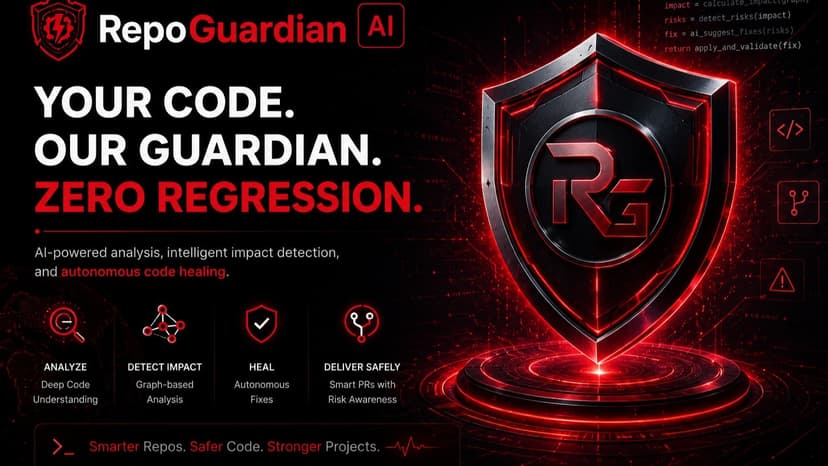
RepoGuardian AI
RepoGuardian AI is an autonomous repository intelligence and impact analysis platform designed to help developers understand, analyze, and safely modify large codebases. The system performs deep parsing to understand repository structure, builds dependency graphs using Neo4j, and generates semantic embeddings for intelligent code understanding. When developers introduce code changes, RepoGuardian AI detects downstream dependencies, predicts architectural impact, identifies breaking changes, and provides AI-powered reasoning about potential failures. Using graph-based analysis, semantic retrieval, and LLM-driven contextual reasoning, the platform can trace ripple effects across files, functions, services, and APIs in real time. RepoGuardian AI also includes a self-healing engine capable of generating backward-compatible fixes, validating changes, and automatically creating pull requests with detailed risk analysis. The platform combines FastAPI, React, Neo4j, Pinecone, Groq Llama 3.3, and Google Gemini embeddings to create a modern developer intelligence workflow focused on proactive debugging, repository understanding, and autonomous code maintenance.
17 May 2026


