🤝 Top Collaborators
🤓 Latest Submissions

HybridRouter
HybridRouter: The Token-Efficient Routing Agent In the modern AI landscape, developers often rely entirely on massive, expensive cloud LLMs for every query, leading to skyrocketing API costs and unnecessary compute overhead. HybridRouter was built to solve this exact problem. It is a highly intelligent, multi-tiered routing agent designed to maximize task-solving accuracy while aggressively minimizing paid API token consumption. What it does HybridRouter acts as a smart gateway for user prompts. Instead of immediately sending a task to an expensive cloud model, the system cascades the request through a strict, cost-aware waterfall pipeline: Tier-0 (Deterministic Solvers): Bypasses LLMs entirely for math, parsing, and structured extraction tasks using pure code, resulting in perfect accuracy at zero cost. Tier-1 (Local AMD Edge Models): For generative tasks, the system leverages models like Gemma 2B or Qwen 2.5B running locally. By fully integrating with AMD ROCm, inference is accelerated directly on AMD GPUs. Smart Confidence-Gating: The local model generates multiple self consistency samples to calculate a "Confidence Score." If the local model is highly confident, the answer is returned (costing 0 API tokens). Tier-2 & Tier-3 (Cloud Escalation): Only when the local model is uncertain (low confidence) does the router compress the prompt and escalate to paid cloud models via the Fireworks API using a cheaper model first, and falling back to a massive model (like Llama 3.1 70B) only as an absolute last resort. Why it matters By shifting the bulk of the computational load to local AMD hardware, HybridRouter drops API costs by up to 60%. It proves that with intelligent routing and hardware accelerated edge AI, developers don't have to choose between cutting costs and delivering state of the art accuracy.
13 Jul 2026
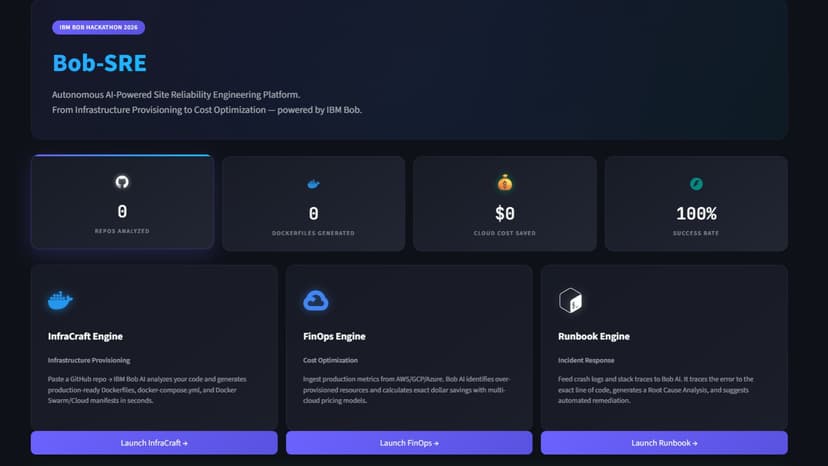
Bob-SRE: AI-Powered Autonomous Engineer
Enterprise engineering teams face two massive bottlenecks: Cloud Waste: Companies waste an estimated $420B annually over-provisioning Docker Swarm/Cloud clusters because manual right-sizing is too complex. Incident Response: When microservices crash (production operations), SREs spend hours manually correlating stack traces to source code. Bob-SRE wraps the IBM Bob AI in a programmatic orchestration layer to automate the entire SRE lifecycle: Infrastructure Provisioning (InfraCraft): It autonomously clones GitHub repositories, analyzes the language/framework using AST parsing, and uses IBM Bob to generate production-ready Dockerfiles and Docker manifests. Cost Optimization (FinOps): It ingests live production metrics, compares them to existing YAML configurations, and uses Bob to generate right-sized resource allocations, instantly calculating exact dollar savings using built-in AWS/GCP pricing models. Incident Response (Runbook): It ingests raw stack traces, classifies the severity, and utilizes Bob to trace the error back to the exact line of code, generating a markdown Root Cause Analysis report with prioritized fixes. 6. How We Used IBM Bob (Application of Technology) Rather than using IBM Bob conversationally or as an IDE plugin, we engineered a programmatic wrapper (BobCLIClient) that executes Bob as a backend microservice via Python's subprocess. We built a Prompt Engine that dynamically injects repository context, AST scan results, and configuration heuristics into strict templates before sending them to Bob. We then use Regex to parse Bob's output, extract the generated YAML/Dockerfiles, and inject them into our interactive, glassmorphism-styled Streamlit UI.
17 May 2026

