
🤝 Top Collaborators




🤓 Latest Submissions

VocalScout
Across every industry—corporate compliance, customer support, healthcare, engineering documentation, and media streaming—critical institutional knowledge remains trapped in unstructured, single-language video files. Finding a specific moment, troubleshooting step, or policy clarification requires tedious manual scrubbing across hours of footage. VocalScout transforms passive video archives into an active, multi-industry retrieval system by which anyone can asks a question via voice in their native dialect (e.g., querying in Hindi, German, or Japanese about an English procedural recording).The engine aligns speech down to the millisecond, running cross-lingual search over structured data without requiring prior translation or costly re-recording.It delivers a synthesized voice explanation directly in the user’s language to clarify the visual context immediately.
30 Sep 2026
ShadowAgent Guard
THE PROBLEM AI coding agents like IBM Bob, Copilot and Cursor now follow instruction and permission files that live inside the repository: AGENTS.md, rules folders, custom modes and MCP server configs. The agent obeys these files, which makes them a new attack surface. A pull request or a cloned repo can hide instructions in invisible Unicode characters that a human reviewer cannot see in the diff, auto-approve a shell tool through MCP, or give an agent mode unrestricted edit and command rights. AI-written code also introduces "slopsquatted" dependencies: package names the model invented, which attackers can register. Research on code-generating models has found that roughly one in five recommended packages did not exist. Existing reviewers, including Bob's own /review, check the application code. None of them check the AI supply chain: the dependencies an agent invents and the files that tell the agent what to do. THE SOLUTION ShadowAgent Guard is a security gate for AI-native threats, built on IBM Bob 2.0. It protects three points in the developer workflow: 1. Before the agent starts work: a global Bob lifecycle hook scans any workspace when Bob is prompted in it. If the repo is hostile, the prompt is blocked before it reaches the model and the developer sees a warning listing each finding. 2. During review: inside Bob, /guard runs a dedicated ShadowAgent Guard mode that launches three parallel subagents (dependencies, agent configuration, test integrity), merges their findings, gives a BLOCK or PASS verdict with a trust grade from A to F, and writes hardened replacement configs with an explanation for every change. 3. In CI: a one-line GitHub Action (uses: Ahmadbey678/ShadowAgent-Guard@main) fails pull requests that carry these risks, posts the report to the job summary and uploads SARIF to GitHub Code Scanning. WHAT IT CATCHES Nonexistent and typosquatted packages, checked against the live PyPI and npm registries; malicious install scripts; hidden-Unicode instructions, decoded to show what the agent actually reads; prompt injection in rules files; auto-approved MCP shell tools; over-permissive agent modes; secrets not covered by .bobignore; and tests that were deleted, skipped or weakened to make a PR pass. MEASURED IMPACT On the demo repository, an AI-generated pull request with 11 planted issues, ShadowAgent Guard caught all 11 (13 findings, grade F, BLOCK) in about one second. The same PR after remediation passes with grade B. Several of these issues, such as invisible Unicode instructions, cannot be found by manual review at all. TARGET USERS Teams adopting AI coding agents who need to trust the repositories and pull requests those agents work on. Developers get a warning in their IDE, reviewers get a verdict and ready-made fixes, and the pipeline gets a gate. It needs no dependencies, adopts in one line of CI config, and reports render in the browser without being uploaded anywhere. WHAT IS NEW ShadowAgent Guard secures the agent itself, not just the code it writes, and uses Bob to audit and harden Bob's own attack surface.
27 Sep 2026
Bimanual Pick-Handoff-Place with VLM Planning
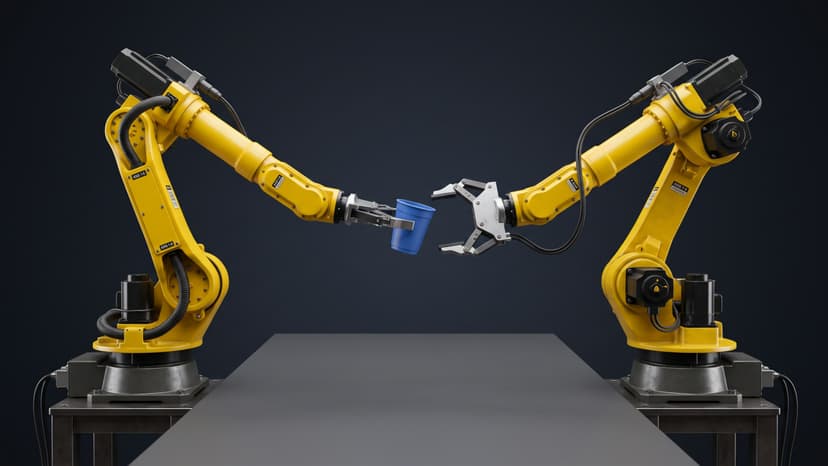
Two simulated SO-101 arms face each other across a table. Arm A picks up a cup, hands it to Arm B across a shared reach zone, and Arm B places it on a marked target — all driven by a natural-language instruction that a hosted vision-language model (Gemini 3.6 Flash) interprets alongside a rendered camera frame to select which scripted primitive to run next. A local CLIP model, converted to OpenVINO IR and benchmarked on Intel CPU, cross-checks that the target object is actually visible in the scene, giving the submission a genuine local-inference component alongside the hosted VLM. All arm motion uses classical inverse kinematics and waypoint control rather than a learned policy — a deliberate scope decision made under a tight timeline, documented openly in the repo's README. The system was evaluated across 10 randomized seeds (varying cup position, color, and lighting) with a 100% task success rate. Several episodes exercised the planner's fallback path after hitting the VLM provider's free-tier rate limit, demonstrating graceful degradation rather than failure. The OpenVINO benchmark shows FP16 CLIP inference running about 11% faster than FP32 on the available hardware, with half the model size. As an online-track team, we benchmarked on our own available Intel Core i7 hardware rather than Core Ultra Series 2/3, which wasn't provided to remote participants — this and every other simplification (kinematic grasping, position-only IK, narrow randomization) is documented transparently in the repository rather than glossed over.
16 Sep 2026

Aethel Bio
Aethel Bio is an enterprise precision oncology platform built 100% on Natively AI, bridging Next-Generation Sequencing (NGS) pathology data with active clinical trials in real time. THE PROBLEM Late-stage cancer patients are out of time, but traditional trial matching is bogged down by 50-page unstructured pathology PDFs. Over 80% of eligible patients are rejected due to rigid inclusion cutoffs without waiver evaluation, while pharma sponsors lose millions opening trial sites blind to regional patient demand. OUR SOLUTION & ARCHITECTURE Orchestrated on Natively AI, Aethel Bio transforms genomic reports into actionable clinical pathways: • AI Pathology Parser: Parses PDF, DOCX, and TXT files in under 3 seconds, extracting mutations (EGFR, KRAS, BRCA1), staging, and organ panels. • Protocol Waiver Sensitivity Slider: Interactive tolerance slider letting clinicians test "what-if" scenarios for borderline lab function (e.g., eGFR 54 vs 60 mL/min) without altering official EHRs. • Dual-View Exporters: Generates technical Physician Dossiers with PI referral drafts alongside plain-language Patient Guides with care-team checklists. • Sponsor Feasibility Analytics: Maps unmatched patients (<50% match score) into a de-identified market registry, giving pharma sponsors density maps and CSV/JSON exports. • 1-Click Guest Sandbox: Instant access for oncologists, and patients with zero sign-up friction. TECHNOLOGY Built on Natively AI using React/Next.js, TypeScript, Tailwind CSS, and client-side HIPAA sanitization. Natively AI orchestrates our Supabase (PostgreSQL) DB and secure ClinicalTrials.gov REST API v2 sync. IMPACT Aethel Bio slashes trial discovery time by 99%—turning days of research into 3 clicks, empowering patients, and optimizing clinical trial enrollment.
10 Aug 2026
RegiSphere
Our project is an AI-powered compliance analysis system that leverages Coral v1 and the Mistral AI API to evaluate GitHub repositories for domain-specific rules and regulations. The system is designed with a modular architecture consisting of a frontend, backend, and intelligent agents that work together seamlessly. The frontend allows users to input a GitHub repository URL, which is then processed by the backend and routed to specialized agents. These agents, in collaboration with the Fire-Crawl agent, extract the repository’s structure, metadata, and domain-relevant information. The results are compiled into a detailed compliance report, ensuring accuracy, efficiency, and adaptability across various domains.
21 Sep 2025


