
🤓 Latest Submissions

AI Debate Arena: Voice-First Debate Coach
AI Debate Arena is a voice-first adaptive debate platform designed to help users practice thinking, speaking, and defending their ideas under pressure. Instead of practicing with static questions or scripted prompts, users enter a multi-round debate where they choose a topic and position, then speak their arguments naturally using their voice. The AI takes the opposing position and dynamically generates rebuttals based on what the user actually said, making each debate responsive rather than predetermined. The platform uses AssemblyAI for speech recognition and real-time voice interaction, while a dedicated debate engine maintains the conversation state, arguments, rounds, turns, and positions throughout the debate. Gemini is used to generate context-aware AI rebuttals and personalized post-debate insights, with Gemini TTS providing the AI opponent's spoken responses. After the debate, AI Debate Arena analyzes the user's performance across areas such as argument quality, rebuttal handling, clarity, structure, and persuasiveness. These insights are then transformed into a personalized coaching profile containing strengths, improvement areas, priorities, actionable recommendations, and targeted practice exercises. The result is a complete improvement loop: Speak → Defend → Listen → Analyze → Improve → Practice Again AI Debate Arena is built with Python, Streamlit, AssemblyAI, Gemini, PyAudio/sounddevice, and automated testing, with 690 passing tests supporting the core system. The platform supports both local microphone-based interaction and browser-based voice interaction for cloud deployment. Our goal is simple: don't just practice speaking — practice thinking under pressure.
30 Sep 2026

TABLEMIND - Self Correcting Bimanual VLA
TABLEMIND is a conversational Physical AI system for bimanual robotic manipulation in a dinner-table environment. It enables two simulated SO-101 robotic arms to interpret natural-language goals, perceive the current scene, coordinate actions, verify outcomes, and adapt when the user's requirements change. The system follows a closed-loop SEE → THINK → ACT → VERIFY → ADAPT pipeline. Natural-language commands are converted into structured goals, while visual perception identifies table objects and their spatial state. A custom-trained Ultralytics YOLO26n detector recognizes plates and glasses, with OpenCV for image processing and OpenVINO optimization for efficient Intel CPU inference. MuJoCo provides the physics simulation and SO-101 robotic environment, while Cartesian IK and coordinated planning translate goals into physical manipulation. A key capability is bidirectional conversational goal reconciliation. TABLEMIND can begin with one complete place setting, respond when the user changes the requirement to two, physically restore the additional plate and glass, verify the new state, and then respond to another change back to one by physically removing the extra setting. This demonstrates adaptation to a changing user goal rather than simply restarting a predefined workflow. The system also supports voice interaction through Speechmatics, with a Streamlit web interface providing the demonstration application. Every manipulation is verified against the simulated physical state, enabling the system to reason about whether the intended outcome was actually achieved. For hardware validation, the OpenVINO vision pipeline was tested on an Intel Core i5-1135G7 CPU. Core Ultra Series 2/3 hardware was not available for this submission.
16 Sep 2026
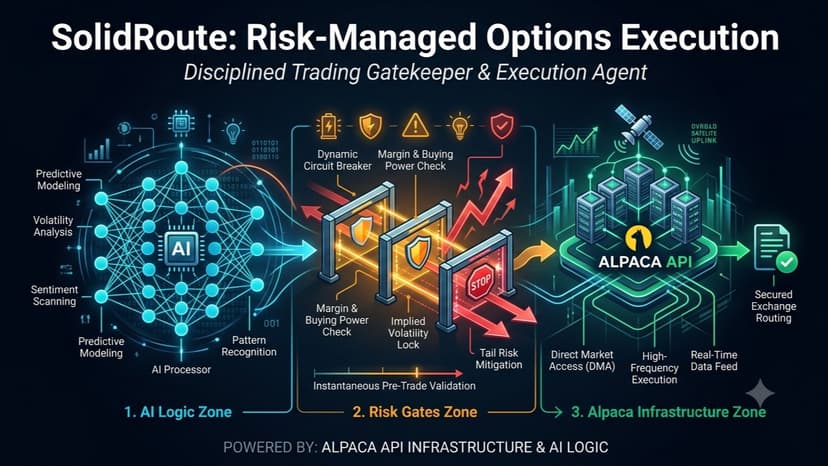
SolidRoute: Risk-Managed Options Execution Agent
SolidRoute is an advanced, Streamlit-based options execution agent designed to eliminate emotional trading and high-risk exposure through automated intelligence. Built natively with the Alpaca API for seamless paper trading, the platform provides real-time account tracking (Equity and Buying Power) and live asset charting within a vibrant, responsive light theme. Its defining feature is the Autonomous Risk Gatekeeper, which analyzes contract specifications and calculates implied volatility (IV) in real-time. If a trade exceeds safe threshold limits, SolidRoute triggers an intelligent cool-down warning banner, prompting users to bypass with caution or instantly pivot to secure, low-risk alternative assets like defensive value shares and treasury index ETFs. Engineered for both seamless judge evaluation and production-grade reliability, the application incorporates a dual-credential design: it automatically falls back to secure secrets for zero-friction cloud onboarding while allowing custom API key inputs on the fly for personal portfolio linking. Satisfying advanced hackathon criteria, SolidRoute also integrates Model Context Protocol (MCP) and CLI server status connectivity. Complete with real-time market hour checks, robust error handling, and automated order routing via the `alpaca-py` SDK, SolidRoute delivers a polished, responsive, and risk-aware trading assistant.
4 Sep 2026


