

Shaheer Iftikhar@ShaheerBuildin
3
Events attended
2
Submissions made
Pakistan
4+ years of experience
About me
Founder of Scaffold, an AI learning platform that diagnoses students’ knowledge gaps and guides them through personalized teaching, testing, and mastery. I build AI-powered products, automation workflows, and full-stack applications, with a focus on education and voice AI.
🤓 Latest Submissions
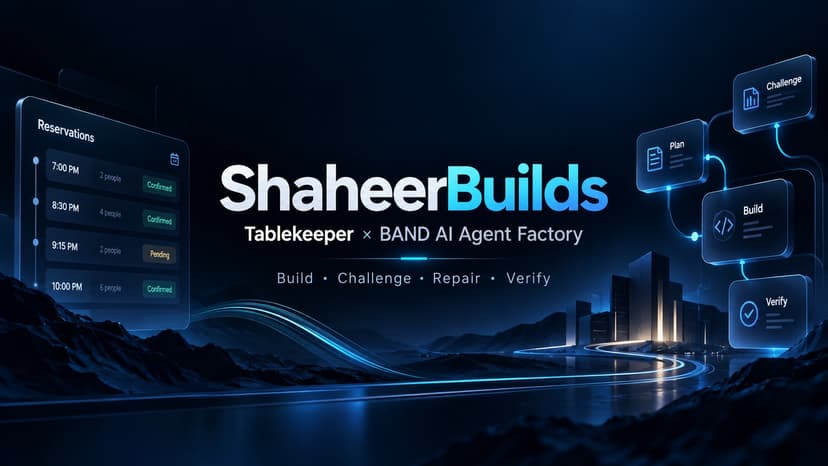
Tablekeeper — Built by a BAND Agent Factory
**Tablekeeper — Built by a BAND Agent Factory** Tablekeeper is a restaurant reservation system built through BAND's multi-agent AI factory. Our goal was to demonstrate reliable software engineering through specialized agents, independent QA, failure recovery, and verifiable results. **Our Five-Agent Factory** We configured five specialized roles: - **Architect:** Plans, delegates, and manages acceptance. - **Builder:** Implements features and prepares artifacts. - **Red Team QA:** Challenges code and identifies defects. - **Verifier:** Independently validates approved artifacts. - **Commander:** Coordinates the workflow. The factory follows planning, implementation, adversarial testing, repair, and verification. Human interventions are documented rather than presented as complete autonomy. **The Application** Tablekeeper handles restaurant availability, bookings, cancellations, competing requests, recurring reservations, time zones, and planning operations. Four development stages progressively introduced core reservations, browser workflows, concurrency, recurring bookings, and advanced planning. **Real Failures and Recovery** Independent QA exposed problems including hidden availability grids, stale booking context, and data consistency issues. These were addressed through documented repairs, regression tests, and independent verification. **Verified Results** All four shipped official stage suites passed local tests: - Stage 1: 120/120 - Stage 2: 25/25 - Stage 3: 7/7 - Stage 4: 6/6 Additional browser, concurrency, and isolated execution checks passed. Private judging tests are not included. **Reproducibility** Built with BAND, Codex, Python, Docker, and browser technologies, the public repository includes four runnable stages, reusable agent mandates, factory documentation, and genuine BAND session evidence. Tablekeeper demonstrates collaborative AI engineering with clear responsibilities, transparent failures, and independently verified outcomes.
6 Oct 2026

Assembler — Voice Agentic Systems
Voice AI can talk. Businesses need it to act. Assembler turns business intent into reusable, executable voice-agent workflows through a simple flow: Describe → Assemble → Run. A prompt tells a model what to say. An Assembler Blueprint defines what it is allowed to do: the workflow, data, tools, rules, connections, and outcomes. A shared runtime executes these Blueprints, so each business does not require a separate, hard-coded orchestration system. AssemblyAI provides the real-time voice interaction layer; Assembler manages business actions. Six starter workflows cover Auto Repair, Ecommerce Support, Real Estate, Restaurant, IT Helpdesk, and Property Management. Our recorded Auto Repair browser demo shows a brake-risk request triggering deterministic safety enforcement. The runtime executes escalate_issue, records the outcome as escalated, and the agent continues responding after the tool result. A separate deployed Harbor Table Restaurant integration test verified Google Calendar availability, booking persistence, Calendar event creation, and Google Sheets synchronization. This is server/integration evidence, not a second recorded voice conversation. Its configuration includes Europe/London scheduling, confirmation calls, and customer feedback. Engineering verification includes 53 passing automated tests, a passing TypeScript check, and a successful production build. The production application and source code are publicly accessible. Assembler targets service businesses handling recurring calls, and agencies deploying agents for clients. This hackathon MVP demonstrates a reusable workflow layer with observable execution; it does not claim that all six starters have received identical live testing.
30 Sep 2026


