
🤝 Top Collaborators
🤓 Latest Submissions
AuraCaptioner: Grounded Multi-Style Captions
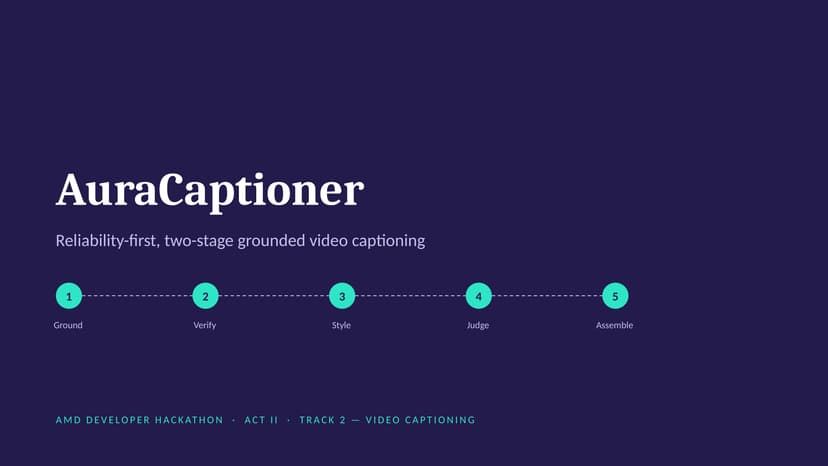
Most captioning pipelines fail on reliability before they fail on quality, missing a style, timing out, or returning malformed JSON zeroes out an otherwise-good submission. The core pipeline follows a two-stage grounding-then-styling architecture. Stage 1 extracts a style-agnostic factual description of the video (subjects, actions, setting, mood, on-screen text, audio) from scene-aware keyframes rather than blind uniform sampling. A Chain-of-Verification pass then drafts verification questions against those facts and re-checks them independently, dropping unsupported claims, measurably reducing hallucination versus "just be grounded" prompting alone. Speech transcription and OCR are gated behind cheap voice-activity and text-likelihood checks, so silent or text-free clips skip those calls entirely. Stage 2 rewrites the verified facts into four distinct tones, formal, sarcastic, humorous_tech, humorous_non_tech each with explicit rubrics, negative constraints, and brevity limits to counter known LLM-judge biases (verbosity and style-invariance). A self-judge pass, deliberately run on a different model than the generator to avoid self-preference bias, scores each caption on accuracy and style match and regenerates weak ones within a runtime-bounded retry budget.
13 Jul 2026

PayGuard AI - Payment Fraud detection system
Indian UPI scams such as fake refund QR codes, lookalike payment links, marketplace advance-fee scams, and social-engineering tricks often succeed because victims act on a single piece of information without verifying it. PayGuard AI provides that missing second opinion before money moves. Users submit a payment detail along with context (amount, source, and purpose), and a team of specialized AI agents investigates collaboratively. After an initial guardrail check using Featherless AI, the FastAPI backend creates a dedicated Band room where agents work sequentially, sharing findings through a common context rather than communicating directly. The workflow includes destination intelligence, QR and UPI validation, web intelligence, and final verdict synthesis powered by AI/ML API models using Band Room built using Band AI. When evidence is unclear, agents can request additional information from the user. The response is added back into the same shared context, making humans part of the collaboration loop instead of an external override. Every investigation produces an auditable record and a shareable report, enabling banks, UPI apps, fintechs, and marketplaces to integrate PayGuard AI as a pre-transaction risk layer. Instead of manually searching suspicious UPI IDs, users receive a structured, evidence-backed investigation before pressing Pay.
19 Jun 2026


