
🤝 Top Collaborators




🤓 Latest Submissions
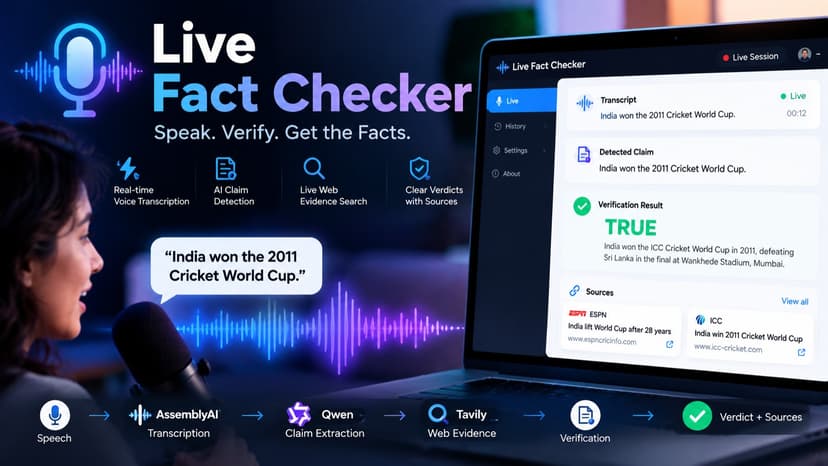
Live Fact Checker
Live Fact Checker is an AI-powered real-time voice fact-checking platform designed to verify factual claims while they are being spoken. Users simply speak into the microphone, and the system uses AssemblyAI for real-time speech transcription, Qwen for claim extraction, Tavily for live web evidence retrieval, and an evidence-based verification engine to determine whether a claim is TRUE, FALSE, UNVERIFIABLE, or AMBIGUOUS. Instead of relying on a fixed database or pre-written answers, the system searches for current evidence and presents the supporting sources alongside each verdict. This makes the experience useful for conversations, interviews, presentations, news discussions, education, research, and everyday information verification. The architecture is designed around a live pipeline: Speech → Transcription → Claim Extraction → Web Evidence → Verification → Verdict + Sources. Claims are processed individually so multiple factual statements can be identified and verified separately. The project focuses on transparency and traceability: users can see what was said, what evidence was retrieved, and why the system reached its result. Future extensions include live call fact-checking, uploaded audio/video analysis, social-media video verification, browser integration, and multi-speaker support.
30 Sep 2026

RepoMap — AI Codebase Navigator
Developers joining an existing software project often face the same problem: before they can contribute, they must understand a codebase they did not build. Finding the important modules, understanding how they connect, identifying entry points, and determining which files are relevant to a requested change can take hours or even days. RepoMap addresses this problem by turning an unfamiliar repository into an AI-generated onboarding experience. A developer provides a public GitHub repository and a development request. RepoMap obtains the repository source, prepares a workspace, and uses IBM Bob 2.0 to analyze the codebase. The result is transformed into an Onboarding Map that presents the repository's major modules, relationships, important files, entry points, and development context in a way that is easier to understand than manually exploring the project. RepoMap also includes ScopeShield. Instead of asking developers to search through an entire repository for every task, ScopeShield uses the generated repository context together with IBM Bob 2.0 to analyze a specific development request and identify the relevant scope. This helps developers understand which parts of a codebase are related to a change before they begin modifying files. The primary target users are software developers, student developers, contributors joining existing projects, and engineering teams working with unfamiliar repositories. The interaction is intentionally simple: provide a repository, run the analysis, explore the generated architecture and onboarding information, and then submit a development request through ScopeShield to understand the relevant implementation scope. The project is designed around a simple workflow: Understand → Map → Scope → Develop What makes RepoMap different is that it focuses on the onboarding and reasoning layer of software development rather than simply displaying a file tree. IBM Bob 2.0 performs the repository-level reasoning while RepoMap provides the structured developer experience around that analysis. The system is also designed with a server-side integration so the IBM Bob credentials remain outside the browser. Repository acquisition and Bob execution happen on the server, while the frontend focuses on presenting the resulting developer context. For the hackathon MVP, we focused on the core onboarding workflow and ScopeShield rather than attempting to build every possible software-engineering automation feature.
27 Sep 2026

