
🤝 Top Collaborators




🤓 Latest Submissions

MarketPulse AI
### 🛍️ The Challenge Small and medium retail businesses (SMBs) operate on thin margins, losing over $1.1 Trillion annually to stockouts and excess inventory. Traditional enterprise supply chain suites are cost-prohibitive, complex, and require dedicated data teams. Independent retailers are forced to make procurement choices using static spreadsheets, leading to dead stock and lost revenue. ### 💡 The Solution: MarketPulse AI MarketPulse AI brings autonomous decision intelligence directly to SMB retailers. It functions as an autonomous merchandise director that analyzes SKU velocities, forecasts demand shifts, and generates optimal inventory rebalancing plans. MarketPulse AI coordinates a multi-agent decision pipeline: - **Demand Sensing Agent:** Models sales velocity, seasonality, and promotional trends. - **Pricing & Margin Optimizer:** Evaluates price elasticity to protect gross margins while clearing aging stock. - **Supply Chain Rebalancer:** Solves constrained optimization across lead times and holding costs. - **Autonomous Planner:** Synthesizes actionable purchase orders with clear rationale. ### ⚡ Powered by AMD Instinct™ MI300X & ROCm MarketPulse AI is engineered for AMD Instinct™ architecture. Real-time retail decisioning requires evaluating thousands of SKU combinations under tight budget constraints. Leveraging the high memory bandwidth and compute density of AMD Instinct™ MI300X with ROCm, MarketPulse AI executes multi-scenario simulations and linear optimizations in milliseconds with zero external API dependencies. ### 🌐 Built for Modern Commerce Featuring tactile budget controls ($10K–$100K presets), real-time executive KPI scorecards, and native 4-language localization (English, French, Spanish, Hindi), MarketPulse AI empowers retailers to make confident decisions in seconds.
18 Oct 2026

FORGE — AI Software Engineer
Problem. Debugging, validating, and releasing software is where developer time leaks. A bug hides across files: reproducing it, tracing the root cause, fixing it, re-running tests, and clearing a release gate can eat hours of manual, error-prone work. Non-engineers can't meaningfully participate at all. Solution — FORGE on IBM Bob 2.0. You describe a problem in plain words. FORGE maps the repository, runs the real test suite, and orchestrates specialized Bob subagents in parallel — architect, debugger, tester, actor, critic, release. Each is a Bob task with real codebase context: it reads files, edits code, and returns structured verification. Every claim is an evidence node (file:line, call chain, diff, test output) so nothing is fabricated. The critic and release gate only pass on real, green test evidence. Target users & interaction. Anyone — founders, PMs, QA, and students — types the problem and watches repository → root cause → fix → tests → security → release gate; engineers get an audit trail and a one-click PR. Creative & unique. Honest by construction: the system refuses to release unverified changes. Deterministic skill learning: every verified Bob-backed fix is distilled into a replayable skill, so repeat defects are fixed with zero LLM calls. Fully observable: every change is a diff, every step an evidence graph. Effectiveness. In end-to-end runs it reproduced and fixed a real checkout race condition on a sample project: failing regression tests → suite green → critic 7/7 → release-ready, with an audit trail and PR.
27 Sep 2026

Engineering Studio AI Multi-Agent Design System
**Engineering Studio AI — X Studio X** is an end-to-end multi-agent engineering platform that transforms product briefs into coordinated engineering packages in minutes. The system orchestrates **11 specialized AI agents** across research, mechanical and electrical engineering, firmware, simulation, cost/business/legal analysis, technical review, adversarial testing, exploratory QA, validation, and final quality gating. Rather than simply generating isolated outputs, X Studio X follows a structured engineering lifecycle: **Generate → Simulate → Review → Challenge → Validate → Reconcile → Deliver** Agents work independently and in parallel where appropriate, while dedicated review and validation agents challenge assumptions, identify failure modes, reconcile cross-disciplinary inconsistencies, and verify outputs against project requirements. Generated artifacts can include Bills of Materials, component selections, electrical schematics, source code, mechanical/CAD specifications, simulation results, cost analyses, compliance reports, and verification and validation results. We also built a **CI/CD Dashboard entirely with native.builder**, integrating GitHub OAuth 2.0, workflow monitoring, build/deployment status, and a Supabase backend. Together, this creates a pipeline from: **Product Brief → Engineering Artifacts → V&V → GitHub → CI/CD** Both applications are deployed on Render for live judge evaluation. **Stack:** Python, FastAPI, Fireworks AI, native.builder, React, Supabase, GitHub OAuth, Docker, and Render. X Studio X treats AI engineering as a **systems-engineering and orchestration problem**, demonstrating how specialized agents can function as a coordinated virtual engineering organization rather than a single AI assistant.
10 Aug 2026
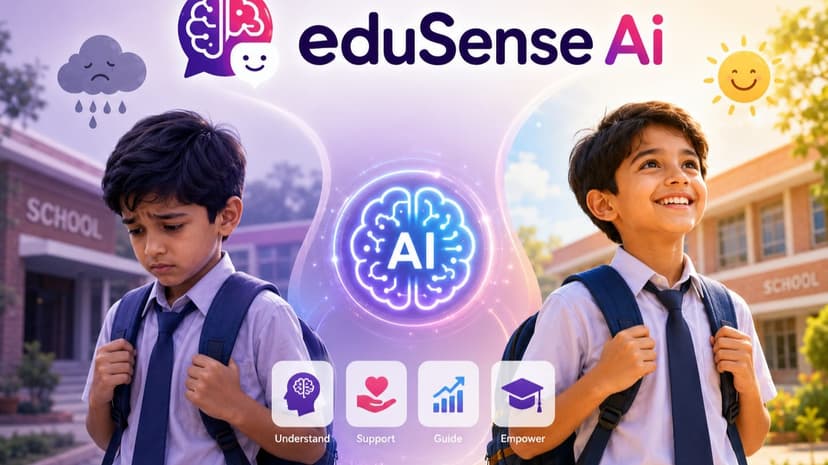
EduSense AI
The motivation for this project stems from the observation that many children experience anxiety due to bullying, classroom trauma, academic pressure, or social challenges, yet these symptoms often go unnoticed until they become severe. The platform combines behavioral questionnaires, emotional assessments, classroom observations, and parental feedback to generate a comprehensive anxiety profile for each child. Machine learning models analyze multiple behavioral and emotional indicators to estimate anxiety risk levels, while Large Language Models (LLMs) provide personalized explanations and evidence-based recommendations tailored to parents, teachers, school counselors, and psychologists.
13 Jul 2026


